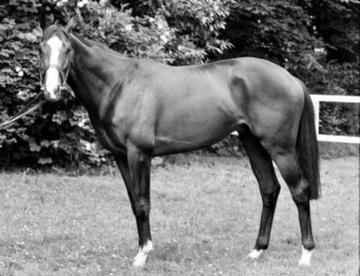
For more than four decades, the kidnapping of Shergar has stood as one of the darkest and strangest crimes in Irish racing history. The Derby-winning stallion, whose ten-length victory at Epsom in 1981 remains the widest winning margin in the race’s long history, was stolen from Ballymany Stud in County Kildare, on the night of February 8th, 1983.
Now Princess Zahra Aga Khan, daughter of the late Aga Khan, has spoken publicly about the trauma for the first time. Her account adds a chilling new detail; Shergar was not kept alive for a long ransom negotiation. She says he was killed within two days of being taken, and that his death was carried out “in an awful way.”
The ransom demand was £2 million, but it was never paid. Princess Zahra has explained that the decision was not as simple as one wealthy owner refusing to hand over money. Shergar had been syndicated, meaning the Aga Khan did not own him outright. The other shareholders had to be considered, and there was also a deeper moral question: if the money was going to the IRA, could it later be used against human beings?
That question helps explain why the ransom was withheld. It was not just about money, insurance, or ownership structure. It was about refusing to fund violence.
Shergar had not been insured against kidnapping. As Princess Zahra put it, who would ever have imagined that someone would kidnap a horse? Yet that is exactly what happened. Armed men broke into the stud, took the horse, and briefly abducted groom Mr Jim Fitzgerald, before releasing him. Shergar’s body to date has never been found.
The IRA has long been suspected of carrying out the kidnapping. The commonly accepted version is that the operation was amateurish and badly planned. The kidnappers were prepared for a ransom demand, but not for the reality of handling a valuable, nervous, full-grown thoroughbred stallion. Shergar was a national symbol of Irish breeding and racing, but to the gang that took him, he seems to have been a fundraising target they did not know how to control.
This is where Mr Sean O’Callaghan (Irish Republican Army’s Southern Commander) enters the story. Mr O’Callaghan was a former Provisional IRA member who later became an informer for the Gardaí. In later accounts, he claimed the Shergar plot was an IRA fundraising operation that went wrong almost immediately. His version was that the kidnappers could not manage the horse, that Shergar panicked, and that he was killed shortly after being taken. Princess Zahra’s new account appears to strengthen the general outline that Shergar died early in the abduction rather than after a prolonged captivity.
In 2008, The Sunday Telegraph reported claims from another IRA member that Shergar was killed after a planned vet failed to appear and the ransom was not paid. With Gardaí searches making release difficult, allegedly decided it was too risky to let the horse go and ordered him shot four days after the kidnapping. The source said two men entered the stable, one with a machine gun, and Shergar died a violent, bloody death.
“There was blood everywhere and the horse even slipped on his own blood. There was lots of cussin’ and swearin’ because the horse wouldn’t die. It was a very bloody death.”
But Mr O’Callaghan’s role also raises an important political point: what, if anything, is the Sinn Féin connection?
The true Sinn Féin connection is not that Sinn Féin has been proved to have ordered or carried out the Shergar kidnapping. No such proof has been established, and no one was ever convicted over Shergar’s disappearance.
The documented Sinn Féin connection is Mr Sean O’Callaghan himself. He was not only a former IRA figure and later informer; he was also elected in 1985 as a Sinn Féin councillor in Tralee, County Kerry. That means one of the best-known sources for the IRA account of Shergar’s death, had a real political connection to Sinn Féin.
That distinction matters.
Sinn Féin was widely regarded during the Troubles as the political wing of the republican movement, while the Provisional IRA was the armed organisation. The two were closely associated in public perception and republican politics, but they were not the same legal entity. So the accurate statement is this: the Shergar kidnapping has long been attributed to the Provisional IRA, and one of the key later sources on the alleged IRA role, Mr Sean O’Callaghan, was also a Sinn Féin councillor. That is the real Sinn Féin link personal, political, and historical, not a proven party role in the crime itself.
Princess Zahra’s comments bring the story back from conspiracy and folklore to its human and moral core. Shergar was not an abstract symbol, a ransom asset, or a political bargaining chip. He was a remarkable animal, described by those who knew him as kind and gentle, and he was killed because criminals tried to turn him into money.
The tragedy is sharpened by what he represented. Shergar was one of the greatest racehorses of his generation, a symbol of Irish racing excellence, and a source of national pride. His kidnapping was not only a blow to the Aga Khan’s family and racing operation; it was an act that shocked Ireland and Britain because it violated something people regarded as beyond politics.
More than forty years later, the essential facts remain grim. Shergar was kidnapped. A ransom was demanded. The money was not paid, partly because it could have funded violence. The IRA has long been suspected. Mr Sean O’Callaghan, a former IRA man, Garda informer, and later Sinn Féin councillor, gave one of the most influential accounts of what happened. Princess Zahra has now added that Shergar was killed within two days, and in a terrible way.
Shergar’s remains have never been recovered. His killers were never brought before a court. But the latest account from Princess Zahra makes one thing clearer than ever; the kidnapping was not a clever political operation. It was a cruel, bungled crime that destroyed one of racing’s greatest horses.





Leave a Reply