There is a familiar rhythm to fuel prices in Ireland. Costs rise sharply, headlines point to global crises, and frustration builds at petrol stations across the country. Recently, that cycle has repeated itself, with rising tensions involving Iran blamed for sudden spikes that pushed prices close to, and in some cases beyond, €2 per litre.
At first glance, the explanation seems straightforward. Oil is a global commodity, and when conflict threatens supply; particularly in critical regions like the Middle East, prices rise everywhere. In early 2026, motorists saw increases of over 30 cent per litre in a matter of days as markets reacted to geopolitical uncertainty.
But if global events are only part of the story, what explains why Ireland consistently feels more expensive than many of its neighbours?
To understand that, you have to look beyond the headlines, and into the structure of the price itself.
The Price Beneath the Price.
Strip away the pump display and something striking emerges. In Ireland, the majority of what drivers pay for fuel has little to do with oil at all. According to AA Ireland data, approximately 65% of the price of petrol and 60% of diesel is made up of taxes and levies.
Put simply, when you pay around €1.75 per litre:
- Roughly 60 cent reflects the actual fuel cost.
- More than €1 goes to the State.
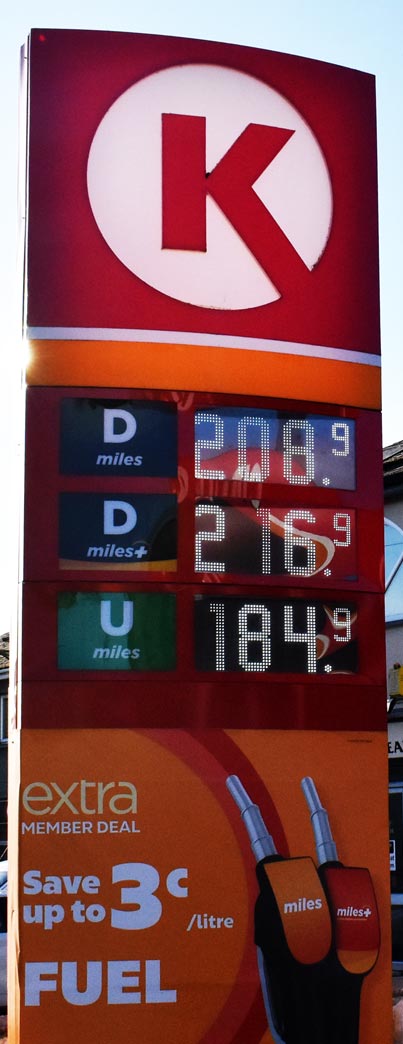
This is not a marginal difference. It fundamentally changes how global shocks are experienced at a local level. If oil prices rise, Irish motorists don’t just pay more for fuel, they pay more tax on that higher price as well. Value Added Tax (VAT), set at 23%, is applied on top of the entire cost, including excise duty and carbon tax. The result is a compounding effect, often described as a “tax on tax,” where price increases are amplified rather than simply passed through.
It is here that the gap between global explanation and domestic reality begins to widen.
Global Markets, Local Multipliers.
There is no question that international events matter. The recent surge in prices, following Middle East tensions, reflects genuine concern about supply disruption. Oil markets are notoriously sensitive, and even the perception of risk can trigger immediate price increases.
But the same global oil price applies across Europe. The difference lies in how each country translates that price into what consumers actually pay.
In Ireland, that Translation is Particularly Heavy.
Before tax, Ireland sits roughly in the middle of European fuel costs. After tax, it often ranks among the most expensive. This explains a common experience for motorists near the border, as crossing into Northern Ireland can reduce the cost of a full tank by €15–€20, despite the fuel itself being sourced from the same global market.
The conclusion is difficult to avoid, global events may set the baseline, but domestic policy determines the final impact.
The Case for High Taxes
Of course, there is a logic behind Ireland’s approach. Fuel taxation is not simply a revenue tool, though it certainly provides substantial income for the Exchequer. It is also a central pillar of climate policy.
Carbon tax, currently aligned with a rate equivalent to €71 per tonne of CO₂, is designed to discourage fossil fuel use and encourage a transition to cleaner alternatives.
In theory, the principle is sound, make carbon-intensive behaviour more expensive, and people will gradually shift toward more sustainable choices. The revenue generated is also partially reinvested into Ireland’s energy efficiency programmes and social supports, aimed at offsetting fuel poverty.
From a policy perspective, this reflects a broader European trend. Governments are increasingly using price signals to drive behavioural change.
Where Policy Meets Reality.
The difficulty lies in how that theory plays out in practice. Ireland is not a country where driving is easily optional. Outside major urban centres, public transport options are limited, distances are longer, and reliance on private vehicles is often unavoidable. For many households, fuel is not a discretionary expense; it is a necessity.
In this context, higher fuel prices do not significantly reduce consumption. Instead, they increase financial pressure. The burden is not evenly distributed either. Rural households, tradespeople, and lower-income workers are disproportionately affected. A commuter travelling 50 kilometres each day cannot simply switch to an electric vehicle overnight, nor can a small business absorb rising diesel costs indefinitely.
What emerges is a tension between long-term policy goals and short-term lived experience.
The Ripple Effect Through the Economy.
Fuel costs do not exist in isolation. They flow through the entire economy.
When diesel prices rise, transport becomes more expensive. That, in turn, increases the cost of goods, food distribution, construction and services. A sustained increase of just 30 cent per litre can cost the average motorist over €300 per year, but the indirect costs spread far wider.
This is why fuel prices often feel like a multiplier of the broader cost-of-living crisis. They do not just affect drivers; they affect everything.
Government Response: Reactive or Strategic?
When prices spike sharply, governments tend to intervene. In recent weeks, temporary cuts to excise duty, (up to 20 cent per litre), have been introduced to ease pressure on households and businesses.
These measures provide immediate relief, but they also highlight an uncomfortable truth; the government has significant control over fuel prices and can reduce them quickly when it chooses to do so.
Critics argue that this reinforces the idea that high prices are, at least in part, a policy choice rather than an inevitability. Supporters counter that such interventions must remain temporary, or risk undermining climate commitments and public finances, and both perspectives have merit.
A System Under Strain – Ireland’s fuel pricing system is not broken, but it is under strain.
On one side, there is a clear need to reduce emissions, meet climate targets, and transition toward a more sustainable energy system. On the other, there is the immediate reality of households struggling with rising costs in a country where alternatives are not yet fully in place.
The current approach attempts to balance these competing pressures. But balance is difficult to maintain when external shocks, such as global conflicts, push prices sharply higher. In those moments, the structure of the system becomes more visible, and more contested.
So Who Is Responsible?
The honest answer is not simple. Global events like the Iran conflict undeniably influence fuel prices. They set the direction of travel and can trigger rapid increases. But Ireland’s tax structure determines how steep that journey feels. It is not a question of either/or, it is both.
At a Crossroads
Ireland now faces a deeper question about the future of its fuel policy. Should taxes remain high to drive long-term change, even if that increases short-term hardship? Or should the burden be eased, at least until viable alternatives are available for all? There are no easy answers. But one thing is clear: for many Irish drivers, the issue is no longer abstract. It is not about global markets or climate targets in isolation.
It is about the price on the pump, the cost of getting to work, and the growing sense that something in the system is no longer quite in balance.







Leave a Reply