The grave of George Plant still attracts annual republican commemorations, while his story remains one of the most striking and contested in Tipperary’s revolutionary past.
Early March each year holds a particularly haunting place in Tipperary history because it marks the anniversary of the execution of Mr George Plant, one of the most controversial republican figures of the early 20th century. On Thursday March 5th 1942, George Plant was executed by military firing squad in Portlaoise jail, bringing a dramatic and deeply disputed chapter of Irish history to a close.
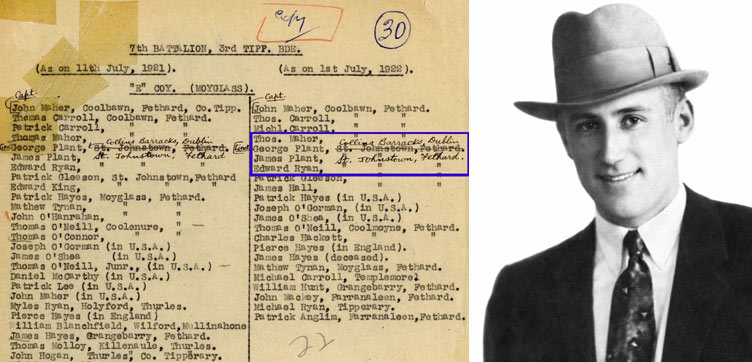
Pictured Left → E Company (Moyglass), 7 Battalion, 3 Tipperary Brigade, IRA, membership list.
Pictured Right → George Plant executed by military firing squad in Portlaoise jail, March 1942.
The above shows George Plant’s membership during the War of Independence and Civil War, and his change of address to “Collins’ Barracks, Dublin”,where he was tried, convicted and sentenced to death. The James (Jimmy ) Plant also on this list above was George’s brother.
Born on January 5th 1904, at St Johnstown, Fethard, Co. Tipperary, George Plant grew up in a Protestant farming family. The Plant family were known locally as hardworking, strict, and largely removed from politics. Yet George’s life took a decisive turn in 1916, when he and his older brother James were harshly interrogated by the local constabulary about their associations with local republicans including Seán Hayes and Dan Breen. That experience appears to have had a lasting effect on both boys.
By 1918, George and James had joined Na Fianna Éireann, and during the War of Independence and Civil War George served in the Moyglass unit of the 7th Battalion, 3rd Tipperary Brigade, IRA. He earned a reputation for bravery and reliability. Captured near the end of the Civil War, he escaped from Templemore jail and made his way home across country.
After the 1923 ceasefire, George and James emigrated, living and working in Scotland and later across North America. But Plant’s involvement with republican activity did not end. In 1929 the brothers were sentenced to seven years for their part in an IRA bank robbery in Tipperary town. After serving time in Limerick and Portlaoise, George eventually returned to the United States. In 1938, as Seán Russell steered the IRA in a more militant direction, Plant came back to Ireland and by 1940 was on full-time IRA service.
The event that sealed his fate was the killing of Michael Devereux, quartermaster of the IRA’s Wexford battalion. Devereux, wrongly suspected of informing to the gardaí, disappeared in September 1940. His body was not discovered until a year later, after the sensational escape of IRA chief-of-staff Stephen Hayes from IRA custody triggered fresh revelations and investigations.
Plant and IRA Southern Division commander Joseph O’Connor were first charged with Devereux’s murder in the Special Criminal Court. That case collapsed when key witnesses withdrew their statements, claiming they had been beaten and intimidated into making them. However, the government then took extraordinary steps under emergency legislation to retry the matter before a special military court. In a highly controversial move, normal rules of evidence were effectively suspended, allowing previous witness statements to be read into evidence even when those witnesses refused to testify.
On February 27th 1942, George Plant, along with Patrick Davern and Michael Walsh, was convicted and sentenced to death. O’Connor was acquitted on a technicality. Amid widespread public appeals for mercy, the sentences of Davern and Walsh were commuted to life imprisonment, but Plant’s was not. He was executed just days later, on March 5th 1942.
Even decades later, the Plant/Devereux affair remains clouded in controversy. The legal process used to convict Plant has long been criticised as one of the most troubling episodes in Irish judicial history.
Later research suggests that Michael Devereux was likely innocent of informing and that Plant was probably involved in his murder. Yet debate continues, shaped by the turbulent politics, secrecy, and emergency powers of that period in wartime Ireland.
In September of 1948, Plant’s remains were returned to his family and reburied at St Johnstown, where his grave still attracts annual republican commemorations.







Leave a Reply