- A “Pedestrian Walkway” Returns to the Wild.
- Tarmac, Trolleys, Plastic Bags and Trampled Trees.
- Double Ditch Obliterated, Then Abandoned.
Please first see the video immediately hereunder before preparing yourself to weep.
Now may I suggest you quickly grab a box of tissues.
Once upon a time, there was a place in rural Thurles, Co. Tipperary that had the cheek to be historic. They called it “The Double Ditch”; a raised path built through wet ground, faced with limestone, and rooted in the grim practicality of the once Great Famine, (1846-1849), to keep people working, to keep families alive, to keep feet dry enough to move. Yes, same was a civic scar, but an honest one, and a rare thing to be found in modern Ireland; a piece of lived history, a public walkway you could still walk on.
Naturally, this could not be tolerated. So it became “connected”, “improved”, “enhanced”, “brought forward”, (whatever soothing verb local councillors, the local Municipal District Administrator and her officials would prefer), until all of it were “totally and wantonly obliterated”, its ancient hedgerows removed and the route flattened under heavy machinery, without so much as the courtesy of admitting what was being lost to the residents of our struggling town.
Then, after much denial of its existence, with a straight face that would even shame a Victorian undertaker, it reappeared in planning language as being a “paved, pedestrian, walking route along a historical walking path”, despite being described by local councillors and politicians as not paved at all, before being levelled and left with only a temporary skin of tarmacadam.
And now we arrive at the masterpiece of their planning – “The Aftercare”.
Because nothing says “community amenity” like building a walkway and then abandoning it to rot, as if maintenance were an optional lifestyle choice, like decaf or seatbelts. The grand vision, a safe walking route on Mill Road, Thurles, tied into wider footpath plans, presented as “overdue” and “necessary”.
The execution, however, appears to have followed the classic local-government model; do the ceremony; pour the tarmac; maximise the photo credit, then disappear vanishing into the mist.
So the area has now again begun its return to nature, that sacred Irish policy position otherwise known as “leaving it in a hape”.
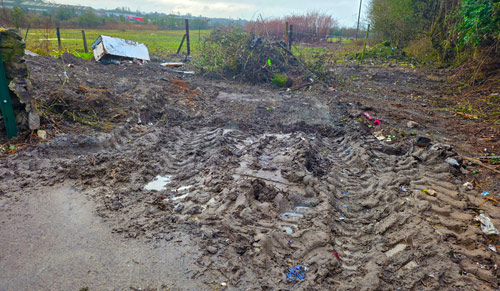
First came the willow saplings, same thrusting up through the tarmac like a botanical middle finger to uninterested municipal district officials, while rooting themselves into every crack that sheer neglect has kindly widened for them.
Then arrived the briars and brambles, years of Autumn’s leaves, nettles and rank grass, all working in quiet co-operation like they’ve been awarded the contract. Soon enough, the walkway becomes less of a public route and more of a living demonstration of what happens when you build infrastructure with no real future plan to mind it, other than personal glorification.
And the litter, ah, the litter; not the dainty odd sweet-wrapper sort. No, this is the full rural-civic anthology, large plastic bags flapping like distressed flags; tyres slumped in the verge; broken wire fencing sagging like exhausted excuses. The occasional supermarket trolleys, thoughtfully dumped to ensure nobody confuses the place for cared-for land. If you’re lucky, a washing machine or two, because why wouldn’t you add white goods to a heritage corridor?
But the true flourish, the one that should make even the most hardened press-release writer blush, is how the site has been used as a stage for virtue, and then as a bin for its consequences.
In spring 2025, the area beside ‘Dun Muileann‘ on Mill Road, Thurles, became part of the One Hundred Million Trees planting push, funded locally by Allied Irish Banks’ Thurles branch, with students and the odd idle volunteer turning up to plant a dense mini-forest, using the Miyawaki Method; the whole point being fast-growing biodiversity and a carbon sink. The public reporting around it speaks of over two thousand native saplings planted at the site, a serious effort, and no small gesture of community buy-in.
And then, in the sort of anticlimax Ireland has successfully perfected; those young trees are left in a space now allowed to slide into total disorder, where over the past number of months horses are permitted to trample through the plantings that were meant to be protected long enough to establish themselves. A “green space”, promised and photographed, now reduced to a patch of scruff and horse manure, where the only thing thriving is the evidence of nobody being responsible.
That’s the moral of it, really, the fetish for the new, paired with the total inability to mind what’s then built.
Because it takes a special kind of civic arrogance to first flatten a famine-era landmark that once, literally, put bread into mouths, and then to shrug at the basic upkeep required to stop the replacement from becoming an overgrown dumping lane.
We are told, endlessly, about “heritage”, “biodiversity”, “active travel”, “community”. The words are always there; the maintenance however rarely is.
And so the Double Ditch, the real one, survives mostly as an idea: something that mattered, that was walkable, that carried memory in its stones. What’s left on the ground is the modern tribute: tarmac, blocked drains, weeds, rubbish, bent fencing, and the quiet certainty that nobody, supposedly in authority, will be held to account for any of it.
On behalf of myself, I offer my sincere apologies to Thurles Branch of AIB; (Sponsors), to Mr Richard Mulcahy (Co-founder of the 100MT Project initiative) and to all those students who enthusiastically and eagerly took part in last April’s planting.
Hopefully some of the trampled saplings will continue to survive, after all horse dung is a nutrient-rich organic fertilizer and soil conditioner.
The Waste Continues.







Leave a Reply