Extract from a publication by L. M. McCraith, [Mrs Laura Mary McCraith-Blakeney (born 1870)], originally published in 1912.
“The first, the gentle Shure (Suir) that making way
By sweet Clonmell (Clonmel), adornes (adorns) rich Waterford; …”
(Excerpt from poem by Edmund Spenser’s ‘Irish rivers’.)
♦ Note: It should be noted that in 2026 Cahir Castle has since been fully restored and has now become a major tourist attraction in Cahir, Co. Tipperary. However this was not the case in 1912 when McCraith published her book.
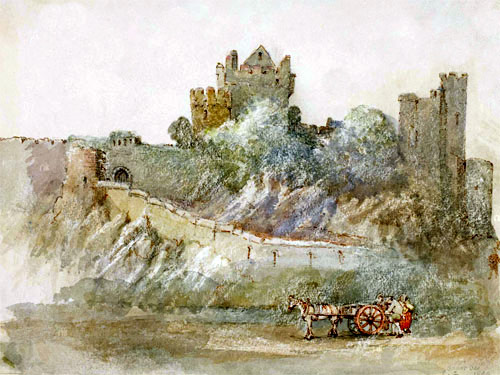
The Suir – From Its Source To The Sea.
Cahir Castle rises on an island in the Suir, and commands the bridge in the middle of the town. This old ivy-clad Butler stronghold is probably the best example of late feudal architecture in Ireland. It was built in the fifteenth, or early in the sixteenth, century, and has remained in the family of its builders ever since.
The Butlers ceased to live in their castle about a hundred and fifty years ago. It has not been inhabited since a company of infantry was quartered there in the days of the late Earl of Glengall (he it was who gave the site for the present barracks, about a mile outside the town, formerly used for Cavalry, and now used for Field Artillery). For over a century the Castle has undergone no structural alteration, but remains an eloquent witness of the life led long ago in Ireland by a Lord of the Pale.
Centuries before the Butlers built the present Castle; centuries before even Conor O’Brien, Lord of Thomond, founded his castle there in 1142, the rock in the Suir upon which it stands was regarded as a natural point of vantage, to be defended by a “dun,” or fort. Its very name in Irish, Cathair-Duine-Iascaigh, (Irish – “the stone stronghold of the fish-abounding fort), is a word-history.
An old Irish MS♦., the Book of Lecan, records the destruction of this fort of Cathair Curreagh in the third century.
♦ Note: “MS” is the standard abbreviation for “Manuscript” (from Latin manu scriptus, “written by hand”)
This is the outline of the romantic story. A relative of Curreagh Lifé was killed by Finn MacRadamain, chief of the district surrounding Cathair, the modern Cahir. In revenge, Curreagh Lifé murdered Finn’s mistress, Badamair, who had her dwelling on the Cathair-Duine-Iascaigh, whence she supplied Finn with food and clothing, no doubt of her own catching and weaving. After murdering her, Curreagh plundered the fort, and escaped away beyond the river Bannow towards Waterford. Finn pursued him. After many days he got sight of Curreagh in the distance. Thereupon Finn pronounced an incantation over his spear, and hurled it at Curreagh, who was in the midst of a group of friends. Nevertheless, the spear found its way truly to Curreagh’s heart and killed him.
The Brehon Laws refer to this fort of Cathair, and Geoffrey Keating states that, among many other royal residences, Brian Boru fortified and used this fort of Cathair also.
When the Anglo-Normans came first to Ireland, Knockgraffon, and not Cahir, was the principal place in the Barony, which passed, about 1215, to one of Henry II’s knights, Philip of Worcester. From him it passed to his nephew, William, whose great-granddaughter brought it to the de Berminghams by her marriage with Milo de Bermingham. In 1332 the Barony reverted to the Crown on William de Bermingham’s attainder. But the English King was little bettered by Cahir. As has been said already, Bryan O’Brien and his Irish had by 1332 overrun and re-conquered Tipperary.
However, in 1325 the King granted the Barony to James, Earl of Ormonde, and to Elizabeth, his wife. James Cildare, the natural son of this Earl, by Catherine Fitzgerald, daughter of the Earl of Desmond, has generally been recognised as the founder of the Cahir branch of the Butlers. Since he, or his successor, quartered the de Bermingham arms with his, there was probably also a prudent alliance with the previous owners.
The new Lords of Cahir held an equivocal position. They occupied the borderland between the two great warring houses of Butler (Ormonde) and Fitzgerald (Kildare). Butlers by descent, Fitzgeralds by marriage and interest, they contrived throughout the Barons’ War, and the fiercest struggles of the sixteenth century, to retain their estates amid the ruin of their confederates. Perhaps the position of their Castle helped them, for an old record says:
“In the mydst of ye ryver Suyre lyeth an Ilaund, ye same a natural rock, and upon yt a Castle, which, although yt may not be built with any greate arte, yet is ye seite such by nature that yt may be said to be inexpugnable.”
Cahir Castle has changed little during the centuries. Today it closely resembles its appearance in 1599, as pictured in the Pacata Hibernia ♦.
♦ Note: Pacata Hibernia (Latin for “Pacified Ireland”) is a significant 17th-century historical work by Sir Thomas Stafford detailing the Elizabethan Wars in Ireland, particularly the campaign in Munster under Sir George Carew, offering a contemporary, soldier’s perspective with valuable maps and plans of Irish towns and fortifications. First published in 1633, it serves as a primary source for understanding the final, bloody stages of Gaelic Irish resistance against English rule, culminating in the Flight of the Earls and the Plantation of Ulster.
Instead of at once attacking O’Neill in the North, those of the Irish Council who had estates to lose in the South persuaded Essex to lead his army into Munster. Having been defeated near Maryborough, Essex marched to Kilkenny, thence to Clonmel, and so on to Cahir.
Reynolds, secretary to the Earl of Essex, describes Cahir as “the only famous Castle of Ireland which was thought impregnable; it is the bulwark for Munster, and a safe retreat for all the agents of Spain and Rome.” The Butlers of Cahir were staunch for Hugh O’Neill. Cahir Castle, therefore, Essex attacked.
Encouraged by Hugh O’Neill’s victories, and expecting reinforcements from Mitchelstown, those “heathens,” as the English writer courteously termed the garrison, refused to surrender. Thereupon Essex put his cannon into position, and began a vigorous siege. Despite wide breaches in their walls the garrison held out bravely for ten days, until they found that their expected reinforcements had been cut off. Despairing, the garrison attempted to make a sortie and to vacate the Castle under cover of darkness. It was a desperate endeavour, and was discovered by the besiegers. Eighty of the garrison were slaughtered, and the English took the Castle.
Essex re-garrisoned Cahir with English troops, left his wounded there, and went on to Clonmel. It was his first success, and his last, in Ireland.
In spite of this armed resistance, the Lord of Cahir managed to keep his Castle and lands from confiscation. This was through the influence of the head of the Butlers, Thomas, Earl of Ormonde, called “the Queen’s Black Husband” from his colouring and his Sovereign’s marked preference.
During the Cromwellian Wars and, later, during the Revolution, the luck of the Butlers of Cahir held. The Baron of Cahir was a minor during the wars of 1641–50, his guardian being George Mathew, a half-brother of the Earl of Ormonde.
In 1647, previous to the coming to Ireland of Cromwell in person, Lord Inchiquin, ‘Murrough of the Burnings‘, (Murrough O’Brien, 1st Earl of Inchiquin♦), who was then fighting on the side of the Parliamentarians, invested Cahir Castle. The siege was one of hours only. The Castle was promptly handed over to Inchiquin, and a flimsy story put about to shelter Mathew’s cowardice; or was it his prudence?
♦ Note: The slaughter of the garrison at Cashel and the subsequent devastation of Catholic-held Munster earned Inchiquin the Irish nickname, Murchadh na Dóiteáin or “Murrough of the Burnings”.
Cromwell himself appeared before Cahir Castle on February 24th, 1650, and again George Mathew surrendered without a shot having been fired. One of the conditions of surrender was that: “The Governor may enjoy his estate, which he has as his jointure, and the wardship of the heir of Cahir”.
Although the Butler estates were surveyed by Petty♦during the Commonwealth for that object, they were not actually allotted to soldiers or adventurers; and at the Restoration, in 1662, Ormonde had little difficulty in reinstating his kinsman, “the heir of Cahir.”
♦ Note: Sir William Petty (1623–1687), an English scientist, physician, and political economist who was a key figure in the Cromwellian land confiscations in Ireland. He was responsible for overseeing the famous Down Survey of Ireland in the 1650s, which was the first detailed, large-scale land survey in the world.
The Butler luck, or prudence, held also during the Revolution. Thomas, seventh Baron Cahir, fought for James II on the bloody and disastrous field of Aughrim♦, and was outlawed in 1691. But, two years later, his outlawry was reversed and his estates restored. Being known as strong Catholics, with Jacobite leanings, the Lords of Cahir lived abroad during the eighteenth century.
♦ Note: Aughrim, County Galway. The battle was one of the bloodiest ever fought in Britain and Ireland; 7,000 people were killed.
By the death of Pierce, eleventh Baron, in 1788, the old Butler line became extinct. But a claimant appeared in the person of Richard Butler of Glengall, who derived his descent from Sir Theobald Butler, Baron of Cahir, in the time of Elizabeth. Richard Butler was married to a niece of Lord Chancellor Clare, and, as legal difficulties were thus smoothed over, he succeeded as twelfth Baron Cahir. He was afterwards created first Earl of Glengall. His son, the second Earl, died in 1858 without a male heir. The Barony of Cahir fell into abeyance again, and the Earldom became extinct.
The present representative of the Butlers of Cahir is the last Earl of Glengall’s daughter, Lady Margaret Charteris, to whom belongs the beautiful park through which the Suir runs for over two miles, together with many acres of surrounding mountain and valley.
Cahir Castle is in excellent preservation. It still serves for flower shows and other gatherings. The Butlers migrated, first, to Cahir House, a Georgian mansion, overlooking the Market Square on one side, and the lovely demesne upon the other, and, later, to the Lodge, on the opposite bank of the Suir.
Cahir Park.
The beautiful green banks of the River Suir are nowhere more attractive than in Cahir Park. To appreciate the place properly, you really have to see it for yourself.
Fortunately, the park is open to pedestrians. Private carriages and anglers can also enter, but only with permits, which (at the time of writing) were available from the Estate Offices in Castle Street.
It’s hard to say when Cahir Park looks its best: on a hot summer’s day, when cattle stand knee-deep in the broad, clear river and the trees and pastures are at their richest “living green”; or in late autumn, when the scarlet coats of huntsmen and the dappled white, black and tan of the foxhounds come and go through groves of golden oaks and coppices, with yellow bracken underfoot and laurels still keeping their summer colour.
In places the riverbanks become almost steep, and a graceful bridge spans the Suir at Kilcommon. From there you can reach a picturesque thatched cottage, built as a tea-house♦, and once a favourite rendezvous-is reached.
♦ Note: “Picturesque thatched cottage, built as a tea-house” refers to the ‘Swiss Cottage’ and again, is today 2026 also fully restored and a major tourists attraction.
END







Leave a Reply