Thurles supporters of Daniel O’Connell used their bare hands to grab food at subscription dinner.
On March 25th, 1925, the Scottish inventor John Logie Baird gave the first public demonstration of televised silhouette images, shown in motion at Selfridges department store in London.
But now a new stamp launched by An Post yesterday, July 30th, appears to deny that above statement. The background of this new stamp appears to show a television aerial on the chimney of a Dublin house, behind the nationalist leader Daniel O’Connell; latter known as “The Liberator”, (1775-1847). Daniel O’Connell, is correctly acknowledged as the political leader of Ireland’s Roman Catholic majority, during the first half of the 19th century.
One stamp, of two launched yesterday, costing €1.65 each, shows O’Connell travelling through our capital city, seated on a rather elaborate golden chariot/sled, possibly depicting his release from Richmond Prison in 1844. He had been released following a three months jail sentence, having proposed a monster meeting in Clontarf, Dublin, latter which had been declared illegal. The proposed meeting, due on the 8th of October, was declared illegal by the then government and banned. O’Connell was afraid there would be violence, if the meeting went ahead so he cancelled it. This disappointed many of his following resulting in a decline in O’Connell’s popularity.
The background to the left-hand-side of one of these two new stamps, directly behind O’Connell, shows the front of the General Post Office, (O’Connell Street, Dublin), while the background on the right-hand-side (See image framed in red hereunder) depicts a building with a chimney which displays an old style television aerial.
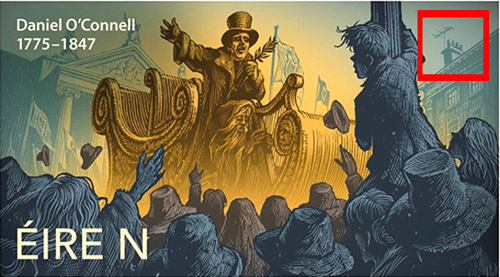
Television was not imported into Ireland until 1949, some 104 years after the image and times depicted on the stamp.
We understand that the stamps were developed by the Irish designer/artist Mr David Rooney, without the use of AI during the stamps design.
Some 12 years previous, in 2013, the Central Bank of Ireland issued a silver €10.00 commemorative coin in honour of James Joyce, latter which misquoted a famous line from “Ulysses”, despite being warned on two occasions by the Department of Finance over difficulties with design.
Ireland’s Central Bank later stated, after 10,000 coins were minted and launched, that the error was “an artistic representation of the author and text and not intended as a literal representation”.
The author himself had written: “Signatures of all things I am here to read.”. The Central Bank included a “that” in its final sentence, with their coin design reading: “Signatures of all things that I am here to read”, possibly if the truth was know to avoid copyright.
But down here in Tipperary, “The Liberator” was well known and much loved, both prior to and after his death on May 15th 1847 in Genoa, Italy.
He first came to Thurles as a guest of Mr Nicholas V. Maher M.P. in 1829, attending at Maher’s home (Today Thurles Golf Club), for a banquet given in his honour.
He also attended at Stephen Smee’s Corn-store, on lower Kickham Street, (In front of the present Pallottine College) to attend a subscription dinner. The large attendance of both agricultural labourers and small landowning farmers, who came to show support, was afterwards seen as an embarrassment by O’Connell, as those Thurles people in attendance were seen to behave in somewhat of a voracious and ravenous fashion, used their bare hands to grab food from the available containers.
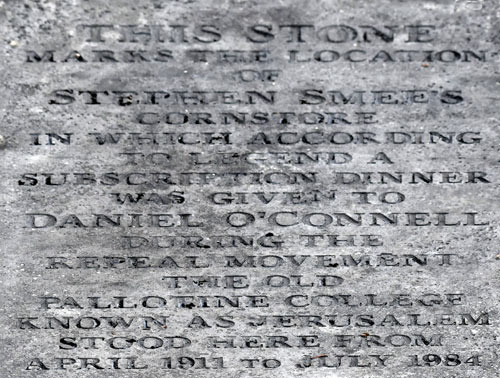
A Memorial plaque (pictured above) in the Pallottine College grounds records this latter event.
It reads: “This stone marks the location of Stephen Smee’s Corn-store in which, according to legend, a subscription dinner was given to Daniel O’Connell during the Repeal Movement. The Old Pallottine College, known as “Jerusalem” (later) stood here from April 1911 to July 1984.”
The Repeal Movement/Association was a mass Irish political movement set up by the same Daniel O’Connell in 1830, to campaign for a repeal of the Acts of Union of 1800, between Great Britain and Ireland. This Association’s aim was to revert Ireland to the fully devolved government which had briefly been achieved by Henry Grattan and his patriots, in the 1780s.
Perhaps local councillors and their officials, who have successfully destroyed most of the rich history of Thurles, might contact The Pallottine College Phone: 0504 21202, E mail: pallottinefathers@gmail.com and arrange to have this plaque professionally cleaned, to honour the 250th year of O’Connell’s birth.







Leave a Reply