“Plus ca change, plus c’est la même chose” or “the more things change, the more they stay the same”, is a proverb usually attributed to the French critic, journalist, and novelist Jean-Baptiste Alphonse Karr, (1808-1890) who used it in 1849.
Then perhaps Karr had come to this conclusion, having read Ecclesiastes (Ch. 1-Verses. 9-10-11), latter literature contained in the Christian Old Testament.
(9) “What has been will be again, what has been done will be done again; there is nothing new under the sun”.
(10) Is there anything of which one can say, “Look! This is something new? It was here already, long ago; it was here before our time“.
(11) “No one remembers the former generations, and even those yet to come will not be remembered by those who follow them”.
So what brought all this on I hear you ask?
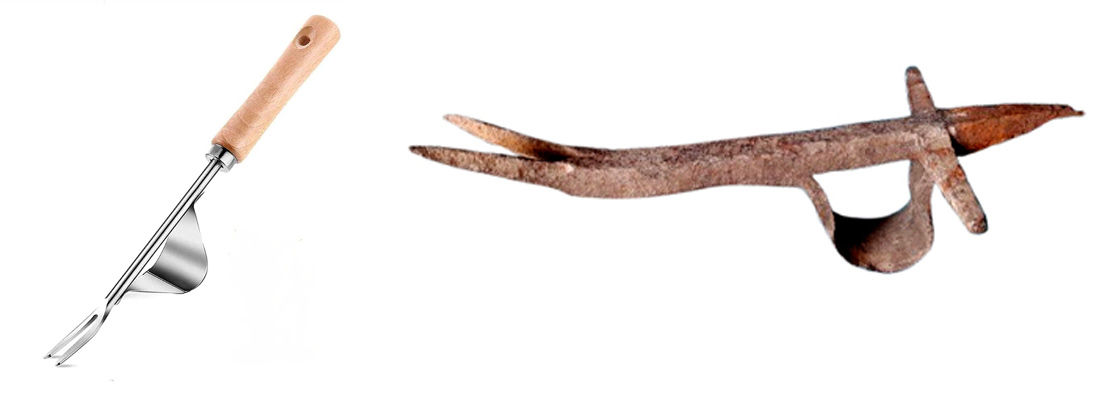
(2) Head only of a large 17th century, two handed, farm labourer’s ‘Grubber’.
I was looking at some gardening equipment on line; in search of something to remove unwanted growth from my small grass lawn area, when I spotted a small hand held ‘Gardener’s Daisy Grubber’.
This small ‘Daisy Grubber’ reminded me of a blacksmith made, spade size, Grubber, used back in the 17th/18th/19th century, also used to remove stubborn, deep-rooted, Thistle and Dock roots from corn fields, prior to harvesting. The immediate removal, back then, ensured that the seeds of both weeds would not end up amongst oat and barley seed, being trashed and due for sowing the following spring.
This spade size, ancient Grubber would take on an alternative use during the middle of the 19th century; becoming useful to those employed by Irish landlords and their agents, to assist in evicting tenants.
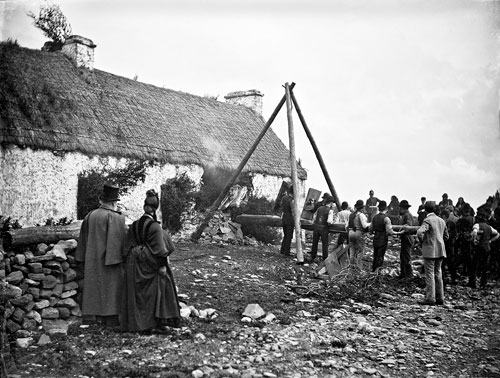
Those tenants either failing to pay or unable to pay their rent were evicted, often by force, from their homes. This same agricultural Grubber, whose teeth resemble a modern day claw hammer, was used to remove nails/spikes from roof timbers. Once the nails/spikes were removed/drawn, the thatched roof on such dwellings could be easily collapsed; ensuring that the evicted tenants could not return to seek shelter over future nights.







Leave a Reply