The Irish government (Cabinet) is due to consider a new digital and AI strategy this week, and the standout proposal is the Government’s intention to legislate to restrict social media access for those under 16 years old. The political context matters. Ireland is heading into its EU Presidency (July–December 2026) and online safety is being positioned as a priority. The strategy is expected to reflect a familiar line: Ireland would prefer EU-wide rules, but will take national action if Europe moves too slowly.
Enforcement, Not Slogans. The key question isn’t whether protecting children is important, it’s how the State can make any restriction meaningful. Last year’s plan for a “digital wallet” age-verification pilot points to the enforcement challenge. An under-16 restriction is only as strong as the age assurance behind it. If access is still controlled by “enter your date of birth”, then the ban becomes more of a headline than a barrier. But age checks raise a second concern, that of privacy. Any system must avoid becoming an online ID-by-stealth, or creating new data trails for children and families. If the public believes age verification means uploading identity documents for everyday apps, trust will evaporate quickly.
Algorithms are moving to centre stage. One of the most significant elements of this debate is the focus on “recommender systems”, the algorithms that decide what users see next, i.e. instead of showing you posts in simple time order, the platform uses algorithms to predict what will keep you watching/scrolling/clicking and then automatically serves more of that. The Joint Oireachtas Committee on Artificial Intelligence has urged that “recommender systems” should be off by default, and that platforms should be prevented from switching them on for children’s accounts. This goes beyond moderation and into product design, the mechanics that can drive compulsive use, extreme content pathways, and unhealthy comparison. If Government wants to reduce harm, recommender controls may prove more effective than an age line on its own.
The wider EU backdrop. The strategy also comes as European regulators intensify scrutiny of platforms and AI systems. It includes discussion about engaging the European Commission to ensure the EU AI Act’s prohibited practices remain fit for purpose as AI capability grows. At the same time, Big Tech is lobbying hard. Meta has told Government it should prioritise efforts to scrap the planned EU Digital Fairness Act, which is expected to target addictive design and dark patterns. That alone signals where the next regulatory battles will be fought, not just content, but the way products are built.
Will it work? Supporters say an under-16 restriction is a clear, protective line that reflects what many parents want. Critics, including CyberSafeKids CEO Mr Alex Cooney, argue a blanket ban could be porous, children will find workarounds and that it risks shifting responsibility onto families, rather than forcing platforms to reform. Ultimately, Ireland will be judged on outcomes. If this is to be more than a headline, it needs three things, workable age assurance, credible privacy safeguards, and real obligations on platforms, especially around said “recommender systems” and addictive design.
Opinion: the ban headline isn’t enough, tackle harm by design. An under-16 ban is an easy political sell. But it risks becoming a comforting story we tell ourselves while the underlying machinery remains untouched. The platform problem isn’t mainly that teenagers exist online. It’s that many products are engineered to maximise attention, and the fastest way to do that is through emotional escalation, endless recommendations, and compulsive loops.
If Ireland wants a serious policy, it must do more than draw a line at 16. Age assurance has to be privacy-preserving, not a backdoor ID requirement. And the real test of ambition will be whether Government is prepared to confront “recommender systems“, the very engines that push users from one piece of content to the next. A mature approach would target companies, not children, transparent design rules, meaningful enforcement, and algorithmic limits for minors. Otherwise, we’ll get a strong headline, and the same problems, just simply shifted around.
The decision by Minister for Education and Youth, Ms Hildegarde Naughton to pause the SNA allocation review is being presented as calm, careful engagement. In reality, it reads like an emergency brake pulled after the system lost public confidence. The Department today has now halted all review changes, including cases where schools had already been notified of reductions, and has halted further letters being distributed, until further talks conclude.
That climbdown matters because the damage was not theoretical. By mid-February, national reporting indicated a substantial number of schools had been advised of proposed reductions for September 2026, with reviews still ongoing across the system. In places like County Tipperary, where schools already balance long travel distances, limited specialist services and stretched staffing, even the suggestion of a cut can trigger immediate anxiety for families and staff, because replacing supports is rarely straightforward, and delays have real consequences.
The most serious criticism is not that reviews exist, but that the review appears to be anchored to a narrow definition of “primary care need”, while schools are trying to deliver genuine inclusion in busy, complex classrooms. This approach may suit an administrative model, but it struggles to reflect the daily reality of autism, anxiety, communication needs, sensory overload, behavioural regulation and safety supports that keep children present, learning and well in school.
Even where Government insists overall SNA numbers are rising nationally, parents do not experience “national totals”. They experience whether support exists in their child’s classroom, in their school, on their timetable, from next September. For principals, the immediate issue has been the uncertainty; letters arriving without clear explanations that schools and communities can trust, and an appeals-based system becoming the default route to preserve basic supports.
The result is a familiar pattern; schools forced into scramble mode, families left fearful, and SNAs living with insecurity, while Ministers attempt to restore confidence after the fact.
If Ireland can fund the world, it can fund inclusion here at home. Government has pointed to significant overall spending on special education and additional SNA posts. But the public anger here is rooted in a simple perception; children with additional needs are being treated as a variable in a resourcing exercise, rather than as young citizens, whose right to education should be guaranteed in practice, not merely promised in policy statements.
This is where the old phrase about Ireland as the “land of saints and scholars” starts to ring hollow. A country that prides itself on education should not run a core disability support through a process that leaves parents hearing developments informally, or forces schools into repeated fights to keep what they already have.
Political contrast is unavoidable. The State can move quickly and confidently when funding priorities relate to foreign policy, international commitments, or expanding the national footprint abroad. In Budget 2026, the State found record allocations to project Ireland abroad; a record €840m in overseas development assistance and new funding for expanded diplomatic footprints, championed by Mr Simon Harris, through the Department of Foreign Affairs and Trade. It also committed a record €1.49bn for defence, through the Department of Defence. Separate reporting has put Ireland’s support to Ukraine since 2022 at €467m, with further commitments announced in late 2025. Those decisions may be defensible in their own right, but they sharpen the question parents keep asking; “Why does the system struggle so visibly when it comes to getting certainty right for children with special educational needs here at home?”
That question lands sharply at local level. In County Tipperary, as in many counties, schools are not arguing for luxury supports. They are arguing for stability, the ability to plan staffing, to avoid disruptions for vulnerable children to prevent September becoming a cliff-edge, where SNAs are central to keeping children safe, regulated and able to access learning, the idea of “review first, reform later” feels somewhat backwards.
The pause must not become a temporary quietening of the headlines, before the same review process returns with slightly amended language. If Government is serious about inclusion, it should redesign allocations around individual need, transparency, and proper multi-disciplinary supports and not around a narrow definition of care and an appeals mechanism that schools rely on to prevent harm.
If Ireland wants to be a land of scholars again, it needs to start by proving, in real staffing decisions, that children who need support will have it, without panic, without uncertainty, and without having to fight for it, every upcoming year.
Cashel Branch Librarian Ms Maura Barrett Reports:-
Children Events this week in Cashel Library.
1. The next meeting of the Juvenile Book Club will meet on tomorrow, Tuesday, February 17th, 6:30pm to 7:00pm. Please Contact Tel: 062-63825.
2. Join us on Friday, February 20th, from 10:00am to 10:30am, for a fun and Cozy Story Time. Enjoy the magic of books and quality time together! To book your spot or learn more, Please Tel: 062-63825.
3.LEGO Free Play in Cashel Library! (Strictly 7 years +). Join us for creative fun on Fridays: Feb 20th from 3:30pm to 4:15pm. Build, play, and let your imagination soar! Booking required: Tel: 062-63825.
Adult Events this week in Cashel Library.
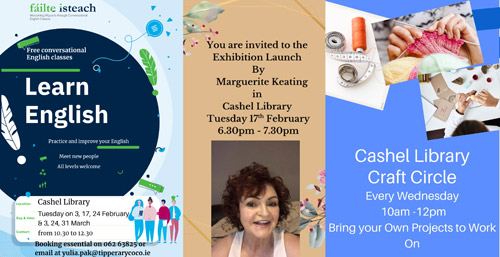
1. There are free conversational English classes in Cashel Library – Tuesday morning at 10:30am. Practice and improve your English, Meet new people. All levels welcome. Contact Tel: 062-63825 or email cashellibrary@tipperarycoco.ie
2. Cashel library invites you to the Exhibition Launch of artwork by Ms Marguerite Keating on TuesdayEvening, February 17th, at 6:30pm. Refreshments Served. All are welcome.
3. Join the Cashel Craft Circle every Wednesday morning, from 10:00am to 12:00pm, for their weekly social gathering. Bring along your own project to work on, share ideas, patterns and enjoy a chat and a ‘cuppa’ with others. No need to book, just come along. Cashel library Tel: 062-63825.
The Easter Supermarket Aisle is really a ‘Confession’ of what we Value.
Not taste. Not ingredients. Not children’s health. What we value and what we reward, is packaging that wins the argument in the moment.
Enter into any Irish supermarket in the weeks before Easter and you’ll find it, that dazzling wall of foil, cartoon faces and glossy packaging, positioned strategically at child height. Now walk a child past that wall of Easter eggs and watch what happens. They don’t scan ingredients. They scan cartoon characters, colour and sparkle. Their attention is being bought through design and the bill is handed to parents at the till.
That’s why the palm oil conversation matters. Not because palm oil is a cartoon villain, but because it’s often part of a bigger formula: cheaper fats, big sweetness, high profit margin, huge volume. And, when you attach that formula to a licence kids already love, you get a product that sells itself and most importantly for the retailer, sells fast.
Palm Oil Conversation Matters.
A Tesco listing for a Tesco Peppa Pig Easter product includes “Vegetable Fats (Palm, Shea…)”. Read that again; the most child-attractive packaging can be paired with ingredients designed to protect a price point, not a growing body. Now here’s the part that will annoy people. Supermarkets will say, “We simply stock what customers buy.”
Yes True, but incomplete. Retailers shape what customers buy. They choose what gets eye-level space, what gets aisle-end promotion, what gets “2 for €X”. They decide what looks like the normal choice. If the loudest, sweetest, most character-heavy egg is placed where every family must pass, then “choice” becomes a bit of theatre. A kid asks. A parent caves. The system works exactly as is so designed.
And don’t pretend we don’t know the long game. Health guidance remains consistent: keep saturated fat lower overall and don’t let it quietly dominate the diet. We also know that diets built around ultra-processed treats don’t damage a child in one day, they train preferences and routines over years.
The tragedy is that Irish makers who are trying to do it better are often invisible to children.
That’s a strong ethical and ingredient choice. But on a crowded Easter shelf, a subtle box can’t compete with the instant dopamine or feel-good hit of a character egg.
So here’s my fair, defensible ask: Supermarkets: Stop hiding Irish quality behind adult-looking packaging and premium-price assumptions. Give local makers seasonal visibility where families actually shop. Supermarkets aren’t trying to harm children. They are, however, designed to maximise sales per metre of shelf space. Character products sell fast, drive “pester power”, and deliver predictable seasonal turnover. Artisan chocolate can be slower-moving, pricier, and less visually “grabby” for small hands. Irish chocolatiers: You don’t need to slap a cartoon face on everything, but you do need to meet kids where they are. Easter is visual. Make “better ingredients” look fun. The uncomfortable truth is that the better chocolate product often loses the packaging battle. Here’s where Easter gets unfair. Many artisan brands package beautifully for adults; elegant boxes, subtle colours, premium cues, but kids don’t buy with adult eyes. Parents:Don’t let the aisle decide for you. Flip the box. Read the fat list. Buy the fun, but buy it with open eyes. Look for palm oil/palm kernel oil on the label (it will be named).
Easter should be a treat. It shouldn’t be a marketing lesson where children learn that the brightest box is automatically the best choice.
If we really want better food culture, we have to reward it, not just applaud it.
Reducing the voting age to 16 is often sold as a simple, modern reform, to bring young people into the ‘democratic tent’ earlier, to boost turnout, and strengthen civic culture. In practice, it is neither simple nor risk-free. If voting is the most consequential act of civic membership, then lowering the threshold should only happen where the benefits are clear, durable and supported by institutional scaffolding to make sure it work. Right now, there are strong reasons not to entertain it.
First is principle and coherence: Eighteen is widely understood as the point at which the State recognises full adult status. Voting sits alongside other “full membership” rights and responsibilities, and it matters that this package is intelligible. Lowering the voting age, while leaving most other adult thresholds intact, either creates a new inconsistency, or invites pressure to “tidy up” the rest of the law to match. Either way, it is not a neat reform; it changes the logic of adulthood in public policy.
Second. The lived reality of 16-year-olds is structural dependence. Many teenagers are financially dependent, living under parental authority, and constrained by school and household expectations. That does not mean they cannot form political views. It does mean their ability to cast an independent vote can be narrower than it is for adults. In some cases, the risk is that a ballot becomes a proxy for household influence, not a genuinely autonomous civic voice.
Third. The modern information environment makes younger cohorts more vulnerable to manipulation. Politics is increasingly shaped by micro-targeting, influencer pipelines and rapid misinformation loops. Expanding the electorate to include minors increases the premium on strong media-literacy and civic preparation. Even advocates of votes at 16 regularly acknowledge that early, structured political education is essential. The problem is that civic education is uneven and often contested, so the reform risks outpacing the safeguards.
Fourth concern: Schools become an unavoidable political battleground. If 16-year-olds are voters, schools are the most efficient point of contact. Teachers and principals would face intensified pressure to “balance” content; parents would worry about politics being smuggled into classrooms; campaign groups would seek access through “non-partisan” resources. International discussions of votes at 16 frequently stress education as a prerequisite, but that is exactly where the most polarising arguments land.
Fifth. There are serious administrative and safeguarding complications around registration. An electoral register must be usable and transparent, but the Irish State also has a duty to protect under 18s’ personal data. Where 16–17s have been enfranchised, special arrangements have been needed to manage this tension. It is not a reason never to do it, but it is a reason not to treat the change as cost-free or merely symbolic.
Sixth. The political and constitutional “bandwidth” argument matters, especially in Ireland. Changing the national voting age is not a routine legislative tweak; it carries constitutional implications and would demand major political energy. In a country with multiple urgent reform priorities; housing, health capacity, infrastructure, cost-of-living etc., there is a fair question; “Is this the best use of this scarce reform capital?”
And Finally. The promised benefits are not guaranteed. Events that feel unusually important, visible, and emotionally charged, can see strong youth participation, but that does not automatically translate into higher turnout in ordinary elections or lasting engagement. Research from countries that have lowered the age are encouraging findings in some contexts, mixed results in others, and a recurring theme that outcomes depend heavily on preparation and political environment. In other words, the evidence is conditional not a clear mandate.
None of this denies that young people deserve a stronger voice. It argues that lowering the voting age is a blunt tool with real downsides. If the aim is youth influence and civic strength, there are lower-risk steps; better civic education and media-literacy; easier registration at 18; structured youth assemblies with real consultation power; even pilots at local level where issues are closer to daily life. Before redefining who gets a vote, we should fix the foundations that make democratic participation meaningful in the first place.
This website uses cookies to improve your experience. We'll assume you're ok with this, but you can opt-out if you wish.AcceptRead More
Privacy & Cookies Policy
Privacy Overview
This website uses cookies to improve your experience while you navigate through the website. Out of these, the cookies that are categorized as necessary are stored on your browser as they are essential for the working of basic functionalities of the website. We also use third-party cookies that help us analyze and understand how you use this website. These cookies will be stored in your browser only with your consent. You also have the option to opt-out of these cookies. But opting out of some of these cookies may affect your browsing experience.
Necessary cookies are absolutely essential for the website to function properly. This category only includes cookies that ensures basic functionalities and security features of the website. These cookies do not store any personal information.
Any cookies that may not be particularly necessary for the website to function and is used specifically to collect user personal data via analytics, ads, other embedded contents are termed as non-necessary cookies. It is mandatory to procure user consent prior to running these cookies on your website.









Recent Comments