The Revolutionary Innovation That Could Transform The Future Of Plastics.
Could Microorganisms Help Solve The World’s Plastic Pollution Problem?
Plastic pollution is one of the biggest environmental problems facing the world today. Most plastics are made from fossil fuels and can take hundreds of years to break down. Over time, they can turn into tiny pieces called microplastics, which pollute our oceans, rivers, soil and even our food. But a British company called Shellworks is developing an exciting alternative.
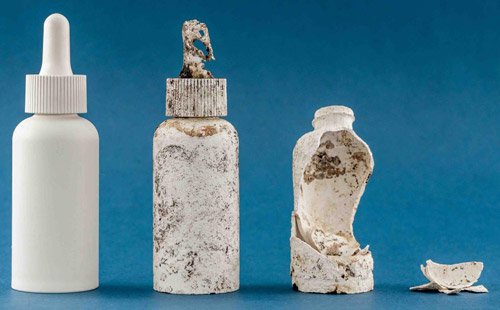
Its new material, called VIVOMER, looks and works much like ordinary plastic. However, instead of being made from oil, it is produced using naturally occurring microorganisms and plant-based materials. The most exciting part? It is designed to break down naturally after use, rather than remain in the environment for hundreds of years. In October 2026, Shellworks received international recognition when it was included in the Norrsken100, a list of 100 promising startups working to solve some of the world’s biggest problems.
How Does VIVOMER Work? The idea behind VIVOMER is surprisingly simple. Instead of using oil to make plastic, Shellworks uses tiny living organisms known as microorganisms. These microorganisms are fed plant-based materials, including by-products from farming and industry. As they feed and grow, they naturally produce a substance called PHA, which can be used to make packaging. This material is collected, processed and shaped into products such as bottles, containers and cases. One major advantage is that VIVOMER can be made using many of the same machines already used to manufacture plastic products. This could make it easier for businesses to switch to more environmentally friendly packaging.
Strong Enough to Use, but Able to Break Down Naturally One of the most interesting things about VIVOMER is that it is designed to be strong and long-lasting while being used. According to Shellworks, the material is waterproof, can handle moisture and is suitable for everyday products. It can also be made in different shapes, colours and finishes. This makes it useful for products such as: Skincare and cosmetics containers Shampoo and beauty packaging Deodorant cases Refillable bottles and everyday packaging
But unlike ordinary plastic, VIVOMER is designed to be broken down by microorganisms when the right conditions are present. Shellworks says the material has received TÜV AUSTRIA home-compostability certification, meaning it has passed recognised tests for breaking down in home composting conditions. However, this does not mean it will disappear immediately if thrown into the countryside or ocean. How quickly it breaks down depends on factors such as temperature, moisture, thickness and the presence of microorganisms.
Growing International Recognition Shellworks is already attracting attention from businesses and investors. In October 2026, it was selected for the Norrsken100, which highlights startups developing new solutions to major global challenges. More than 1,400 companies were nominated, with Shellworks recognised in the Circular Economy and Materials category. Its technology is also being used by well-known beauty and personal care brands, including Wild, Sonsie and Hair by Sam McKnight. This shows that the material is no longer simply an interesting scientific idea. It is already being used in real products. In March 2026, Shellworks also secured US$15 million in investment, led by French investment firm Alter Equity. The funding will help the company increase production and bring its materials to more businesses around the world.
Could This Create Opportunities for Ireland? This technology could also offer interesting opportunities for Ireland. Ireland has strong farming, food-processing, biotechnology and manufacturing industries. These sectors could potentially work together to develop new materials using agricultural by-products and other renewable resources. For example, materials left over from food production might one day become useful ingredients for making environmentally friendly packaging. This could help reduce waste while creating new business opportunities and jobs.
What Are the Challenges? Although VIVOMER is promising, there are still challenges to overcome. Producing these materials on a large scale must become affordable enough to compete with ordinary plastics. Businesses also need reliable supplies of raw materials, while consumers need clear information about how to dispose of the packaging correctly. It is also important to study the full environmental impact of producing, transporting and disposing of these materials. Just because something is made from plants or can biodegrade, does not automatically mean it is better for the environment in every situation. Independent testing will help show where VIVOMER offers the greatest benefits.
A Small Material with Big Potential VIVOMER offers an exciting example of how nature and modern technology can work together. Instead of making packaging from fossil fuels that can remain in the environment for centuries, Shellworks is showing how microorganisms can help produce useful materials designed to break down after use. Of course, no single invention will solve the world’s plastic pollution problem. We still need to reduce unnecessary packaging, reuse products where possible and improve waste management. However, developments such as VIVOMER show that better alternatives are becoming possible.
Perhaps the most exciting lesson is this: some of the answers to our biggest environmental problems may already exist in nature. We simply need to find smarter ways to use them.
Blackrock, Co. Louth, 1937 – A kiss that made international headlines.
It is almost impossible to imagine today, but in 1937 a young Scottish woman was sentenced to one month in prison; her crime was for kissing her boyfriend on church property, in Blackrock, Co. Louth. Her name was Ms Julia Clarke, and she came from Glasgow, Scotland.
The local vigilance committee was reportedly outraged by the incident, and the matter eventually came before the court in Dundalk. Ms Clarke received a month’s prison sentence, while her boyfriend was ordered to contribute £2 (40 Shillings) to the St Vincent de Paul Society. [Note: In 1937, the minimum weekly wage for a male agricultural labourer in Ireland, aged over 20 years was 1 pound and 4 shillings (or 24 shillings) for 54 hours work. Employers frequently provided room and board, which they were legally allowed to deduct from these cash payments at the rate of 1 shilling and 11 pence per day.]
Fortunately for Ms Julia, she had already returned to Glasgow, and thus the prison sentence was never served. And what was her crime again? Simply kissing a young man! The case attracted international attention and became an extraordinary example of the strict moral attitudes prevailing in Ireland at that time.
How times have changed! Today, a kiss between newly-weds is a familiar and joyful sight at church weddings. In many wedding ceremonies, the words “You may kiss the bride”, are among the most eagerly anticipated of the entire celebration. Although note, the kiss is not formally part of every church’s marriage rite, it has become a cherished tradition at countless weddings.
The contrast is remarkable. In 1937, a young woman could receive a prison sentence for kissing her boyfriend on church grounds. Today, couples regularly exchange a kiss in front of family, friends and clergy as an expression of love and commitment.
But Holy Ireland was not alone in punishing public affection. (1) As recently as 2010, two British people received one-month prison sentences in Dubai, following allegations of kissing in a restaurant. (2) In 2009, a woman in Bahrain was jailed for 20 days following an incident involving kissing in public and an argument with police. (3) In 2017, a couple in Tunisia received prison sentences after being found kissing in a car, although their convictions also involved other allegations. (4) In 2026, a young couple in Aceh, latter a western province of Indonesia, were publicly caned after being convicted of kissing during a livestream.
The above cases remind us that attitudes towards public affection have varied enormously across different societies – and that freedoms we now take for granted are not universal.
Returning to Blackrock, Co Louth, it is fascinating to think that a simple kiss in a seaside village in County Louth could once cause such an international sensation. Nearly 90 years later, Ms Julia Clarke’s story offers a striking reminder of just how much Irish society has changed.
From a prison sentence for a kiss to a kiss celebrated at a wedding – what a difference a few generations can make! And perhaps the greatest irony of all is that the original kiss took place on church property. What would the authorities of 1937 make of the Ireland we know today?
Warning: Here in Thurles, Co. Tipperary local romantics are still advised to exercise extreme caution, particularly around the areas of Liberty Square and church properties. While back in 1937, a kiss could land you in prison; here in Thurles today, a kiss could end up in marriage and according to some married men, that’s a life sentence with no possibility of parole!
So for God’s sake, if visiting in Thurles, do try to control yourselves.
Lyrics: Irish songwriter Christina Keane. Vocals: Co Kilkenny singer, drummer and publican Seamus Moore, (“Moore The Hurr”).
SingerSeamus Moore.
They say money can’t buy happiness, but sure, wouldn’t it be lovely to have enough of it to find out! I suppose we’ve all dreamed of winning the lottery, throwing away the bills, buying a new car, and never having another worry in the world. Well, this next song tells the story of an old Irish countryman whose luck takes a wonderful turn, and suddenly all his dreams come true. But as we all know, there’s a big difference between dreaming of a fortune and waking up with one! Enough said.
The Winning Dream.
The Winning Dream.
It was early Friday mornin’ I was cycling into town. The front wheel it was wobbling and the mud guard fallin’ down. The two legs of me trousers were tied up with bits of twine, And the pension book was telling me a pint would soon be mine. “How are ye Mr. Murphy” said the postal clerk to me. “Not too bad “, says I, “for a man of seventy three”. A fox came to me house last night and stole me only duck. “Buy a lottery ticket” she says, “it might change your luck”. I took the little girls advice and I handed her a pound. Outside I scratched the ticket with a pen knife I had found. Well I nearly dropped me trousers and grew a head of hair, When I realised I was a bloody millionaire. No more hay or turf to save, no more feeding calves. One kick from me big boot and the bike was in two halves. I headed for the local, sure I was feeling great, And friends I never knew before came in to celebrate. Not long after that I had a new suit on me back, A new red car outside the door and a telephone on the rack. The wife was sporting a blond wig, where her grey head used to be, And the wellington tracks had disappeared from just below her knee. I sat down admiring the new dress that she wore, A brand new set of teeth she got installed the day before. Well I held her oh so tightly, like when I was a groom, And we looked rich and graceful as we waltzed around the room. T’was then I got an awful shock I thought I’d nearly die, I spied me ugly misses as I opened up one eye. With curlers in her old grey head she nearly made me sick, “Get up and milk the cows”, she says, “you ravin’ lunatic”. T’was then I realised that it was all a dream. The cows were mooing in the field and the cat was at the cream. Me bike was thrown in the hedge and me trousers had a shine, T’was lovely while it lasted, that winning dream of mine. T’was lovely while it lasted, that winning dream of mine.
One of three high-profile murder cases involving victims in County Tipperary has now reached a verdict, following the conclusion of the trial into the death, sadly, of 80-year-old Timothy (Teddy) Murnane.
Mr Sean Harding aged 32, with an address at Marian Terrace, Tipperary Town, has been found not guilty of murder, but guilty of manslaughter. The jury returned a 10-2 majority verdict after seven hours and 40 minutes of deliberations at the Central Criminal Court sitting in Cork.
Mr Murnane died at University Hospital Limerick on 14 September 2025, two days after being found seriously injured outside his home, having disturbed Harding during a burglary. Mr Harding showed no reaction as the verdict was delivered. A sentencing hearing has been scheduled for Monday next, November 9th, when victim impact statements will be heard.
Two other major Tipperary murder trials have also been before the courts: Josephine “Josie” Ray aged 89, Nenagh: Jury deliberations in the trial of Hasan Ali Gori, who denies her murder, have been adjourned until Monday. Scarlett Faulkner aged 28, Birdhill: A woman and a teenage girl have denied murdering Ms Faulkner, who died following an assault earlier this year.
While the Teddy Murnane case has now reached a verdict, sentencing remains outstanding. Three major Tipperary cases. One verdict delivered. Two further murder cases awaiting resolution.
Our thoughts remain with the families and loved ones of all three victims.
A moment captured in Limerick in 1952, a photograph that became part of Irish sporting history, and a remarkable lady whose passing marks the end of an era.
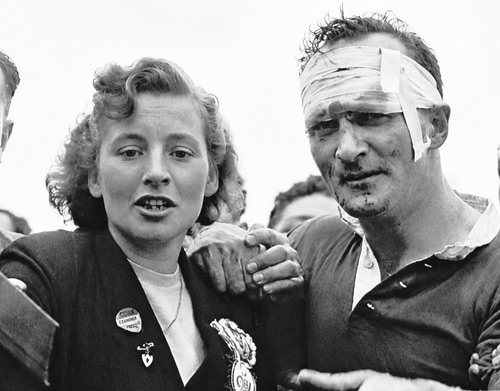
On 13 July 1952, following one of the most memorable Munster Hurling Finals ever played, a photograph was taken at the Gaelic Grounds in Limerick that would become one of the most recognisable images in the history of Gaelic games.
Cork had just defeated Tipperary by 1-11 (14pts) to 2-6, (12pts), ending Tipp’s great hopes of four successive Munster titles. At the centre of Cork’s victory was the legendary Christy Ring, battered, bloodied and bandaged after another extraordinary performance. Standing beside him was a young woman holding a Kodak box camera. Her name was Rita Fenton, (later Rita Lowry,
Then a native of Ballygarvan, County Cork. The image captures a wonderful moment of sporting history. Mr Ring, his head heavily bandaged, rests his arm across Rita’s shoulders as she attempts to have her own photograph taken with her hurling hero.
What makes the story particularly fascinating is that Rita was no ordinary spectator. Born in 1927, she was herself an accomplished camogie player. Having moved from Cork to Fawnagown, Tipperary in 1948, she helped establish the Seán Treacy camogie club and went on to represent Tipperary. Remarkably, she had played against her native Cork in the Munster Camogie Final that very same year.
Rita was also a personal friend of Christy Ring. Their friendship continued long after that famous afternoon, with Ring sending her letters and Christmas cards over the years. For decades, the identity of the young woman in the photograph remained largely unknown to the wider public. She became affectionately known as the “Blood and Bandage Lady”. It was not until May 2016, some 64 years after the photograph was taken, that the Irish Examiner, assisted by family friend Jerry Ring, brought her remarkable story to a wider audience.
Rita recalled that she had been passing her Kodak box camera to a friend so that a photograph could be taken of herself alongside Christy. At that very moment, another unknown photographer captured the scene that would become famous. The photograph appeared in the Cork Examiner on 14 July 1952 and would eventually find a permanent place in the visual history of Cork hurling, including a display at Páirc Uí Rinn. Although the original photograph survives in the Irish Examiner archives, the name of the photographer responsible has not yet been firmly established. Beyond that celebrated image, Rita devoted much of her life to Gaelic games, collecting photographs, newspaper reports and sporting memorabilia in an extraordinary series of scrapbooks.
Now comes the sad news that Mrs Rita Lowry (née Fenton) has passed away, in her 100th year. Her death was reported yesterday November 5th 2026. She leaves behind a wonderful legacy, not only as the young woman in one of hurling’s most cherished photographs, but as a camogie player, club pioneer, lifelong sporting enthusiast and devoted family woman. Seventy-four years after that unforgettable afternoon in Limerick, the photograph remains a powerful reminder of a different sporting age an era of fierce rivalry, extraordinary characters and enduring friendships.
Christy Ring’s name will forever occupy a special place in Irish sporting history. Thanks to one remarkable photograph, Rita Lowry’s name will always be remembered alongside his.
This website uses cookies to improve your experience. We'll assume you're ok with this, but you can opt-out if you wish.AcceptRead More
Privacy & Cookies Policy
Privacy Overview
This website uses cookies to improve your experience while you navigate through the website. Out of these, the cookies that are categorized as necessary are stored on your browser as they are essential for the working of basic functionalities of the website. We also use third-party cookies that help us analyze and understand how you use this website. These cookies will be stored in your browser only with your consent. You also have the option to opt-out of these cookies. But opting out of some of these cookies may affect your browsing experience.
Necessary cookies are absolutely essential for the website to function properly. This category only includes cookies that ensures basic functionalities and security features of the website. These cookies do not store any personal information.
Any cookies that may not be particularly necessary for the website to function and is used specifically to collect user personal data via analytics, ads, other embedded contents are termed as non-necessary cookies. It is mandatory to procure user consent prior to running these cookies on your website.






Recent Comments