Thurles – Tipperary – The real hidden and unspoiled Ireland
Thurles.info was created to provide a community news and information portal for the people of Thurles and the County of Tipperary. We wish to share with you, and the world in general, all the historical features and modern amenities of this beautiful part of Ireland.
Please explore Thurles.Info and feel free to broadcast your views, comments and suggestions with us.
We welcome any contributions which would balance and complement this website.
Thurles (Irish: Dúrlas Éile) is a town on the river Suir in County Tipperary and is the largest town in North Tipperary. Thurles is surrounded by the Silvermines which are mountains to the north-west and the Slieveardagh Hills to the south-east. The town itself nestles in the heart of the beautiful Suir Valley.
With a population of over 8000 people, Thurles gets its name from the Irish word Durles Eile Fhogartaigh meaning the strong fort of the O’Fogarty’s of Eile which formed part of the O’Fogarty stronghold, during the the twelfth century.
The ancient territory of Éile obtained its name from pre-historic inhabitants called the Eli, about whom little is known beyond what may be gathered from legends and traditions. The extent of Éile varied throughout the centuries with the rise and fall of the tribes in occupation. Before the 5th century A.D. the details of its history which can be gleaned from surviving records and literature are exceedingly meagre, obscure and confusing. During this century however Éile appears to have reached its greatest extent, stretching from Croghan Bri Eli (Croghan Hill in Offaly) to just south of Cashel (in Corca Eathrach Eli). The southern part of this territory embraced the baronies of Eliogarty and Ikerrin, a great part of the modern barony of Middlethird, the territory of Ileagh, and portion of the present barony of Kilnamanagh Upper.
The many castles and monastic settlements, which surround Thurles, bear lasting evidence to the area’s rich and colourful history. The town itself owes its development to the Norman Butlers and particularly to James Butler, who was created Earl of Ormondby Edward III in 1328. Two of the original family fortresses still remain in Thurles today.
Modern day Thurles has grown from its early beginnings to a thriving hub of shop’s and businesses. It also has on offer a wide variety of facilities, including two historic museumsSt Mary’ Famine and War Museum and Lar na PairceGAA Museum. Thurles is the birthplace of the Gaelic Athletic Association, founded in 1884 in Hayes’ Hotel. Local Semple Stadium is Ireland’s second largest sports arena with a capacity for 60,000 people, second only to Croke Park Stadium, Dublin. It is no wonder therefore that Thurles can offer a variety of sporting facilities including Gaelic games, Fishing, Horse & Greyhound Racing, Golf, Leisure Centres,and Equestrian Centres.
Thurles has two third level Colleges:
St. Patricks College:This third level educational institution, is located in the centre of our picturesque town and has a history of religious and humanities education dating back to 1837. The college currently offers a range of courses from introductory to masters level in education, business, religion, theology, philosophy, pastoral care, and psychology. As well as offering a number of full time academic courses, St. Patrick’s College serves as a centre for theological, pastoral and spiritual renewal in the region.
Tipperary Institute: Tipperary Institute is a dynamic higher education, development and research centre established by the Government of Ireland . Management of the Institute is the responsibility of the Chief Executive Officer, supported by the Senior Management Team. Tipperary Institute have two campus locations, Thurles in North Tipperary and Clonmel in South Tipperary. The work of TI is carried out by three specialist departments: ICT, Rural Development and Business Development.
The closest major airport to Thurles is Waterford Airport . This airport has international and domestic flights from Waterford, Ireland and is about 73 km from the center of Thurles, Ireland.
Shannon Airport
Distance (km): 85
Time Away: 1.5 hrs
Nearest International Ferry Port
Dun Laoghaire
Distance (km): 160
Time Away: 2 hrs 15 mins
Nearest Railway Station
Thurles
Distance (km): central to town
Time Away: 2 mins
Nearest Cities
Dublin
Distance (km): 166
Time Away: 1 hrs 45 mins Waterford
Distance (km): 85
Time Away: 1 hr 25 mins Cork
Distance (km): 104
Time Away: 1 hr 30 mins Killarney
Distance (km): 150
Time Away: 2.5 hrs Limerick
Distance (km): 95
Time Away: 1 hr 20 mins Galway
Distance (km): 160
Time Away: 2.5hrs Sligo
Distance (km): 214
Time Away: 3.25 hrs Belfast
Distance (km): 315
Time Away: 4 hrs 10 mins Athlone
Distance (km): 96
Time Away: 1.5 hrs
A Growing Catalogue of Arrests, Resignations, Expelling’s and Charges Raises Questions.
As Sinn Féin positions itself as a “Government-in-waiting”, the party continues to face uncomfortable scrutiny over the number of members, former members and associates who have been arrested or charged with serious offences in recent years.
An examination of publicly reported cases between 2015 and 2025 reveals a significant series of criminal investigations involving individuals linked to the party; ranging from sexual offences and child exploitation to violent crime, coercive control, fraud, and high-profile gangland-related charges. While the party has consistently stressed that individuals facing prosecution are immediately suspended and that Sinn Féin “does not tolerate criminality,”the accumulation of cases has prompted renewed debate about whether the organisation is adequately equipped to manage governance at national level.
A Decade of Difficult Headlines. Among the most serious cases is that of Mr Jonathan Dowdall, the former Dublin City councillor who was arrested and later charged in connection with the Regency Hotel investigation. Dowdall ultimately pleaded guilty to facilitating the murder of Mr David Byrne and received a four-year prison sentence before entering the Witness Protection Programme.
Also significant is the conviction of Mr Michael McMonagle, a former Sinn Féin member in Derry, who pleaded guilty to multiple counts of sexual assault against minors. He was sentenced to prison and later returned to court for breaching court-imposed restrictions.
Then there was Mr Niall Ó Donnghaile a Senator and former Sinn Féin Seanad leader who was suspended (reported Sept 2023) and resigned from the Seanad in December 2023. Referred internally to PSNI/Social Services after it emerged, he had sent “inappropriate” messages to a 17-year-old; party says there were no criminal findings, but the matter led to his suspension and later resignation.
Mr Barry McElduff, a Former Sinn Féin MP (West Tyrone) was suspended in January 2018 and then resigned as MP shortly afterwards. The reason was he posted a video widely seen as mocking the Kingsmill massacre, (Whitecross massacre) which saw the shooting dead of 10 workmen, which caused major public outrage; suspension was a party sanction (the incident was not a sexual/criminal charge but was a conduct controversy that led to suspension/resignation).
In Belfast, Mr Cathal McLaughlin, a councillor at the time of his suspension from the party, was charged and later convicted of sexual assault, receiving a suspended sentence. His appeal was dismissed.
In recent days a female, a party member in Co Laois, was expelled from Sinn Féin after her home was searched by an Garda Síochána and her partner was arrested in connection with a terrorism-related investigation. The probe relates to an alleged far-right extremist group plotting an attack on a mosque in Galway, linked to explosives found in Co Laois and Co Down. Sinn Féin’s statement says the member failed to inform the party that her home had been raided, or to alert the party to the seriousness of the situation. That failure was cited as the reason for expulsion. Her partner, a man in his 30s, remains detained under Section 30 of the Offences Against the State Act. He is not named in initial press reports. The fact that a raid occurred on the house of a party member linked through a partner to an extremist investigation, touches on issues of vetting, disclosure and risk management within the party structure.
The full facts are not yet publicly available. However, we understand that the suspect in this far-right extremism probe met Mrs Mary Lou McDonald campaigning during the general election and urged people to vote for the party last year, declaring: “Let’s bring our country back.” While not known as a party member he was in attendance at a party event in Dublin some six weeks ago. Sinn Féin have confirmed that the woman and her partner, who is being held in a Midlands Garda Station, were signed into Leinster House twice. We ask the question, “Is Sinn Féin now expelling members for terrorist activities, God knows in the past they were welcomed?”
Why have so many Councillors Jumped Ship in the past decade?
Name.
Council/Area
When left
Reported Reason/ Context
June Murphy.
Cork (Fermoy).
Sept 2015.
Resigned citing “an increasingly negative experience” amid local bullying/discipline disputes.
Kieran McCarthy.
Cork County Council.
June 2015 (expelled).
Expelled after an internal review into constituency structures (financial/disciplinary disputes).
Melissa Mullane.
Cork.
2015 Suspended (12 months).
Following the Cork East internal review; part of the same row that saw other departures.
Ger Keohane.
Cork County Council.
Nov 2015.
Resigned from Sinn Féin (reported as a defection) part of multiple Cork departures in 2015.
Noeleen Reilly.
Dublin City Council (Ballymun-Finglas).
Feb 2018.
Resigned citing an “orchestrated bullying campaign”; previously suspended by the party.
Lisa Marie Sheehy.
East Cork.
Sept 2017.
Resigned citing intimidation / being “plotted against”(connected to the Cork East disputes).
Sorcha O’Neill.
Sorcha O’Neill Kildare (former Sinn Féin councillor).
Apr 2017.
Resigned citing “bullying, hostility and aggression” within the local organisation.
Gabe Cronnelly.
Galway County Council.
May 2020.
Resigned from Sinn Féin and sat as an Independent; cited lack of local/national support.
Paul Hayes.
Cork County Council May 2020.
May 2020.
Resigned from Sinn Féin and sat as an Independent; cited lack of local/national support.
Danielle Twomey.
Cork County Council (East Cork).
Dec 2023.
Resigned citing relentless online harassment and internal party “backhanded moves”; now Independent.
Aidan Mullins.
Laois County Council.
Aug 2024.
Resigned after being told he would be suspended for three months; said he was being “silenced” on migration and related issues.
Caroline Dwane-Stanley.
Laois County Council.
Dec 2024.
Resigned saying the party was “not a safe place”; cited the party’s handling of a controversy affecting her family.
Ursula Gavan.
Limerick City & County Council.
Jan 2025.
Resigned citing “family loyalty” after her husband, Senator Paul Gavan, was left off the party’s Seanad selection.
So we ask “Pattern or Misfortune?“ Sinn Féin would argues that such incidents are comparable to those occurring in other major parties and insists that swift disciplinary action is taken when allegations emerge. In several cases, the party suspended individuals even before charges were formally brought, citing safeguarding concerns.
Critics, however, contend that the volume and gravity of cases linked to Sinn Féin is “disproportionately high,” particularly compared with other parties of similar size. They also point to instances where individuals remained active in local structures despite concerns being flagged, or where the party leadership sought to distance itself, only after legal proceedings became public.
Security analysts note that Sinn Féin’s rapid growth, combined with historically looser local-level structures, may have contributed to inconsistent vetting and oversight. Several of the cases involved long-standing activists who operated within community-based settings with limited central supervision.
Mounting Political Pressure. Opposition politicians have already moved to capitalise on the issue, arguing that Sinn Féin has yet to demonstrate that it can meet the standards of transparency, safeguarding and organisational discipline expected of a party preparing to lead government. Privately, some within Sinn Féin acknowledge that the headlines of the past decade, and particularly the high-profile nature of the most serious cases, have caused significant internal discomfort.
The Question for Voters. As the party continues to anticipates entering government for the first time in the Republic, the question lingers: Can Sinn Féin convincingly reassure the public that its structures, oversight and internal controls are robust enough for national leadership?
The answer may ultimately rest not on the number of individuals charged, but on whether the party can demonstrate that it has learned from its many past failures, and whether voters believe Sinn Féin can uphold the standards it repeatedly demands from other parties in Government.
“Congratulations to Mrs Kitty Lyons (nee Ryan) formerly of Coolkill, Ballycahill, Holycross, Thurles, Co. Tipperary, latter the daughter of the late Denny and Mary Ryan, of the same address, who today, Friday January 19th, celebrates her 100th birthday.
Wife of the late Denny (Denis) Lyons; latter a former native of Skibereen, Co. Cork; Mrs Lyons now currently resides in Nottingham, England.
A close friend for many years of Mrs Kathleen and the recently deceased Mr Ned Bowe; Mrs Lyons is mother to a family of 6; (2 boys and 4 girls), and left Ireland in the early 1950, to carry on a nursing career in the central UK Midland region of Nottingham, latter the legendary home of Robin Hood.
Today, at 1:30pm, in the Acorn Nursing Home, Nottingham, where she resides, she will be joined by family members, extended relatives and close friends to celebrate her 100 birthday.
She will also receive a cheque from the President of Ireland, Mr Michael D. Higgins for €2,540 euros; wishing her a happy birthday and congratulating her on her longevity. She will also receive a birthday card and a congratulatory message from the current UK monarch, His Majesty King Charles III (Mountbatten-Windsor) and his wife, Her Majesty Queen Camilla (Parker Bowles, latter formerly HRH the Duchess of Cornwall).
Amongst the known family members attending will be her son Eugene, daughters Lynda, Bernadette and Angela, other extended relatives, together with her many friends within the Nottingham area, where she diligently served.
Other members of her extended family which include nephews, nieces, neighbours and family fiends, all resident in the Ballycahill, Thurles area; today, send their best wishes to Kitty, latter who was a frequent visitor to Tipperary, vacating in Haye’s Hotel, here in Thurles. We wish you many more years of continued good health and happiness.
Good humouredly described by someone recently, as being “A cross between a game of Ice Hockey and Murder”; yet over 80,000 spectators from home and abroad will descend on Croke Park, Dublin, on Sunday next, July 23rd 2023, to watch Co. Kilkenny, (the latter ‘All-Ireland winners’ 36 times in total, between the years 1921-2019), compete with the current reigning champions Co. Limerick, in the game of Hurling.
Hayes Commercial Hotel, Thurles, Co. Tipperary today.
Hurling remains the fastest field sport in the world today, with the ball often reaching speeds of up to 100mph and with, on average, an estimated 350,000 hurley sticks produced every year within the Irish State.
One of the oldest games still in existence in the world, the game of “Hurling” dates back to early times, here in Ireland, with the first written reference to the game appearing in the written Brehon laws of the 7th century.
However, references to hurling were made much earlier in tales of the heroics of the Irish legend, warrior hero and demigod, Sétanta. Latter would gain his possibly better-known name, after killing the craftsperson Culann’s fierce guard dog, in self-defence; having driven a hurling ball (sliotar) deep into the animals throat, using his hurley stick, thus resulting in the choking the unfortunate animal. Sétanta offered to take the dogs place, until a replacement could be located or another animal reared, hence he, Sétanta, became the “Hound (Irish for which is “Cú”) of Culann“; hence his new name/title “Chullainn”.
While banned in the 12th century by Norman invaders who had arrived into Ireland, the game of hurling nevertheless, continued to grow in popularity up until the early 19th century, before Irish customs and traditions became again heavily repressed and which saw hurling decline across the island, with the exception of strongholds here, within the province of Munster.
This decline was to change following an article written by Co. Clare man Michael Cusack, called ‘A Word about Irish Athletics’ which appeared in both the ‘United Ireland’ and ‘The Irishman’ newspapers. On October 11th, 1884 Cusack’s article to both papers was supported by a communication from Tipperary man Maurice Davin, who had dominated athletics for over a decade and who gave his full support to the October 11th publications.
A week later Cusack submitted a signed letter to both newspapers announcing that a meeting would take place in the Hayes Commercial Hotel, Thurles, Co. Tipperary; staged to take place on November 1st 1884. Thus the first meeting of the Gaelic Athletic Association (GAA) for the Preservation and Cultivation of National Pastimes took place, recognising that Ireland’s indigenous sports needed to be preserved standardised and regulated.
At the meeting Maurice Davin was elected President, while 3 other attendees namely Michael Cusack, John Wyse Power and John McKay were elected as secretaries. Archbishop Thomas William Croke, Charles Stewart Parnell and Michael Davitt were invited to become patrons.
The newly formed Gaelic Athletic Association would cover both of Ireland’s indigenous games identified as Gaelic Football and Hurling. GAA clubs quickly began to spring up all over Ireland and people began to play the games of Hurling and Gaelic Football and take part in Athletic events with pride.
The first All-Ireland hurling match took place in 1887, in Birr, Co. Offaly, with Co. Tipperary defeating Co. Galway.
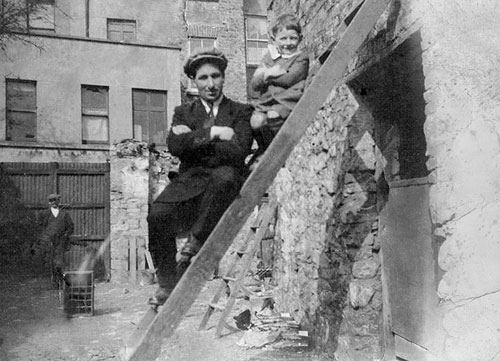
The story is as related by the late Mr Timmy Maher, Church Lane, Thurles, Co. Tipperary, to the late historians Mr James (Jim) & Mrs Brigid Condon, Butler Avenue, Thurles, Co. Tipperary in the year 2000.
Note on the late Mr Timmy Maher: Timmy knew Thurles. He was a keen observer, who could unravel the most complicated genealogies with ease. The ubiquitous Ryans, Mahers and Dwyers whose complex ties and ancestry confused many, posed no problems whatsoever to the astute Tim. Nicknames, of course, were critical for differentiating between the many popular family names. His whole recorded narrative hereunder is liberally laced with these delightful sobriquets . . . Toot-n-Nan, Turney Larry, Stiffy, Mag-a-Hoe, Foll-de-Doll, The Guardian Angel, Pull-a-Pint, Call-in-the-Morning, Shittyfoot, Moll-the-Bobber, Cross-the-Roads, Mawbags, Glassybaggs, Goodybags, Hole-in-the- Wall, Sprig, Abbey, Fireball, High Hat, Ranty, Shifty, Mr Deeds, Moonlighter. Sunman … and many more we couldn’t even attempt to spell or understand.
Consanguinity (Of the same blood) was a town feature. You only had to talk to Timmy for a few minutes when you would find yourself welcoming him ‘as a long lost cousin’. Timmy was neither saint nor sinner; he was simply one of us. Despite his foreign travels he never lost his parochial outlook. He was a ‘jack-of-all-trades’ and master of quite a few. Indeed, he collected more than memories. His regard for the past made him reluctant to throw away anything, from the old fork he claimed was used to stir the cabbage in the big pots used during the Great Famine, to a unique letter from Arnold Harris Mathew the last claimant to the title of Earl of Liandaff.
Timmy’s Story.
“In them days there weren’t any such thing as A, B or C streams, there were only two groups, the ‘tough chaws’ who used to scratch a lot, taught by Mr Wall, and the better sort who were groomed for better things by Mr Walker. Actually a great deal of the teaching was left to monitors – older boys like Danny Keane, Martin Drew, Jimmy Galvin and Denis Delaney.
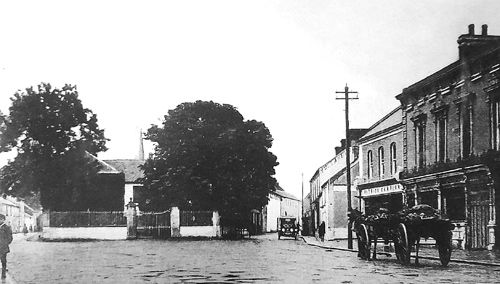
Canon Wilson’s Car and on the left hand side access to Church Lane.
We were a delicate and miserable lot, no wonder none of us ever came to anything. Every Monday morning we’d bring our penny to school to pay for our few books and the fuel; even if we didn’t have it, it didn’t matter.
We were all barefoot except sometimes in the winter months we might be lucky enough to have a pair of wooden clogs bound with iron hoops. I’ll say one thing for the auld clogs though, you couldn’t beat them for sliding on the icy roads as long as they lasted.
Hygiene and nutrition how are you! Half of us had ‘Tetters’ (ringworm, eczema. herpes etc.) and ‘Bowknocks’ (festered swellings on our leathery feet). Do you know how they used to cure these painful swellings? The mother or father would take a needle and thread and stick it through them and then squeeze out the festering mess. Sure wasn’t the cure more painful than the complaint!
‘Tis funny though the things you remember years afterwards. Did I tell you the one about the day that auld Mr. Wall caught Jack Conners and ‘The Pensioner’ (Dan Hogan) smoking a clay pipe in the classroom. ‘Twas like this; in them days the Monks used to take a break in the mornings for their elevenses. When Mr. Wall was coming back after his break he spotted the two boyos’ through the window as they were ‘fogging’ away. The poor man was outraged. He charged into the classroom; ‘Come up here Hogan, you scalawag’, he fumed, ‘what do you mean smoking in my class?’ ‘What’, the terrified Hogan mumbled, ‘me sor … no sor … sure ‘twould only make me sick, sor’. Like a petrified rabbit ‘the Pensioner’ scanned the room in search of cover and safety from the teacher’s threatening leather. Then in panic he shinnied up the support pole in the centre of the classroom (these poles were about 8″ in diameter and were supporting the wide, high ceiling of the rooms). ‘Come down here this instant’, bellowed Mr. Wall. Dan wouldn’t budge but hung on for his life with hands and knees. Then with the practiced ease of a lifetime of handling unexpected situations, Mr. Wall took the long-handled window hook from the corner and hooked the bold Dan down by the suspenders. And what was really funny was that all the time that Dan was hanging on high above the class his arse was out through his britches.
I remember well the times Mrs. Carrigan would call by and give Mr. Wall a gallon of sweets. Mr. Wall would dole them out to us every day as long as they lasted. Mind you, that was a rare treat in them days.
But, you know, we loved auld Wall. When he was leaving us, we all trooped up to the railway station with him. Nor were we ashamed when we cried as the auld steam engine pulled him away from us for ever. I don’t know whether it was just a case of the devil you know being better than the devil you don’t or if it was genuine affection and regret. Myself … I loved that auld man.
I was a terror for ‘mitching’ myself, (playing truant from school). The truant officer then was auld Halogen. He was a terrifying spectre; a big dark man riding a high bicycle. I can remember the day that the father had to bring me up Hayes’ Lane to appear before the authorities for my latest bout of ‘mitching’. Didn’t the father have to pay a fine of a shilling and I was warned to mend my ways or I’d be sent away!
After school some days we used go up to where the District Hospital is now, poking around looking for spent brass. You see the British military had moved out and it was a great place for scavenging though I never found nothing. It was here that another Hogan, ‘Sir Billy’, found a live grenade and had his poor hand blown off. (When asked why they called Hogan ‘Sir Billy,’ Timmy replied, ‘Sure, he looked like a Sir?). It was there in Ronnie’s field (latter opposite the present CBS Primary School) that the two little Care brothers were drowned; weren’t they trying to skate on the ice in the old quarry that was there then.
Church Lane Remembered:
I still remember the auld grandfather with his shaggy beard and paralysed arm; he was a man for all seasons. He was born in Graguenageenah back in 1830, but wasn’t baptised until three years later in St. Mary’s in Killenaule; don’t I have his Baptismal Lines.
The grandfather in his early years was a ‘hedge-school-master’ up near Ballingarry before he came to town as a clerk to Maurice Poor (Power). Power’s shop and pub was where Quinnsworth is today (Today Tesco). Later the grandfather became a bailiff of the court and was responsible for serving writs and summonses. He always implied that he was a Nationalist ‘plant’. You see, when he’d get the summonses to serve, he’d have time to give advance notice to the people being summonsed and in that way, they could quickly remove all stock or valuables before they could be distrained or impounded. It proved quite profitable as well. He got a pound for the early warning and seven and six (7s – 6p) for serving the summons!
But the auld grandfather had many irons in the fire. Did you know that he operated a poitin still right there in the lane, in the back bedroom. Because you needed running water to distil whiskey, he dug a well in the bedroom and the father used to work the pump for him. In fact the father had another important job as well, he had to act as taster to ensure the brew was mature and potable. Didn’t he take his job so seriously that after one tasting session he was unconscious for six days. Faith you’d be surprised who the auld grandfathers customers were. They were never caught, though the street was patrolled regularly by the R.I.C.
It was up the lane that the Protestant gentry would come every Sunday to attend services. I can still remember the Chaises and Landaus swaying up along the lane … the Morgans of Crossogue, the Langleys, the Knoxes … I remember auld Bill Bannon drove the Knox family to services …the mother – elegant in her finery, the two sons facing her in the carriage and the liveried footman on the back. In them days the only car seen in the lane was auld Canon Wilson’s. That new-fangled contraption always had a motley gang of ragged kids, chasing after it.
Ah, you wouldn’t remember the time of the Great Flu’… Wasn’t I in bed myself with it but I’d creep to the window and look out every time a funeral procession would come up the lane. Sick as I was, didn’t I count nine funerals in one day! Sometimes the coffins would be left inside the gate and my father and grandfather would bury them after work. . . for that alone the two of them deserve a place in Heaven. The priests and ministers in the funeral processions would wear white linen around their tall top hats and another broad white sash across their shoulders. After the burials it was the custom for them to give the linen sashes to the poor attending, to make little items of clothing for themselves or their children.
Sure, they were the hardest of times … and don’t I remember going around the town myself collecting pennies to buy breastplates and ornaments for the coffins of many’s the poor soul. We used to varnish the crude ‘Workhouse’ coffin and then mount the newly purchased brass fittings ourselves. Ah, ’twas sad and I could tell you a lot about them hard times.
But the lane wasn’t all doom and gloom. We had our characters. Apart from the auld grandfather, the most colourful was ‘Jack the Webb’. A grand auld fellow when he was sober, but God help the lane when he had drink taken.
Ours was a very unusual lane. At one end we had James Sayers who rang the bells for the Cathedral and at the other we had Sam Whittaker who rang the bells for the Protestant Church. In the middle of the lane lived a shoemaker named Paddy Ryan who was nicknamed ‘The Angel’. Well anyway, when the Webb would be coming home after his drinking bouts… it was his changeless habit to pause unsteadily outside each house door in the lane and berate the unfortunate inhabitants … nothing was safe or sacred from Jack the Webb’s sharp tongue… not even Dooley’s auld horse. Finally, exhausted from his imprecations on man and animal, he’d look to the unsteady heavens and enlist the help of the Almighty; “O Lord, take me out of this den of iniquity with its bell ringers above and its bell ringers below and its angels in the middle”.
Jack’s brother and sister-in-law were two other very unique characters who shared the lovely sobriquet (Nickname), ‘Toot ‘n Nan’ , but I wouldn’t like to say how they got that name. Did you know that we had a family in the lane who claimed to be related to the wife of President Harry Truman, President of the United States? They were the Eades.
The lane, like all of us, is now quiet a sad relic of grander days and precious memories. You can still peek through the rotten door of Dooley’s dilapidated auld house and see his once grand jarvey car, now mouldering away. Me own yard is cluttered with memorabilia of forgotten trades, guarded now by an arthritic auld dog named ‘Dooley’.
Around Thurles Town:
‘Twas a kind of romantic place then with its soft dim gaslights and the glow of oil lamps in the shops and pubs around the streets. I could tell you where every gaslight standard stood … Molloy’s corner, the Bank corner, outside Hayes’ Hotel, at each end of the Suir Bridge, outside the Presbytery, at the end of our own lane … Aye, and the water pumps, the ‘Judies’ as they were called. I remember where they all were. Isn’t there one of them still left at the Stannix Home (Widow’s Home). Don’t I remember one evening — with not another vehicle in sight — seeing the ‘Black and Tans’ ramming their Crossley tender into the stone pedestal of the Judy that stood in the Square opposite Ryan’s Jeweller’s.
In my mind I can still see Jack Conners and Mickey ‘Coldbread’ as they made their rounds lighting up the town’s gaslights. Don’t you know, when the town got its own electricity, the bright bulbs only made the town look dingy and neglected, with its crooked railings, peeling paint and rough gravel streets.
I could name off all the shops, aye, and tell you a tale or two about some of them. Do you know that in one shop the ‘grocer’s curates’(shop boys) had to whistle whenever they were sent to the back stores to bring up more supplies for the shop! This, of course, assured the owner that the help was not sampling the goodies in the back room. Then there was the inventive butcher who never bought anything but cattle that died on local farms. He had a workman whose sole job was to stand up by the slaughterhouse and holler out ‘How . . . How … How’ … so that the local townsfolk would think that live cattle were being driven in constantly for slaughter.
I can recall the day that ‘Sewerdy’ was dying of the thirst and he asked me to pawn his waistcoat in Flannagan’s. Didn’t I get one and six for it (1s-6p) and ‘Sewerdy’ gave me tuppence for meself.
Mixie Connell
In them days the social life centred around the auld Transport Hall (also known as the Sinn Fein Hall, up in Mixie Connell’s Lane). I was in the band and why not? Didn’t I help found the present town band. Here we had dances three nights a week. You could get into the ‘workday hops’ for sixpence. It cost two shillings on Saturday nights when the dancing went on until all hours. There used to be plenty of ham and barmbracks (Currant Cakes) washed down with frothy pints from Mixie’s, [Mixie O’Connell’s pub Liberty Square, today Sos Beag Coffee shop, (Latter Translated from the Irish – Little Break)].
These weekend dances went on until the time to go to First Mass on Sunday morning, where few of us could stay awake through those long sermons. The auld floor boards used to shake to the stomping of hobnailed boots; the women’s feet rarely touched the boards. I’m telling you there was energy spent up that lane …Jackie Burke, Jamesie Cahill, Jimmy Dooley, McCowan, Jack Brown, Arthur Fagan, Maggie (‘Mixie’) and Kitty, her sister, the Kinnanes. On the bandstand were the four Fitzgeralds, the Graydons, Billy Maher, Johnny ‘John’ Ryan, Jack Ryan Gollagher, Timmy Finn, Tom Loughnane, John Mulcaire, Paddy Rafferty, Willie Ryan and God knows who else.
I remember we were in the middle of a great night when Archbishop Fennelly died. That poor saintly man got little sympathy and sweet prayers when the dancing had to be abandoned as a mark of respect.
Will I tell you a good one about the band? Around this time a split developed in the band membership. You know Leo Spittle (God be good to him now) whose uncle was the Mayor of Kilkenny; well he got a lot of brass band instruments from there and with these a new band was formed. Didn’t they put all that shiny array of musical equipment on display in Shanahan’s window.
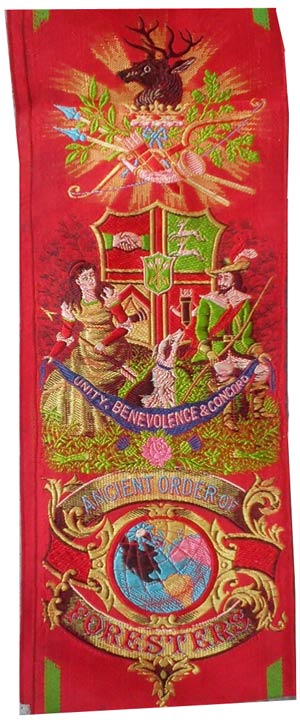
Ancient Order Of Forresters
Of course, those of us who wanted to keep the old band together were very upset by the formation of this rival band – me more than the rest. Anyway, I heard the members of the ‘new’ band plotting to march before the ‘Forresters’ on their way to Mass on St Patrick’s Day. Since this was traditionally an honour reserved for the old band, I was determined to do something about it. So, one dark night, I upped and stole all the new band’s brassy instruments! Mind you I paid dearly for this little transgression sometime later. It seems that when I later applied for a Visa to go to the U.S.A. the local police didn’t give me a very good character reference and my application was turned down. Later, still I did get admitted to Canada though … but that’s another story.
Who were the ‘Forresters‘? They were a kind of benevolent society and Joe Pollard was the Chief Ranger. Others that I can remember were Mulcaire (the auld lad entirely), Tone Quinn, Bill Quinn, Ter Lawlor, Mattie Mack and Jim Doyle. They really cut a dash every St. Patrick’s Day as they stepped right out of history’s pages and marched proudly down to Mass. They wore military-like uniforms, green jackets, white pants, high boots, gold sashes and tall hats – trimmed with feathers… they looked like a whole platoon of Wolf Tone’s. To give them their due though, they weren’t all show; they helped many a poor soul in this town … and out of their own pockets at times!
Certainly there was other entertainment at that time. The earliest carnivals that I remember were down at the Presentation Convent grounds. I can still remember the time they strung a cable from the top of the Laundry chimney stack and ran it down the Convent field through a big cock of hay to the ground. The daring were invited to climb up and then swing down on a pulley to the ground. Wasn’t it there that poor ‘Leggy’ Maher earned his badge of courage and a lifelong gammy leg. However, for us kids, it offered other more lucrative possibilities. You see the brave aerialists usually landed head over heels and the loose change in their pockets scattered all over the place. We’d grab what we could and run … kid’s eyes (possibly black and white striped hard boiled sweets), tanners (6 pence coin), an occasional bob (1 shilling coin)… but mostly coppers (1 Penny coin). I can still recall the excitement.
I got going to my first moving picture show back in 1917. The father took me to McGrath’s and to this day I can remember the name of the picture, ‘Coming through the Rye’. In that cinema Jackie Burke and the sister, Mona, provided the musical accompaniment. The first film to come to Delahuntys, didn’t I hurl in the field where the cinema was built; was a real tear-jerker named ‘Orphans in the Storm’. ‘Twas booked-out solid for a whole week. You’d have to get down very early on Sunday nights if you wanted to get a seat. Joe Mack’s daughter – the one who later became a Nun – used to play the piano there.
Ah, back then, too, we’d look forward to the live productions of the Parnell Players. That was a talented lot, I can tell you …John Burke, the O’Brien brothers, Mrs. Carey and of course, Maudie Mooney.
It was around 1926 when over four hundred Welsh Miners descended on the town. It was during the great strike/lockout in England. They came over to raise funds to continue their struggle for decent conditions and a living wage. They would march in military formation all around the town and then give open-air concerts. Anyone with a spare room or bed put them up while they were here. We had a few nice Welshmen staying at our house.
Do you know I still have my first Library Card. It was up opposite Llandaff Lodge in Hayes’ Lane then; it cost me two bob (2s-0p) for a year. After the Great War (World War I) all the local discharged soldiers used to go up once a week to the Labour Exchange then located where Clancy’s Electrical shop is now. The Exchange was run by Mahony and the daughter. I can still hear the old jingle that they used to sing on the way to collect their money:-
Up to Mahony’s and in to sign. That’s where you’ll get your twenty nine (29s-3p). Inky, Pinky, Parlez Vous.
[The English WWI song “Mademoiselle from Armentières” bears the last line of the above . ‘Inky Pinky’ was a Scottish children’s name for parsnip and potato cakes, but it has been rightly suggested that it was also an onomatopoeic reference to the sound of rustling bed springs and therefore more likely to be a soldier’s offensively irreverent, obscene derivation.]
This website uses cookies to improve your experience. We'll assume you're ok with this, but you can opt-out if you wish.AcceptRead More
Privacy & Cookies Policy
Privacy Overview
This website uses cookies to improve your experience while you navigate through the website. Out of these, the cookies that are categorized as necessary are stored on your browser as they are essential for the working of basic functionalities of the website. We also use third-party cookies that help us analyze and understand how you use this website. These cookies will be stored in your browser only with your consent. You also have the option to opt-out of these cookies. But opting out of some of these cookies may affect your browsing experience.
Necessary cookies are absolutely essential for the website to function properly. This category only includes cookies that ensures basic functionalities and security features of the website. These cookies do not store any personal information.
Any cookies that may not be particularly necessary for the website to function and is used specifically to collect user personal data via analytics, ads, other embedded contents are termed as non-necessary cookies. It is mandatory to procure user consent prior to running these cookies on your website.









Recent Comments