Shoppers in Thurles are noticing striking price differences between local supermarkets, underlining the continued strain of rising grocery costs across Tipperary.
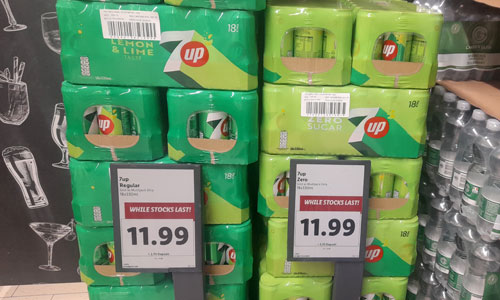
A check in Thurles this week showed that an 18-can slab of 7UP Zero cost €8.99 in Aldi, €10.00 in Dunnes Stores, and €11.99 in Lidl; a €3 difference between two main German international discount chains operating in Ireland.
Zero 7Up – Comparing Lidl price today.
While small on paper, the gap highlights how uneven supermarket pricing has become during Ireland’s ongoing cost-of-living crisis.
Prices remain high. Nationally, grocery inflation stands at 6.3%, with the Competition and Consumer Protection Commission (CCPC) estimating that food prices have climbed by roughly 27% since 2021. Even as energy bills ease, household shopping remains costly. Shoppers say they are now comparing prices item by item, with differences between stores adding up quickly.
Surveys show major contrasts. A recent Checkout.ie study found big variations in the cost of a standard grocery basket. Prices came to €150 at Lidl, €207 at Dunnes Stores (or €172 after vouchers), €195 at Tesco (or €185 with Clubcard), and €209 at SuperValu. An Irish Independent comparison of branded goods found a smaller basket costing €34.51 at Aldi, versus €49.24 at Dunnes and €49.88 at Tesco, a price gap of more than 40% on identical everyday items.
Different models, different prices. Aldi and Lidl run leaner operations with smaller product ranges and lower margins, helping them hold prices down. Local costs and Ireland’s new deposit-return scheme can also affect prices; for example, some 18-can packs now include a €2.70 refundable deposit, which does not appear on shelf labels.
Impact on local households. For families in Thurles, a few euro saved on a single product can mean €20 to €25 per week, or over €1,000 a year. With grocery prices still rising faster than inflation overall, more shoppers are switching stores, choosing own-brand goods and tracking weekly promotions. The example from Thurles shows that even between discount retailers, prices now vary widely, making careful comparison a key part of every household shop.
Ms Catherine Connolly has been elected Ireland’s 10th President following a lacklustre campaign.
In an election marked by voter apathy and political disillusionment, Teachta Dála Ms Catherine Connolly has been elected as Ireland’s 10th president, securing an overwhelming victory that nonetheless leaves the Government politically bruised.
Ms Catherine Connolly.
While the presidency is a largely ceremonial office, with limited constitutional powers, the result represents a symbolic blow to the coalition led by Taoiseach Mr Micheál Martin. The centre-right parties, Fianna Fáil and Fine Gael, suffered from weak campaigns and uninspiring candidates, paving the way for Ms Connolly’s decisive win.
Aged 68, Ms Connolly has lived in the Claddagh area of Galway City since 1988 with her husband, retired woodwork teacher Mr Brian McEnery, latter now aged in his early 70s. The couple have two adult sons. Her brother-in-law is Sligo-based socialist politician Mr Declan Bree.
Ms Connolly’s election marks the third time a woman has held Ireland’s presidency, following Mary Robinson and Mary McAleese.
A clinical psychologist by training, she previously worked with the Western Health Board in Ballinasloe and Connemara before practising as a barrister. She is fluent in Irish and also speaks German, having studied psychology in Germany. Raised a Roman Catholic, she has described herself as not practising any religion.
Throughout the campaign, Ms Connolly faced scrutiny over past associations and her personal judgement. A long-time advocate of Irish neutrality, she has voiced opposition to what she describes as “the creeping militarisation of Europe” and has cautioned against efforts to dilute Ireland’s traditional stance of non-alignment. While supported in this election by left-leaning parties, including Sinn Féin, she has reiterated that Irish unity can only be pursued peacefully and with the consent of voters in both jurisdictions, a stance that may in time test her future relationship with Sinn Féin.
Presidential Election does not reflect a surge of enthusiasm for the left as the left would have people believe. Despite her clear victory, voter turnout tells a more complex story. Just 46% of the electorate cast a ballot, with 13% of those votes spoiled. Overall, only one in three of the total electorate voted for a candidate, while 54% stayed at home. In total, 67% of voters were either disengaged or disillusioned, many citing dissatisfaction with the non availability of candidates.
Analysts note that Ms Connolly’s vote share represents support from around just 20% of the total electorate; less than the combined vote secured by Sinn Féin and other left-wing parties in the last general election. Her success, they argue, reflects not a surge of enthusiasm for the left, but rather the collapse of confidence in the traditional parties.
Low turnout, disaffected voters, and an opposition campaign run with ruthless efficiency combined to produce Saturday’s result. For Fianna Fáil and Fine Gael, it was a political humiliation, years in the making. Both parties, critics argue have drifted from the values that once defined them and appear increasingly out of touch on core issues such as housing, healthcare, and the cost of living.
In chasing narrow blocs of voters that distrust them, the two main government parties stand accused of abandoning the liberal, economically moderate, centre ground that long anchored Irish politics. The resulting vacuum, political observers warn, will have to be filled before the next Irish general election.
Pre-deceased by her husband Christy, brothers Liam and Paddy, sisters Mai, Esther and Josie; Mrs Moloughney passed away peacefully, while in the care of staff at Padre Pio Nursing Home, Holycross, Thurles.
Her passing is most deeply regretted, sadly missed and lovingly remembered by her sorrowing family; loving son Gerard, daughter Teresa (Ryan H, Glenreigh, Holycross), grandchildren Thomas, Conor, James, Aidan and Paul, great-grand-daughter Katie, son-in-law Paddy, nephews, nieces, sister-in-law Breda (Moloughney, Coldfields, Two Mile Borris), brother-in-law Eamon (Wilson), extended relatives, neighbours and friends.
The extended Moloughney family wish to express their appreciation for your understanding at this difficult time, and have made arrangements for those persons wishing to send messages of condolence, to use the link shown HERE.
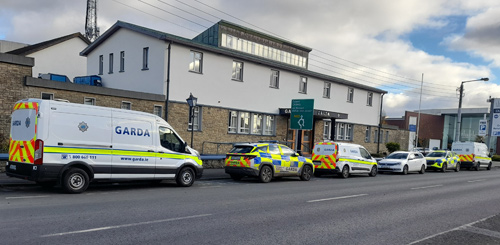
The staffing situation at Thurles Garda Station has been flagged by local people as being inadequate to meet the demands of the districts community. Thurles Garda station is indeed struggling from a lack of Garda manpower as our picture hereunder shows today, with Garda vehicles parked up due simply to the lack of Garda drivers.
A Rank of Garda Vehicles with no officers available to drive them.
In other areas we are aware from Oireachtas Data, that on some days of the week, there are only six Gardaí; (two in Newport-Killaloe, two in Nenagh on outside duty, and one or two in the Roscrea area), thus rendering the current situation in the north of Tipperary as being totally insufficient. This leads to the obvious concerns now being raised by our local community, regarding response times and the ability of Gardaí to continue to provide a visible, reassuring presence in the now Thurles sub-district.
At national level Senior Gardaí are constantly reviewing the allocation of resources solely in the context of operational need, crime trends and policing demands, e.g, Dublin City centre, however, no specific timetable for additional deployment of Gardaí to the Thurles area has as yet been publicly communicated.
Implications for the area within the Thurles sub-district and the overall Tipperary community.
The shortage of Garda personnel has several practical implications:
Fewer officers are available for community-based policing and visible patrols, thus undermining public confidence.
Potential delays in response to incidents, especially in Tipperary’s rural hinterlands served by the Thurles sub-district.
Administrative and procedural tasks (such as sign-offs for passport forms, motor-tax documentation) may become harder to obtain locally, increasing inconvenience for local citizens.
The burden on those Gardai on duty greatly increases, with fewer officers available for proactive policing, referrals and outreach.
What is now needed?
A clear commitment is now required from the Department of Justice and the Garda Commissioners’ office, regarding the allocation of additional Gardaí to be deployed in Thurles and required in the districts rural outlying stations.
Enhanced support for community policing models that allow for proactive engagement, rather than purely reactive responses.
Transparent monitoring of whether the new operational model being rolled out in the Garda service will result in more boots on the ground in Thurles, not continuous reduced cover.
Conclusion: The current staffing shortfall at Thurles Garda Station poses a legitimate concern for local residents especially the elderly. Without timely action to bolster numbers, there is a risk that both the visible policing presence and the capacity for community engagement will remain constrained. As the Garda service progresses with reforms and new deployment models, ensuring that rural and regional stations like Thurles are adequately resourced remains a matter of extreme urgency.
I searched the available public databases [including the An Garda Síochána and the Oireachtas (Parliament PQ records)] for station-specific deployment figures (e.g. cars, drivers, shifts) for Thurles Garda Station, but could not locate any recent publicly-released data that details:-
the number of patrol vehicles assigned to Thurles Garda station;
the number of available drivers or officers authorised to drive same vehicles;
the shift-cover breakdown for drivers/vehicles at Garda station:
Next Question: Are all our salaried Public Representatives still on Summer Holidays or have they hibernated for the Winter?.
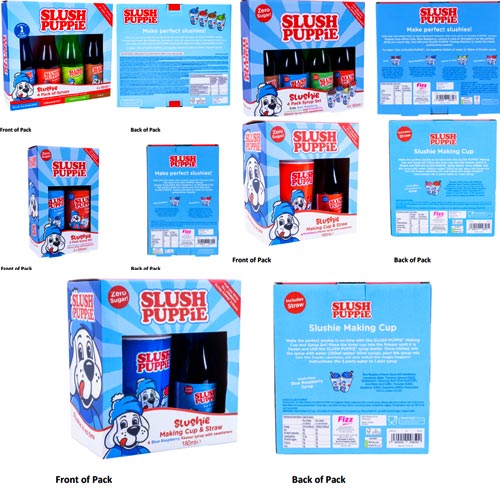
Recall of various SLUSH PUPPiE products due to elevated levels of glycerol.
Alert Summary Dated Friday, 24th October 2025.
Category 1: For Action. Alert Notification: 2025.58. Product Identification: Please see table below for product information. Batch Code: Please see table below for batch codes and best before dates. Country Of Origin: China.
Message: The implicated batches of SLUSH PUPPiE products listed below are subject to recall as they contain high levels of glycerol. Recall notices will be displayed at point-of-sale.
SLUSH PUPPiEProducts
Product name.
Pack size.
Batch code.
Best before date.
Item number.
SLUSH PUPPiE, Slushie 4 Pack of Syrups set, Blue Raspberry, Strawberry, Lemon & Lime and Cola flavours.
4 x 180 ml.
20672.
End 11/2026.
300178.
SLUSH PUPPiE, Slushie 4 Pack Syrup set; ZERO Sugar!; Cola, Blue Raspberry, Lemon & Lime and Strawberry Flavour Syrup with Sweeteners set
4 x 180 ml 300053 20459.
20181. 20459.
End 11/2025. End 03/2026.
300053. 300053.
SLUSH PUPPiE, Slushie 2 Pack Syrup set; ZERO Sugar!; Blue Raspberry & Strawberry Flavour Syrup with Sweeteners.
2 x 500 ml
20181.
End 11/2025.
300052.
SLUSH PUPPiE, Slushie Making Cup & Straw; ZERO Sugar!; & Strawberry Flavour Syrup with Sweeteners set.
180 ml.
20069.
End 07/2025.
300071.
SLUSH PUPPiE, Slushie Making Cup & Straw; ZERO Sugar!; & Blue Raspberry Flavour Syrup with Sweeteners set.
180 ml.
20006.
End 05/2025.
300045.
Nature Of Danger:Glycerol(E 422) is an approved food additive in the European Union (EU). It is used in slush ice drinks as a substitute or partial substitute for sugar and helps maintain the slushy texture by preventing the liquid from freezing solid. There is no maximum level set for its use in flavoured drinks, however, according to legislation, it must be used in foods at a level not higher than is necessary, to achieve its intended purpose. Because young children have a lower body weight, if they consume large quantities of glycerol in a short period of time, it is possible that some young children may experience side effects, such as headaches, nauseaand/orvomiting.
Retailers: Same are requested to remove the implicated batches from sale and display recall notices at point-of-sale. Wholesalers/Distributors: are requested to contact their affected customers and recall the implicated batches and provide a point-of-sale recall notice to their retailer customers. Consumers:Consumers are advised not to eat the implicated batches.
This website uses cookies to improve your experience. We'll assume you're ok with this, but you can opt-out if you wish.AcceptRead More
Privacy & Cookies Policy
Privacy Overview
This website uses cookies to improve your experience while you navigate through the website. Out of these, the cookies that are categorized as necessary are stored on your browser as they are essential for the working of basic functionalities of the website. We also use third-party cookies that help us analyze and understand how you use this website. These cookies will be stored in your browser only with your consent. You also have the option to opt-out of these cookies. But opting out of some of these cookies may affect your browsing experience.
Necessary cookies are absolutely essential for the website to function properly. This category only includes cookies that ensures basic functionalities and security features of the website. These cookies do not store any personal information.
Any cookies that may not be particularly necessary for the website to function and is used specifically to collect user personal data via analytics, ads, other embedded contents are termed as non-necessary cookies. It is mandatory to procure user consent prior to running these cookies on your website.







Recent Comments