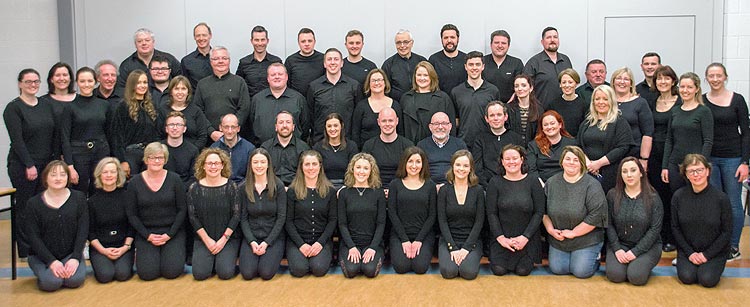
Thurles Muscial Society – Just some of the experienced Cast & Crew performing in the musical drama “Michael Collins”, all anxious to meet their audience for the first time on stage tonight, Tuesday 26/3/2019.
Even within the comparatively small community of Thurles Musical Society, the story of Michael Collins; the Treaty; the War of Independence and Eamon de Valera still resonates.
We could hardly have chosen a better year to stage a musical about his life and times given that the centenary of the Sologheadbeg incident, which kick- started the Irish War of Independence, commemorated just a few weeks ago just a few miles from our Cathedral Town.
The spotlight has certainly been cast upon the exigencies of those days, the fallout, the follow-up, the human tragedy and the loss of life, in a civil war which could be described as anything but civil.
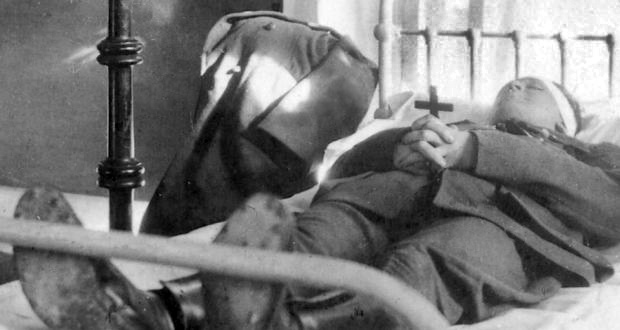
The bandaged body of Michael Collins with bloodied army jacket and Crucifix clasped in his fingers, before being prepared for final burial.
Michael Collins was out of the country at the time of the Sologheadbeg, Co. Tipperary incident, however his connections with Dan Breen, Sean Treacy, Seamus Robinson, Sean Hogan and the flying columns remained close. Many Tipperary freedom fighters were assigned duties in the capital when the heat was on back at home. A number took part in the killing of British intelligence agents in Dublin on November 21st 1920. Thirty-two people were killed or fatally wounded on that ‘Bloody Sunday’: thirteen British soldiers and police, sixteen Irish civilians, and three Irish republican prisoners.
The day began with an IRA operation, organised by Collins, to assassinate the ‘Cairo Gang’ – a team of undercover British intelligence agents working and living in Dublin. IRA members went to a number of addresses and killed or fatally wounded fifteen people: nine British Army Officers; a Royal Irish Constabulary Officer; two members of the Auxiliary Division; two civilians; and another man who is believed to have been an intelligence agent.
Later that afternoon, members of the Auxiliary Division, the Black and Tans, and RIC opened fire on the crowd at a Gaelic football match in Croke Park, Dublin, killing or fatally wounding fourteen civilians and wounding at least sixty others. That evening, three Irish republican suspects, latter being held in Dublin Castle were beaten and killed by their captors, who claimed they were trying to escape. Overall Bloody Sunday was considered a victory for the IRA, as the Collins operation severely damaged British intelligence, while the later reprisals did no real harm to the guerrillas; instead increasing support for the IRA both at home and abroad.
‘But, Bloody Sunday has many connections to this locality – not just for the fact that Tipperary were playing Dublin in a football tournament game at the time. Michael Hogan, a Tipperary player, was killed on the field – his name forever remembered these days through ‘The Hogan Stand’ in Croke Park. Also, Jim Ryan and Bill Ryan‘Laha’ from just out the road in Loughmore / Castleiney were on that Tipperary team and TMS has many connections with the parish of Loughmore Castleiney.
Furthermore, one of the umpires on Bloody Sunday was Thurles man John Joe Callanan, who would go on to captain Tipperary to win the 1930 All-Ireland hurling final (He was the only Tipperary man to win senior All-Ireland’s with two different counties at the time, having won an All-Ireland in 1920 with Dublin. Many of John Joe’s relatives are involved in Thurles Musical Society today, including Mary and Rita Callanan, and Gary Dempsey. John Joe hurled in Dublin with the Faughs club – Harry Boland played full forward for that club and was also chairman of the Dublin County Board from 1911-1916. Throughout this time too, the famous Bob Mockler of Horse and Jockey was a major influence for Faughs in what was their most successful era.
Back to John Joe; the story goes that he held a revolver in his pocket as he umpired the game for the Galway referee Joe Sammon. As people, particularly men of his age at the time, were being searched as they raced from Jones Road in a panic, which followed the shootings, John Joe disposed of the revolver, throwing it over a wall, and therefore getting away to tell the tale.
Further links to Michael Collins and our Society – Thurles man Denis Byrne was one of those who fired the gun salute at his funeral and also flanked the cortège, in uniform, as thousands lined the street to pay their final respects. Denis Byrne, father of legendary Tipperary hurler Mickey ‘Rattler’ Byrne, is great grandfather of John Hayes, who, ironically, plays the part of Harry Boland in our production.
There are many, many more local connections to Michael Collins, De Valera and the events which have framed our history – far too many to get into in this brief account. The happenings have left a real mark on our psyche and even within our on-stage company, it has been very interesting to see the dynamic of Collins people having to play anti-treaty roles and vice versa. As one quipped – “If my father was alive today he’d die of the shame.”
Perhaps though, what this show highlights more than anything else, is the sense of lost opportunity for our country. Had Collins and De Valera gotten back on track and together, where would we be today? It’s a question to which there are so many answers – the answers raising possibly even more and more questions.
History might all be in the past, but each expiring day is shaping our future more and more.
Yes, as Thomas Davis once stated, “Where Tipperary Leads, Ireland follows”.
Keith O’Dwyer-Greene(Michael Collins), Marie Therese Kirby(Kitty Kiernan) and John Hayes(Harry Boland) – three of the leads in the show which has been described as “The Irish Les Mis”
PRO & Vice Chairman for Thurles Musical Society, Mr Noel Dundon, reports:-
Award winning Thurles Musical Society is delighted to be staging the Musical Drama “Michael Collins”, by arrangement with the Michael Collins Production Trust.
The show will run in The Premier Hall, Thurles from Tuesday March 26th through to Saturday March 30th inclusive, with the curtain rising each night at 8:00pm.
This truly fantastic show; described by Director Oliver Hurley as “the Irish Les Mis”, was penned by the late Bryan Flynn with musical arrangements and orchestration by David Wray, and additional vocal arrangements and original musical direction by David Hayes.
It has already been staged to great acclaim this season by Coolmine Musical Society and Oyster Lane Musical Society, and Thurles will now seek to follow in their footsteps and bring this magnificent piece of theatre to a highly expectant audiences.
Thurles and Tipperary, of course, has many connections with the real life Michael Collins and the War of Independence. Indeed, Sologheadbeg in south west Tipperary is generally accepted to have been the location for the firing the first shots of the War of Independence one centenary ago this year, and though Collins was in the United Kingdom, breaking Eamon de Valera out of jail at that time, he was to include the likes of Dan Breen, Sean Treacy and Sean Hogan as members in his hit teams; latter known as flying columns, around the country later.
Loyalties Run Deep Across Political Divides
No matter where this show is staged, there will be many local angles to it. Indeed, within the cast of Thurles Musical Society there are many links to the Michael Collins story and loyalties run deep across both sides of the political divide with currently tremendous banter and commentary within the company as pro-Collins people end up in the anti-camp, and vice-versa as a result of the bass, tenor, alto, soprano divide. Surely Bryan Flynn never anticipated such a scenario as he consigned his thoughts to paper when writing this show. Or, maybe he did?
Front Line Cast
In any event Thurles Musical Society members are really enjoying their project and with a top-class front line, which includes Keith O’Dwyer Greene as Michael Collins, Cathal O’Donoghue as Eamon de Valera, Marie Therese Kirby as Kitty Kiernan, John Hayes as Harry Boland, Peter Donnelly as Joe Emmet, Frank Tuohy, Damian Sweeney, Nina Scott and Linda Ryan as the Abbey Theatre Players, Deirdre Hayes as Mother Ireland, and Jonathan Gleeson as Cathal Brugha, not to mention many more household names playing other roles; the audience is really in for a treat.
Mary Rose McNally is at the helm as Musical Director/ Conductor while Michelle O’Connell, Tommy Sweeney, Rita Dempsey and of course Oliver Hurley complete the production team.
This musical has attracted a company of more than fifty for Thurles, and the committee and those on stage are looking forward to welcoming all those who wish to come along to enjoy what is promised to be a top class production.
Booking Office
The Ticket Booking Office is now open for this major Thurles production at Bookworm, Liberty Square, (On the junction of Liberty Square and Parnell Street in the town). Tickets can also be booked on the Thurles Society Telephone at 085 2868726.
If you do only one thing this year to cast you mind back to the time of Collins and the War of Independence, attend this show. Expect to experience a truly theatrical tour-de-force.
“A Badly Wanted Man: The Story of Sean Hogan” by Tom Hurley.
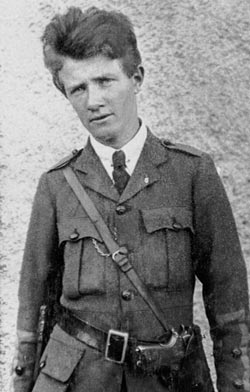
Sean Hogan (1921)
There will no doubt be much interest generated in the Premier County and further afield in an upcoming four-part documentary due to be aired on Tipp Mid West Radio, which investigates the life of IRA freedom fighter Sean Hogan, a native of Stokaun, Greenane, situated just outside of Tipperary Town, in Co. Tipperary.
Sean Hogan first gained notoriety as a teenager from his role in the Soloheadbeg and Knocklong engagements of 1919. He went on to become one of the most wanted men in the British Empire for the duration of this Irish revolutionary period. Hogan together with Dan Breen, Sean Treacy and Seamus Robinson made up what was known as “The Big Four”, and participated in numerous other IRA engagements, which will be highlighted in this radio broadcast.
When the civil war ended in 1923 Sean Hogan did his best to re-adjust to some sort of normal life, but at times down through the years found this exceedingly difficult to achieve. Possible reasons for this are examined in detail in these broadcasts, along with a look at his time spent in America; jail; later family life; vices, and the circumstances behind his death in 1968.
The programmes, which chronicle his whole life, also reflect on the reasons behind his move to live to the Leinster area; querying why he never in later years provided a written account of his revolutionary activities, as did so many of his former comrades. These radio broadcasts will conclude with a look at his legacy and how he is regarded in his native county today.
His life story is investigated and revealed through incorporating material taken from newspaper accounts; parish records; census records, together with genealogical documentation and interviews recorded in his native county and further afield.
Contributors to the programmes include his son Sean Hogan (Jnr); his grandson Treacy Hogan; historians John Connors (Borrisoleigh), Tom Toomey (Limerick) and Sean Hogan (Puckane). There are also interviews with Aileen Sweeney (a descendant of one of the RIC men killed at Soloheadbeg); Anne Power (Tipperary Town); Cormac O’Malley (son of Ernie O’Malley) and Micheál Martin (Cork).
Overall there is a lot of new information contained in these programmes and light is shed on the lasting effects that involvement in the independence struggle had on many of the leading participants.
The four-part documentary entitled “A Badly Wanted Man: The Story of Sean Hogan” by Tom Hurley will be aired at 11.05am on May 16th, 17th, 18th & 19th on Tipp Mid West Radio.
A reminder to all Tipperary residents regarding recycling of old electrical appliances!
WEEE Ireland(Waste Electrical and Electronic Equipment) will be collecting, free of charge, old and broken electrical appliances, county-wide over the next 4 week period.
Remember WEEE material is anything with a plug normally attached and WEEE Ireland will be making their next collection on Saturday May 2nd 2015 between the hours 10.00am and 4.00pm. Central collection areas chosen on the above date for North Tipperary are: – Thurles – from the Mid-Tipperary Mart Yard, Stradavoher, Thurles, and Templemore– from Templemore Town Car Park, Main Square, Templemore.
In South Tipperary the next collection will be Saturday April 23rd 2015, again between the hours 10.00am and 4.00pm. Central collection area for South Tipperary on the above latter date will be in Tipperary town at Dan Breen House, Tipperary.
Remember: TVs and their Aerials, Radios, Microwaves, IT Equipment, Dishwashers, Cookers, Fridges, Freezers, Power Tools, Vacuum Cleaners, Battery Operated Toys, Electric Toothbrushes, Kettles, Toasters, Batteries and all other associated items are totally acceptable.
So here is the perfect opportunity to bring along your old electrical appliances, currently left clogging up your shed /garage and have same recycled. Remember this is a completely FREE service, which eliminates that temptation to dump illegally in our most beautiful of Irish counties, Co. Tipperary.
Borrisoleigh Historical Society: Delia Ryan reports.
Local man, John Connors of Rathmoy will be the guest speaker at the next series of history lectures presented by the Borrisoleigh Historical Society on Tuesday, December 2nd 2014, beginning at 8.00 pm in the Community Centre, Borrisoleigh, Co Tipperary.
John has researched extensively on the life of Tipperary man, Sean Hogan, (13 May 1901 – 24 December 1968) who was rescued on May 12th 1919 from a train at Knocklong, by his more famous IRA comrades, Sean Treacy, Séamus Robinson, Séan Lynch, Dan Breen and four other men from the IRA East Limerick Brigade.
Some of these rescuers later relocated to Dublin and undertook a range of missions under the direction of the Dublin leadership. Some of these missions were in association with a unit known as ‘The Squad,’ originally nicknamed the “Twelve Apostles,” founded by Michael Collins to counter the British intelligence efforts during the Irish War of Independence, mainly by means of assassination.
Although not yet fully eighteen years of age, Sean Hogan was one of the most wanted men in the British Empire, following the Soloheadbeg attack on January 21st 1919, in which two RIC men were killed.
This daring and deadly rescue (two RIC escorts were shot dead there also) had its origins adjacent to Borrisoleigh parish, as Hogan had been captured at Meagher’s of Annfield, by RIC Sergeant Peter Wallace from Roskeen, in an early Monday morning raid.
While many may be aware of this famous and significant event, few will know about the life of the young man who entered the history books from the Soloheadbeg and Knocklong episodes. As well as bringing us a reprise of these more famous events, John Connors will fill the gap about the further periods of Hogan’s early life and his active IRA service in both Dublin and Tipperary, as well as what became of him after the troubled times, with his well-illustrated lecture.
The lecture will be introduced by Puckane historian Sean Hogan, latter author of the much acclaimed “The Black and Tans in North Tipperary – Policing, Revolution and War – 1913 -1922”.
This website uses cookies to improve your experience. We'll assume you're ok with this, but you can opt-out if you wish.AcceptRead More
Privacy & Cookies Policy
Privacy Overview
This website uses cookies to improve your experience while you navigate through the website. Out of these, the cookies that are categorized as necessary are stored on your browser as they are essential for the working of basic functionalities of the website. We also use third-party cookies that help us analyze and understand how you use this website. These cookies will be stored in your browser only with your consent. You also have the option to opt-out of these cookies. But opting out of some of these cookies may affect your browsing experience.
Necessary cookies are absolutely essential for the website to function properly. This category only includes cookies that ensures basic functionalities and security features of the website. These cookies do not store any personal information.
Any cookies that may not be particularly necessary for the website to function and is used specifically to collect user personal data via analytics, ads, other embedded contents are termed as non-necessary cookies. It is mandatory to procure user consent prior to running these cookies on your website.












Recent Comments