Business conducted in Liberty Square depends solely on ‘Footfall’ being increased. Increased footfall results in selling that extra bar of chocolate; packet of crisps; pint of beer; that fashionable ladies top; that gentleman’s shirt and that cup of tea or coffee. Most often it is the collection of a number of small attractions that culminates; thus, reaching a climax or point of highest development in desired footfall; yes, and even more importantly, added employment.
On December 7th 2018, at 09:52am I sent an email to the following elected County Councillors:
Just seven (7) minutes later Cllr. Sean Ryan, [seano.ryan@tipperarycoco.ie] Littleton, replied as follows:-
“Will do George and revert to you. Best wishes, Sean.”
I replied at 10:40am on same date:-
“Hi Cllr. Sean, I will be happy to further assist in the back ground, should support be requested. I will also assist in the funding. Regards ….”
Three days later Cllr. Jim Ryan [jim.ryan@tipperarycoco.ie] replied.
“Hi George I think your proposal should be supported. I have no problem in talking to relevant people in council if you want me to do so. I am a firm believer in highlighting and remembering all those people who have contributed to our history. If you want to meet up I would be delighted to do so. Jim Ryan.”
No other Councillors replied, despite the email being refreshed.
But even more surprisingly, not even one solitary Councillor who received my email, has come back to me since December2018 last, to inform me of Tipperary County Council’s final decision.
Your advice please as to which candidate I should give my No.1 Vote in the Local Elections on Friday May 24th 2019.
The Thurles.Info website sits comfortably on Page 1 of all search engines for those worldwide, using the search word ‘thurles‘. It will be read by well over 80,000 people at least, come the morning of Friday May 24th 2019. In the meanwhile, here is the perfect opportunity and an open invitation to all Councillors, and pretenders to the throne, to send us full details of their achievements to date, over the past five years, since being successfully elected. We will then check and confirm your claims and report on your worth accordingly.
So, it’s a certainty; An Post is moving to the shopping centre for definite; that’s despite the intervention from the most powerful in our community; namely the politicians, local councillors, those who would like to be local councillors and politicians and a disorientated, dying, Chamber of Commerce, all intent on riding a dead horse.
Together, however, they did have some success; mainly driving home a wedge; dividing Thurles town into two sections, instead of working to improve Liberty Square and Thurles Town as a single unit.
One wonders if the current 127 workers plus business proprietors / owners in the Thurles Shopping Centre, will now be rushing out to an upcoming local election, to vote for party’s like Fianna Fáil or the ‘Party of Protest’ (The Bully Party) and certain Independent representatives, all who attempted to directly affect very limited, local, yet available employment.
The Dead Horse Theory
The efforts undertaken by the “Save Our Square”[S.O.S.] committee had all the hallmarks of the “Dead Horse Theory”, so often attempted by Government TD’s and Local Councillors. Indeed, the tribal wisdom of the Dakota Indians, which has been passed down from generation to generation, clearly states, “When you discover that you are riding a dead horse the best strategy is to immediately dismount”.
Ignoring the fact that Tipperary County Council, of which many of the S.O.S. committee are card carriers; same are solely responsible for the decline of Thurles town centre and other towns in Co. Tipperary, through the introduction of Parking Charges. Again, ignoring this logical, simple fact the “Save Our Square” committee choose to attempt a new strategy in their dealings with An Post, the now dead horse:-
(1) They bought a stronger whip. (2) Changed Riders. (3) Threatened the dead horse with termination. (4) Appointed a committee to study the horse. (5) Discussed the feasibility of sending councillors to foreign countries to see how other riders rode their dead horses. (6) Provided further additional funding to improve the dead horse’s performance through the introduction of a dodgy “Dead Horse acquisition and refurbishment fund”.
Now, with election votes dangerously reduced, this dead horse is most likely to be promoted to a supervisory post, enabling it to hire a replacement horse.
The solution to the Thurles town centre decline, which will correct this imbalance, is simple; call a halt to the payment of parking charges, before yet more businesses are forced out of our town centre.
Tipperary Co. Council built six social houses at Cabragh, Thurles, at a cost of some €370 thousand Euro each. We saw recently the Peter McVerry Trust acquiring 25 social houses for €5million through a generous donation made by the Dublin Capuchin Day Centre. Do your arithmetic folks; €5 million divided by 25 = €2 hundred thousand Euro. These units were purchased in Dublin and Kildare (the most expensive accommodation areas in Ireland). It is my opinion that Tipperary Co. Council are simply burning taxpayer’s money and frankly do not need parking charges to fund local government.
“Whoever has ears to hear, let them hear.” – St. Mark Chapter 4. Verse 9.
More advice for ailing Local Councillors and Politicians in our next news bulletin.
Tipperary Independent TD Mr Michael Lowry has confirmed that he has had discussions with Minister Richard Bruton yesterday, with regard to the decision by An Post, to re-locate Thurles Post Office.
Deputy Lowry stated, “I was adamant that it was not a sustainable position for the Chairman and Chief Executive of An Post to refuse my previous request for a direct meeting with their two most senior personnel in that company, latter who are directly responsible for the delivery of policy and implementation relating to company decisions.
I have now been advised by the Minister’s Office and An Post that the Chairman and Chief Executive, have both agreed to meet with myself and my four Oireachtas colleagues, next week.”
The Deputy concluded by saying that he welcomed this opportunity to debate fully this grossly unpopular decision, effecting Thurles town centre, introduced by An Post; while also gleaning a detailed explanation as to the reasons why this decision was taken in the first place and if at all possible, to try to find a compromise in this ongoing debacle.
They began gathering from 10.00am this morning, one hour before the start; the elderly, the retired, local councillors and politicians past and present, the unemployed, business owners and their staff, non-examination year students; all protesting at the decision by An Post, to move its current offices out of Liberty Square to the Thurles Shopping Centre.
They gathered in brilliant, warm, sunshine; most certainly the largest protest group ever to assemble in this rural town in the last 30 year; attracting both local and national media attention, through the attendance of radio, TV and press personnel.
Speaking to many who attended the protest rally, much criticism was being heaped on the present Fine Gael government, with individuals privately and publicly singling out the Minister for Communications, Climate Action and Environment, Mr Richard Bruton for his failure to intervene in An Post’s Dublin decision.
But most blame seemed to be directed to the doorstep of Tipperary Co. Council, the latter blamed for initially driving small and medium sized retailers from Liberty Square, by introducing parking charges, while three large global discount supermarkets on the very outskirts of Thurles, remained in a position to offer large scale free parking spaces.
Many were also critical of the removal of the once thriving Liberty Square market, latter removed to new trading areas at the entrance to Parnell Street carpark.
Meanwhile, the organisers of today’s protest rally, confirmed that they will continue the battle to save Liberty Square, and if at all possible, try to keep An Post and their services, within the very heart of Thurles town.
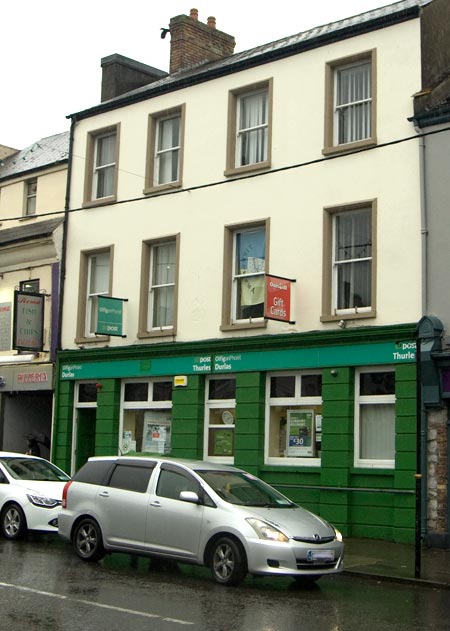
New premises to which An Post is expected to set up shop.
The ‘Stop the Move – Save our Square’ action committee here in Thurles have announced their intention to hold a public rally; same to take place on Friday morning, March 29th next.
The rally will start at 11.00am on Friday morning; with protesters first assembling in the area of the Parnell Street Car Park. Those attending will then make their way out onto Liberty Square, following a route around the Square, before halting outside the current An Post offices.
An Post has repeatedly proclaimed their now existing work premises in Liberty Square as not being ‘fit for purpose’ and also that it would not be financially cost effective to undertake any necessary renovation.
An Post representatives also informed the ‘Stop the Move – Save our Square’ action committee, on Wednesday last, at what was described by the latter as “a disappointing meeting”, that a lease agreement had already been signed to rent their new premises; same having been already selected 500 metres away in the Thurles shopping centre.
The organisers are encouraging as many people as possible to come out in force for this rally, thus sending a message to An Post officials that remaining businesses wish the An Post office to remain at its present location, attracting continued footfall in the town centre area.
A post of Minister for Posts and Telegraphs initially took on the responsibility for Ireland’s postal and telecommunications services for some 60 years, from 1924 right up until 1984. One of the largest civil service departments in the Irish State at its apex; attempts to reform this sector were began in 1978, with the creation of a Posts and Telegraphs Review Group.
Following the delivery of a report from the latter in 1979, same then led to the creation of An Bord Poist, then chaired by Mr Feargal Quinn, and An Bord Telecom, then chaired by Mr Michael Smurfit. Both entities continued to trade until they were replaced in 1984, as state-sponsored agencies.
Its powers and responsibilities were transferred to the newly created Department of Communications. This was one of the largest reorganisations of the civil service in modern times, the old department having had a workforce of some 30,000 employees prior to its dissolution. With the transfer of personnel to the new agencies, the number of civil service employees were almost halved overnight.
Thus An Post, our Irish postal administration, first came into being in 1984 when, under the terms of the Postal & Telecommunications Services Act of 1983, the Post Office services of the Department of Posts and Telegraphs (P&T) were divided between An Post and Telecom Eireann; with the telecommunications operator today known as Eir.
Thurles Post Office moved once before, previously having existed on the south side or ‘Money Side’ in that building known today (2019) as The County Bar, before moving across the road to the north side; where it is presently located on the ‘Sunny Side’.
The positioning of Thurles Post Office during the latter half of the 1800’s, in the then Main Street of Thurles, now renamed Liberty Square.
It was at its present location that, in 1902, the great, late General Richard (Dick) Mulcahy joined the post office’s engineering department, working first here in Thurles. Elected to the First Dáil in the 1918 General Election for Dublin / Clontarf, Mulcahy was appointed Minister for Defence in the new (alternative) government and later to the post of Assistant Minister for Defence. In March 1919 he became IRA chief of staff, a position he held until January 1922. It was he, who together with Michael Collins, was instrumental in developing IRA military strategy against the British, during the War of Independence. General Richard Mulcahy of course was buried following his death (16th December 1971) in Ballymoreen Cemetery, Littleton, Thurles, Co. Tipperary.
This website uses cookies to improve your experience. We'll assume you're ok with this, but you can opt-out if you wish.AcceptRead More
Privacy & Cookies Policy
Privacy Overview
This website uses cookies to improve your experience while you navigate through the website. Out of these, the cookies that are categorized as necessary are stored on your browser as they are essential for the working of basic functionalities of the website. We also use third-party cookies that help us analyze and understand how you use this website. These cookies will be stored in your browser only with your consent. You also have the option to opt-out of these cookies. But opting out of some of these cookies may affect your browsing experience.
Necessary cookies are absolutely essential for the website to function properly. This category only includes cookies that ensures basic functionalities and security features of the website. These cookies do not store any personal information.
Any cookies that may not be particularly necessary for the website to function and is used specifically to collect user personal data via analytics, ads, other embedded contents are termed as non-necessary cookies. It is mandatory to procure user consent prior to running these cookies on your website.







Recent Comments