Accepting the award at the ceremony in Dublin, Ms Buckley described the past year as a “roller-coaster” and said it was an honour to “come home” to celebrate with the Irish creative community, reflecting on how storytelling, music and art shaped her upbringing.
In her remarks, she also paid tribute to her co-star Mr Paul Mescal, who portrays Shakespeare in the film, adding that she loves him. Mr Mescal was named Supporting Actor (Film) for Hamnet , but was not present to collect the award. Hamnet was among the night’s standout winners, also receiving the International Film award and Script (Film) honour and shared between Ms Maggie O’Farrell and Ns Chloé Zhao.
Ms Buckley, who formerly attended the Ursuline Secondary School here in Thurles, has also been recognised during the current awards season for her work in Hamnet, including major international nominations.
EPA announces funding of €6.5m for new research to address climate and environmental policy needs.
EPA announces funding of €6.5 million for 24 new research projects in the areas of:
climate change,
the natural environment,
the green & circular economy and
the environment & human health.
The funding will address emerging research needs of policy makers in Ireland and respond to identified knowledge gaps for policy development and implementation.
In terms of building research capacity, the funding will support 148 research staff across 10 Higher Education Institutions and will have a wide reach through 34 collaborating organisations across the public and private sectors in three different countries.
Reflecting the cross-sectoral nature of environmental and climate policy, the EPA is working in partnership with Met Éireann and the Office of Public Works to co-fund a number of the research projects.
The Environmental Protection Agency (EPA) today announced new funding for environmental and climate research in Ireland, with funding of €6.5 million awarded for 24 new research projects. As well as addressing key knowledge gaps, these innovative projects will support the development of vital research capacity and expertise in strategically important areas.
Research plays a critical role in informing robust policy and decision-making as set out in Ireland’s Research and Innovation Strategy, Impact 2030. The EPA Research Programme has an established focus on policy-relevant research addressing identified knowledge gaps relevant to environmental and climate policy. The outcomes of the EPA Research Call 2025 will contribute to the evidence base for environmental policy in Ireland, strengthen connections between the research and policy communities and deliver positive environmental outcomes.
Projects that will receive EPA funding this year include topics such as:
Assessing impacts of national policies on climate targets
Use of technology in peatland monitoring
Impacts of dams and barriers on rivers and lakes
Streamlining Strategic Environmental Assessment (SEA) through the use of AI
Greening of laboratory analysis protocols and
Greater understanding of sources and sinks of methane
Announcing the funding awards, Dr Eimear Cotter, (EPA Deputy Director General) said: “We face complex challenges in becoming a resilient, competitive and sustainable society. Research, such as that funded through the EPA Research Call, will play a vital role in supporting robust policy- and decision-making while ensuring the protection of our environment and climate. The projects announced today will support targeted, policy‑relevant research and build connections with policy-makers and practitioners, and ultimately support more effective action. I congratulate the successful teams and look forward to seeing the positive impacts of their work.”
The latest EPA funding is significant in terms of further building environmental research capacity in Ireland. It will support 148 research staff across 10 Higher Education Institutions and will have a wider reach through 34 collaborating organisations across the public and private sectors in three different countries. University of Galway received the highest number of successful research awards in 2025.
Commenting on the announcement, Mr Aengus Parsons, (Vice-President for Research and Innovation (Acting) at University of Galway), said: “Our researchers are to be commended for their vision and dedication to addressing the urgent environmental challenges of our times. We thank the Environmental Protection Agency for this support, which strengthens our commitment to research and innovation around sustainable and resilient environments. I look forward to seeing these projects progress to impacts across climate policy, coastal risk, air quality, emissions reduction, peatland resilience, the bioeconomy, and water quality.”
Reflecting the importance of collaboration in addressing climate and environmental challenges, the EPA is working in partnership with Met Éireann and the Office of Public Works to co-fund a number of projects in areas including flood probability, flow statistics for our rivers and climate modelling.
The list of funded projects made under the EPA Research Call 2025 is available on the EPA website. The EPA Research Programme is a Government of Ireland initiative funded by the Department of the Environment, Climate and Communications. Details of the EPA Research Call 2026 will be made available on the EPA website.
The Irish government (Cabinet) is due to consider a new digital and AI strategy this week, and the standout proposal is the Government’s intention to legislate to restrict social media access for those under 16 years old. The political context matters. Ireland is heading into its EU Presidency (July–December 2026) and online safety is being positioned as a priority. The strategy is expected to reflect a familiar line: Ireland would prefer EU-wide rules, but will take national action if Europe moves too slowly.
Enforcement, Not Slogans. The key question isn’t whether protecting children is important, it’s how the State can make any restriction meaningful. Last year’s plan for a “digital wallet” age-verification pilot points to the enforcement challenge. An under-16 restriction is only as strong as the age assurance behind it. If access is still controlled by “enter your date of birth”, then the ban becomes more of a headline than a barrier. But age checks raise a second concern, that of privacy. Any system must avoid becoming an online ID-by-stealth, or creating new data trails for children and families. If the public believes age verification means uploading identity documents for everyday apps, trust will evaporate quickly.
Algorithms are moving to centre stage. One of the most significant elements of this debate is the focus on “recommender systems”, the algorithms that decide what users see next, i.e. instead of showing you posts in simple time order, the platform uses algorithms to predict what will keep you watching/scrolling/clicking and then automatically serves more of that. The Joint Oireachtas Committee on Artificial Intelligence has urged that “recommender systems” should be off by default, and that platforms should be prevented from switching them on for children’s accounts. This goes beyond moderation and into product design, the mechanics that can drive compulsive use, extreme content pathways, and unhealthy comparison. If Government wants to reduce harm, recommender controls may prove more effective than an age line on its own.
The wider EU backdrop. The strategy also comes as European regulators intensify scrutiny of platforms and AI systems. It includes discussion about engaging the European Commission to ensure the EU AI Act’s prohibited practices remain fit for purpose as AI capability grows. At the same time, Big Tech is lobbying hard. Meta has told Government it should prioritise efforts to scrap the planned EU Digital Fairness Act, which is expected to target addictive design and dark patterns. That alone signals where the next regulatory battles will be fought, not just content, but the way products are built.
Will it work? Supporters say an under-16 restriction is a clear, protective line that reflects what many parents want. Critics, including CyberSafeKids CEO Mr Alex Cooney, argue a blanket ban could be porous, children will find workarounds and that it risks shifting responsibility onto families, rather than forcing platforms to reform. Ultimately, Ireland will be judged on outcomes. If this is to be more than a headline, it needs three things, workable age assurance, credible privacy safeguards, and real obligations on platforms, especially around said “recommender systems” and addictive design.
Opinion: the ban headline isn’t enough, tackle harm by design. An under-16 ban is an easy political sell. But it risks becoming a comforting story we tell ourselves while the underlying machinery remains untouched. The platform problem isn’t mainly that teenagers exist online. It’s that many products are engineered to maximise attention, and the fastest way to do that is through emotional escalation, endless recommendations, and compulsive loops.
If Ireland wants a serious policy, it must do more than draw a line at 16. Age assurance has to be privacy-preserving, not a backdoor ID requirement. And the real test of ambition will be whether Government is prepared to confront “recommender systems“, the very engines that push users from one piece of content to the next. A mature approach would target companies, not children, transparent design rules, meaningful enforcement, and algorithmic limits for minors. Otherwise, we’ll get a strong headline, and the same problems, just simply shifted around.
The decision by Minister for Education and Youth, Ms Hildegarde Naughton to pause the SNA allocation review is being presented as calm, careful engagement. In reality, it reads like an emergency brake pulled after the system lost public confidence. The Department today has now halted all review changes, including cases where schools had already been notified of reductions, and has halted further letters being distributed, until further talks conclude.
That climbdown matters because the damage was not theoretical. By mid-February, national reporting indicated a substantial number of schools had been advised of proposed reductions for September 2026, with reviews still ongoing across the system. In places like County Tipperary, where schools already balance long travel distances, limited specialist services and stretched staffing, even the suggestion of a cut can trigger immediate anxiety for families and staff, because replacing supports is rarely straightforward, and delays have real consequences.
The most serious criticism is not that reviews exist, but that the review appears to be anchored to a narrow definition of “primary care need”, while schools are trying to deliver genuine inclusion in busy, complex classrooms. This approach may suit an administrative model, but it struggles to reflect the daily reality of autism, anxiety, communication needs, sensory overload, behavioural regulation and safety supports that keep children present, learning and well in school.
Even where Government insists overall SNA numbers are rising nationally, parents do not experience “national totals”. They experience whether support exists in their child’s classroom, in their school, on their timetable, from next September. For principals, the immediate issue has been the uncertainty; letters arriving without clear explanations that schools and communities can trust, and an appeals-based system becoming the default route to preserve basic supports.
The result is a familiar pattern; schools forced into scramble mode, families left fearful, and SNAs living with insecurity, while Ministers attempt to restore confidence after the fact.
If Ireland can fund the world, it can fund inclusion here at home. Government has pointed to significant overall spending on special education and additional SNA posts. But the public anger here is rooted in a simple perception; children with additional needs are being treated as a variable in a resourcing exercise, rather than as young citizens, whose right to education should be guaranteed in practice, not merely promised in policy statements.
This is where the old phrase about Ireland as the “land of saints and scholars” starts to ring hollow. A country that prides itself on education should not run a core disability support through a process that leaves parents hearing developments informally, or forces schools into repeated fights to keep what they already have.
Political contrast is unavoidable. The State can move quickly and confidently when funding priorities relate to foreign policy, international commitments, or expanding the national footprint abroad. In Budget 2026, the State found record allocations to project Ireland abroad; a record €840m in overseas development assistance and new funding for expanded diplomatic footprints, championed by Mr Simon Harris, through the Department of Foreign Affairs and Trade. It also committed a record €1.49bn for defence, through the Department of Defence. Separate reporting has put Ireland’s support to Ukraine since 2022 at €467m, with further commitments announced in late 2025. Those decisions may be defensible in their own right, but they sharpen the question parents keep asking; “Why does the system struggle so visibly when it comes to getting certainty right for children with special educational needs here at home?”
That question lands sharply at local level. In County Tipperary, as in many counties, schools are not arguing for luxury supports. They are arguing for stability, the ability to plan staffing, to avoid disruptions for vulnerable children to prevent September becoming a cliff-edge, where SNAs are central to keeping children safe, regulated and able to access learning, the idea of “review first, reform later” feels somewhat backwards.
The pause must not become a temporary quietening of the headlines, before the same review process returns with slightly amended language. If Government is serious about inclusion, it should redesign allocations around individual need, transparency, and proper multi-disciplinary supports and not around a narrow definition of care and an appeals mechanism that schools rely on to prevent harm.
If Ireland wants to be a land of scholars again, it needs to start by proving, in real staffing decisions, that children who need support will have it, without panic, without uncertainty, and without having to fight for it, every upcoming year.
Cashel Branch Librarian Ms Maura Barrett Reports:-
Children Events this week in Cashel Library.
1. The next meeting of the Juvenile Book Club will meet on tomorrow, Tuesday, February 17th, 6:30pm to 7:00pm. Please Contact Tel: 062-63825.
2. Join us on Friday, February 20th, from 10:00am to 10:30am, for a fun and Cozy Story Time. Enjoy the magic of books and quality time together! To book your spot or learn more, Please Tel: 062-63825.
3.LEGO Free Play in Cashel Library! (Strictly 7 years +). Join us for creative fun on Fridays: Feb 20th from 3:30pm to 4:15pm. Build, play, and let your imagination soar! Booking required: Tel: 062-63825.
Adult Events this week in Cashel Library.
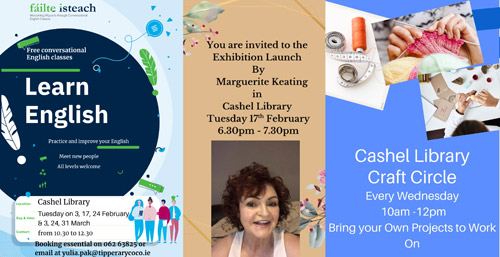
1. There are free conversational English classes in Cashel Library – Tuesday morning at 10:30am. Practice and improve your English, Meet new people. All levels welcome. Contact Tel: 062-63825 or email cashellibrary@tipperarycoco.ie
2. Cashel library invites you to the Exhibition Launch of artwork by Ms Marguerite Keating on TuesdayEvening, February 17th, at 6:30pm. Refreshments Served. All are welcome.
3. Join the Cashel Craft Circle every Wednesday morning, from 10:00am to 12:00pm, for their weekly social gathering. Bring along your own project to work on, share ideas, patterns and enjoy a chat and a ‘cuppa’ with others. No need to book, just come along. Cashel library Tel: 062-63825.
This website uses cookies to improve your experience. We'll assume you're ok with this, but you can opt-out if you wish.AcceptRead More
Privacy & Cookies Policy
Privacy Overview
This website uses cookies to improve your experience while you navigate through the website. Out of these, the cookies that are categorized as necessary are stored on your browser as they are essential for the working of basic functionalities of the website. We also use third-party cookies that help us analyze and understand how you use this website. These cookies will be stored in your browser only with your consent. You also have the option to opt-out of these cookies. But opting out of some of these cookies may affect your browsing experience.
Necessary cookies are absolutely essential for the website to function properly. This category only includes cookies that ensures basic functionalities and security features of the website. These cookies do not store any personal information.
Any cookies that may not be particularly necessary for the website to function and is used specifically to collect user personal data via analytics, ads, other embedded contents are termed as non-necessary cookies. It is mandatory to procure user consent prior to running these cookies on your website.









Recent Comments