|
|
 Up to 100 members of An Garda Siochana, assisted by officers from Revenue Customs, have seized an estimated €13,500 worth of drugs, across the Munster region, following searches of 29 premises today. Up to 100 members of An Garda Siochana, assisted by officers from Revenue Customs, have seized an estimated €13,500 worth of drugs, across the Munster region, following searches of 29 premises today.
A Garda spokesperson has confirmed that the focus of today’s operation was mainly for intelligence gathering, as part of their ongoing operation targeting the sale and supply of drugs in the southern region.
During the planned Garda swoops, which took place here in Tipperary, Cork and Limerick, a total of €8,000 in cash was also seized.
Gardaí from the Limerick Divisional Drugs Unit, assisted by local Garda units and the Garda Dog Unit, executed search warrants for a total of 29 premises and arrested three men, latter understood to be in their 30’s, and associated with, pending analysis, the possession of suspected cocaine and cannabis herb.
The individuals arrested are currently being detained at Henry Street and Bruff Garda Stations, in Co. Limerick, under Section 4 of the Criminal Justice Act 1984.
 Twenty-four Trainee Gardaí, all currently based at the Garda Training College here in Templemore, Co. Tipperary, took part in the manning of a total of 43 Garda checkpoints in the Kilkenny/ Carlow Division, with each checkpoint targeting the movement of local criminal groups. Four vehicles were seized under aspects of the Road Traffic Acts. Twenty-four Trainee Gardaí, all currently based at the Garda Training College here in Templemore, Co. Tipperary, took part in the manning of a total of 43 Garda checkpoints in the Kilkenny/ Carlow Division, with each checkpoint targeting the movement of local criminal groups. Four vehicles were seized under aspects of the Road Traffic Acts.
The operation was led by experienced Gardaí from the Carlow/ Kilkenny Division, assisted by the Armed Support Unit.
As part of Operation Thor’s ‘Project Storm’; twenty-two people were arrested by Gardaí during this policing initiative, aimed at preventing crime, disrupting criminal activity and enhancing community engagement. The arrests were made during a day-of-action in the Thomastown area today 24/10/2018.
Of the twenty-two arrested, thirteen people have been charged, 5 released with a file to be sent to the Director of Public Prosecutions and 1 person has appeared in Waterford District Court. A further 3 people were arrested in respect of outstanding warrants issued by the Court system.
A number of Fixed Charge Processing Notices (FCPNs) were also issued to drivers for a variety of breaches of the Road Traffic Act.
A number of community engagement activities took pace during the day, including road safety workshops at a local schools. The Garda Mounted Unit also visited a number of primary schools in the area.
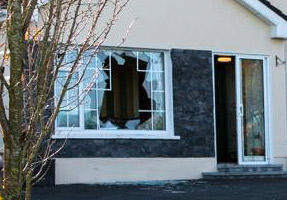 A former model aged 23, and the wife of Mr Patrick Joyce, latter jailed for 14 years for his part in an aggravated burglary at the Corcoran home in Burnchurch, Killenaule, Co Tipperary, was told by a judge that she was part of a contrived accident that led to claims by herself and three of her sisters-in-law, for damages totalling €240,000. A former model aged 23, and the wife of Mr Patrick Joyce, latter jailed for 14 years for his part in an aggravated burglary at the Corcoran home in Burnchurch, Killenaule, Co Tipperary, was told by a judge that she was part of a contrived accident that led to claims by herself and three of her sisters-in-law, for damages totalling €240,000.
Mrs Julieanne Joyce (23) and her sister-in-laws were ordered last June to pay legal costs, which are expected to total almost €100,000, following the throwing out of all claims by Mr Justice Terence O’Sullivan in the Circuit Civil Court.
Mr Patrick Joyce, from Beaumont Hall, Beaumont Woods, Dublin 9, was among a total of 7 such individuals, including Mr Dean Byrne, aged 22, with an address at Cabra Park, Dublin 17; Mr Patrick Gately, aged 28, with an address at Primrose Grove, Darndale, Dublin 17; Mr John Joyce, aged 19, from Lentisk Lawn, Donaghmede, Dublin; Michael McDonagh, aged 22, from Tara Lawns, Belcamp Lane, Coolock, Dublin 5; Thomas Flynn, aged 19, Moatview Avenue, Coolock, Dublin 5, and Donal O’Hara, aged 21, from Glin Park, Coolock, Dublin 5; who all pleaded guilty to their crime.
The gang had been found guilty on October 1st, 2015, of breaking into the Corcoran home, armed with a sawn-off shotgun, a handgun and a machete, (Latter a broad bladed implement used in combat, like a short sword). Mr Mark Corcoran had suffered a fractured eye socket and a broken nose, from a blow from one of the raiders guns. This had resulted in him later undergoing four separate surgeries in an effort to reconstruct his face. Children, who were present in the house at the time of the robbery, were also threatened with death.
This attack, combined with numerous others robberies on those currently resident in rural Ireland, eventually lead to a meeting of some 2000 unhappy Tipperary people; held in the Anner Hotel, in October 2015. The purpose of this meeting; to rebuke the then FineGael /Labour Government over the lack of Garda resources in Co. Tipperary. The meeting in turn led to the setting up by An Garda Síochána of ‘Operation Thor’, sanctioned by government in November 2015.
Two of the afore mentioned criminal gang, namely Mr Patrick Gately, who had 85 previous convictions, and Mr Dean Byrne who had 120 previous convictions, both had their original sentences reduced from 16 years imprisonment to 14 years.
Judge O’Sullivan informed Ms Joyce that her case taken against the Motor Insurers’ Bureau of Ireland (MIBI) and a taxi driver, had all the hallmarks of an exaggerated claim to maximise injuries. The Judge noted and accepted that the four women in question had remained within the vehicle moaning, following this contrived collision, resulting in firemen removing the vehicles roof because of alleged spinal injuries.
The 23 year old Mrs Julieanne Joyce, with an address at Edenmore Walk Apartments, Raheny, Dublin; together with her sisters-in-law Kathleen O’Reilly aged 30, from Clongriffen, Dublin; Elizabeth Ward aged 28, from Priorswood, Coolock, Dublin, and Philomena Joyce aged 19, of Moatview Avenue, Dublin, had all sued the defendants for €60,000, arising from this contrived rear-ending on May 5th, 2014, on Clonshaugh Road, Dublin.
 Investigations are ongoing, following the seizure by Gardaí of the recreational drug (Diamorphine C21H23NO5), with an estimated street value of some €90,000. One man was arrested during this planned operation, which continues to successfully target the sale and supply of drugs here in Co. Tipperary and Co. Kilkenny. Investigations are ongoing, following the seizure by Gardaí of the recreational drug (Diamorphine C21H23NO5), with an estimated street value of some €90,000. One man was arrested during this planned operation, which continues to successfully target the sale and supply of drugs here in Co. Tipperary and Co. Kilkenny.
The drugs were discovered by Gardaí when they intercepted and halted a car exiting the M9 motorway at the Knocktopher village exit at 11.00pm last night. The vehicle seized was then brought to Carrick-on-Suir Garda Station for a thorough search, at which time the heroin was located.
The arrested man, aged in his 40’s, was also the driver of the intercepted vehicle and is currently being detained under Section 2 of the Criminal Justice Drug Trafficking Act, 1996 at Thomastown Garda Station, Co Kilkenny. He can be detained in custody for up to seven days.
The seizure was conducted by Gardaí from the Tipperary Divisional Drugs Unit, assisted by detectives from Co. Kilkenny and members of the Armed Support Unit.
 Twelve people in the Munster region are being interrogated this evening, as part of investigations into alleged child sexual abuse. Twelve people in the Munster region are being interrogated this evening, as part of investigations into alleged child sexual abuse.
The individuals were arrested by Gardaí earlier this evening, with Detectives and Gardaí carrying out a number of searches, which resulted in the arrest of the twelve individuals for further questioning.
Those arrested are being held in different Garda stations in both the Southern and Western Garda regions in relation to these allegations, with several of those being quizzed having previously been already arrested as part of this same ongoing investigation.
Strict reporting restrictions regarding this investigation remain in place, in order to protect any possible victims.
|
Support Us Help keep Thurles.info online by donating below. Thank you.
Total Donated 2026: €290.00
Thank You!
Daily Thurles Mass Livestream
|





Recent Comments