Pre-deceased by her husband Denis (O’Gorman) and her mother-in-law Ann (Mc Galey); Mrs Power O’Gorman passed away peacefully, after a short illness, while in the care of staff at Tipperary University Hospital.
Her passing is most deeply regretted, sadly missed and lovingly remembered by her sorrowing family; loving son David (Mc Galey), grandson Josh, daughter-in-law Kati (Schlingloff), extended relatives, neighbours and friends.
The Power O’Gorman family wish to thank Thurles Lion’s Trust Housing Association, for all the support and kindness given to Mrs Power O’Gorman over the years.
The extended Power O’Gorman family wish to express their appreciation for your understanding at this difficult time, and have made arrangements for those persons wishing to send messages of condolence, to use the link shown HERE.
Pre-deceased by his parents Norah and Tommy, brothers Paddy, Mick, Frank, Joe and Bill, sisters Josie (Molumby), Nell (Hayes), Kath (Grehan), Mary (Callahan) and Bríd (Gooney); Mr Gooney passed away peacefully, while in the care of staff at the Community Hospital of the Assumption, Thurles, Co. Tipperary.
His passing is most deeply regretted, sadly missed and lovingly remembered by his sorrowing family; loving wife Irene (Cooke), son Paul, daughter Elizabeth (Ryan), grandchildren Heather, Kristian, Abby and Anna, daughter-in-law Letitia, son-in-law Sean, brother Ollie, sister Betty (Fogarty), brothers-in-law, sisters-in-law, nieces, nephews, extended relatives, neighbours and friends.
For those persons who would wish to attend Requiem Mass for Mr Gooney, but for reasons cannot, same can be viewed streamed live online, HERE.
The extended Gooney and Cooke families wish to express their appreciation for your understanding at this difficult time, and have made arrangements for those persons wishing to send messages of condolence, to use the link shown HERE.
An Garda Síochána has today welcomed 194 newly attested members to the organisation, following their graduation at the Garda College, Templemore, bringing the total number of sworn gardaí nationwide to 14,481.
The new intake includes 137 men and 57 women, with 18 recruits born outside the State, representing England, France, Latvia, Lithuania, Poland, Romania, Scotland, South Africa, and Wales. A further 17 Garda Reserve members; 13 men and 4 women, were also formally sworn in.
Of the 194 newly attested members: 87 will be assigned to the Dublin region 39 to the Eastern region 47 to the Southern region 21 to the North Western region
Meanwhile, 365 Garda recruits (Intakes 252 and 253) continue their training programme at the Garda College, in Templemore.
The next intake, (Intake 254), consisting of over 220 Garda trainees, will enter the Garda College on Monday next, November 17th. This will bring to approximately 800 the number of Garda trainees who commenced training during 2025.
An Garda Síochána congratulates all newly sworn members and wishes them every success as they begin their policing careers in the service of communities across Ireland.
The public are warmly invited to attend a public meeting for the Upper Suir Priority Area, taking place on Tuesday, 25th November at 7:00pm in Murphy’s Pub, Main Street, Templemore, Co. Tipperary.
The event is seen as a great opportunity to come together, as a community, and talk about the health of our local rivers and streams.
We will be sharing updates on water quality in the Upper Suir catchment, discussing local challenges and opportunities, and exploring how we can work together to protect and enhance our shared water environment.
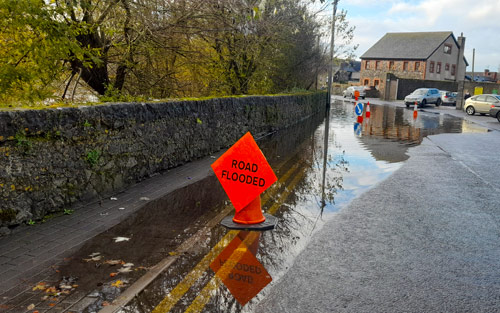
Flooding on Emmet Street Thurles yesterday, totally due to the failure by Tipperary Council to remove sediment and weeds from the River Suir over a 15 year period. Pic: G. Willoughby.
Whether you’re a local resident, landowner, angler, farmer, business owner, or simply someone who cares about your local waterways, your input and ideas are very welcome.
This meeting is part of a wider effort to support community-led action for water and ensure that local voices are heard in decision-making.
There’ll be time for questions, discussion, and a chance to meet others who are passionate about the Upper Suir and its future.
A Growing Catalogue of Arrests, Resignations, Expelling’s and Charges Raises Questions.
As Sinn Féin positions itself as a “Government-in-waiting”, the party continues to face uncomfortable scrutiny over the number of members, former members and associates who have been arrested or charged with serious offences in recent years.
An examination of publicly reported cases between 2015 and 2025 reveals a significant series of criminal investigations involving individuals linked to the party; ranging from sexual offences and child exploitation to violent crime, coercive control, fraud, and high-profile gangland-related charges. While the party has consistently stressed that individuals facing prosecution are immediately suspended and that Sinn Féin “does not tolerate criminality,”the accumulation of cases has prompted renewed debate about whether the organisation is adequately equipped to manage governance at national level.
A Decade of Difficult Headlines. Among the most serious cases is that of Mr Jonathan Dowdall, the former Dublin City councillor who was arrested and later charged in connection with the Regency Hotel investigation. Dowdall ultimately pleaded guilty to facilitating the murder of Mr David Byrne and received a four-year prison sentence before entering the Witness Protection Programme.
Also significant is the conviction of Mr Michael McMonagle, a former Sinn Féin member in Derry, who pleaded guilty to multiple counts of sexual assault against minors. He was sentenced to prison and later returned to court for breaching court-imposed restrictions.
Then there was Mr Niall Ó Donnghaile a Senator and former Sinn Féin Seanad leader who was suspended (reported Sept 2023) and resigned from the Seanad in December 2023. Referred internally to PSNI/Social Services after it emerged, he had sent “inappropriate” messages to a 17-year-old; party says there were no criminal findings, but the matter led to his suspension and later resignation.
Mr Barry McElduff, a Former Sinn Féin MP (West Tyrone) was suspended in January 2018 and then resigned as MP shortly afterwards. The reason was he posted a video widely seen as mocking the Kingsmill massacre, (Whitecross massacre) which saw the shooting dead of 10 workmen, which caused major public outrage; suspension was a party sanction (the incident was not a sexual/criminal charge but was a conduct controversy that led to suspension/resignation).
In Belfast, Mr Cathal McLaughlin, a councillor at the time of his suspension from the party, was charged and later convicted of sexual assault, receiving a suspended sentence. His appeal was dismissed.
In recent days a female, a party member in Co Laois, was expelled from Sinn Féin after her home was searched by an Garda Síochána and her partner was arrested in connection with a terrorism-related investigation. The probe relates to an alleged far-right extremist group plotting an attack on a mosque in Galway, linked to explosives found in Co Laois and Co Down. Sinn Féin’s statement says the member failed to inform the party that her home had been raided, or to alert the party to the seriousness of the situation. That failure was cited as the reason for expulsion. Her partner, a man in his 30s, remains detained under Section 30 of the Offences Against the State Act. He is not named in initial press reports. The fact that a raid occurred on the house of a party member linked through a partner to an extremist investigation, touches on issues of vetting, disclosure and risk management within the party structure.
The full facts are not yet publicly available. However, we understand that the suspect in this far-right extremism probe met Mrs Mary Lou McDonald campaigning during the general election and urged people to vote for the party last year, declaring: “Let’s bring our country back.” While not known as a party member he was in attendance at a party event in Dublin some six weeks ago. Sinn Féin have confirmed that the woman and her partner, who is being held in a Midlands Garda Station, were signed into Leinster House twice. We ask the question, “Is Sinn Féin now expelling members for terrorist activities, God knows in the past they were welcomed?”
Why have so many Councillors Jumped Ship in the past decade?
Name.
Council/Area
When left
Reported Reason/ Context
June Murphy.
Cork (Fermoy).
Sept 2015.
Resigned citing “an increasingly negative experience” amid local bullying/discipline disputes.
Kieran McCarthy.
Cork County Council.
June 2015 (expelled).
Expelled after an internal review into constituency structures (financial/disciplinary disputes).
Melissa Mullane.
Cork.
2015 Suspended (12 months).
Following the Cork East internal review; part of the same row that saw other departures.
Ger Keohane.
Cork County Council.
Nov 2015.
Resigned from Sinn Féin (reported as a defection) part of multiple Cork departures in 2015.
Noeleen Reilly.
Dublin City Council (Ballymun-Finglas).
Feb 2018.
Resigned citing an “orchestrated bullying campaign”; previously suspended by the party.
Lisa Marie Sheehy.
East Cork.
Sept 2017.
Resigned citing intimidation / being “plotted against”(connected to the Cork East disputes).
Sorcha O’Neill.
Sorcha O’Neill Kildare (former Sinn Féin councillor).
Apr 2017.
Resigned citing “bullying, hostility and aggression” within the local organisation.
Gabe Cronnelly.
Galway County Council.
May 2020.
Resigned from Sinn Féin and sat as an Independent; cited lack of local/national support.
Paul Hayes.
Cork County Council May 2020.
May 2020.
Resigned from Sinn Féin and sat as an Independent; cited lack of local/national support.
Danielle Twomey.
Cork County Council (East Cork).
Dec 2023.
Resigned citing relentless online harassment and internal party “backhanded moves”; now Independent.
Aidan Mullins.
Laois County Council.
Aug 2024.
Resigned after being told he would be suspended for three months; said he was being “silenced” on migration and related issues.
Caroline Dwane-Stanley.
Laois County Council.
Dec 2024.
Resigned saying the party was “not a safe place”; cited the party’s handling of a controversy affecting her family.
Ursula Gavan.
Limerick City & County Council.
Jan 2025.
Resigned citing “family loyalty” after her husband, Senator Paul Gavan, was left off the party’s Seanad selection.
So we ask “Pattern or Misfortune?“ Sinn Féin would argues that such incidents are comparable to those occurring in other major parties and insists that swift disciplinary action is taken when allegations emerge. In several cases, the party suspended individuals even before charges were formally brought, citing safeguarding concerns.
Critics, however, contend that the volume and gravity of cases linked to Sinn Féin is “disproportionately high,” particularly compared with other parties of similar size. They also point to instances where individuals remained active in local structures despite concerns being flagged, or where the party leadership sought to distance itself, only after legal proceedings became public.
Security analysts note that Sinn Féin’s rapid growth, combined with historically looser local-level structures, may have contributed to inconsistent vetting and oversight. Several of the cases involved long-standing activists who operated within community-based settings with limited central supervision.
Mounting Political Pressure. Opposition politicians have already moved to capitalise on the issue, arguing that Sinn Féin has yet to demonstrate that it can meet the standards of transparency, safeguarding and organisational discipline expected of a party preparing to lead government. Privately, some within Sinn Féin acknowledge that the headlines of the past decade, and particularly the high-profile nature of the most serious cases, have caused significant internal discomfort.
The Question for Voters. As the party continues to anticipates entering government for the first time in the Republic, the question lingers: Can Sinn Féin convincingly reassure the public that its structures, oversight and internal controls are robust enough for national leadership?
The answer may ultimately rest not on the number of individuals charged, but on whether the party can demonstrate that it has learned from its many past failures, and whether voters believe Sinn Féin can uphold the standards it repeatedly demands from other parties in Government.
This website uses cookies to improve your experience. We'll assume you're ok with this, but you can opt-out if you wish.AcceptRead More
Privacy & Cookies Policy
Privacy Overview
This website uses cookies to improve your experience while you navigate through the website. Out of these, the cookies that are categorized as necessary are stored on your browser as they are essential for the working of basic functionalities of the website. We also use third-party cookies that help us analyze and understand how you use this website. These cookies will be stored in your browser only with your consent. You also have the option to opt-out of these cookies. But opting out of some of these cookies may affect your browsing experience.
Necessary cookies are absolutely essential for the website to function properly. This category only includes cookies that ensures basic functionalities and security features of the website. These cookies do not store any personal information.
Any cookies that may not be particularly necessary for the website to function and is used specifically to collect user personal data via analytics, ads, other embedded contents are termed as non-necessary cookies. It is mandatory to procure user consent prior to running these cookies on your website.









Recent Comments