St Patrick’s Day parade committees across Ireland are warning that escalating insurance costs and reduced availability of public liability cover are placing community celebrations under severe strain, raising the risk of cancellations, scaled-back routes and last-minute uncertainty for towns and villages.
Hereunder, Video of the Thurles, Co. Tipperary, St Patrick’s Day Parade Held 2025.
Volunteer-led committees say public liability insurance has become a barrier to participation, not just a safety requirement, with higher premiums, stricter conditions and growing administrative demands landing on groups that rely entirely on fundraising and unpaid work.
Public liability insurance, covering injury to spectators and participants, as well as third-party property damage, has become increasingly difficult to secure for volunteer-led events, with committees reporting that quotes are higher, conditions are tighter and the administrative burden has grown significantly.
Recent media reporting has highlighted the scale of the challenge, with one Wicklow parade committee facing insurance estimates in the €5,000–€10,000 range (with €6,500 cited), a cost that can exceed the entire fundraising capacity of smaller communities.
At the same time, local-authority event permissions typically require proof of insurance in advance, often at high indemnity limits and with specific policy wording, adding pressure to secure cover early and at a price communities can afford.
A spokesperson associated with the Thurles town St Patrick’s Day Parade Committee, has stated that;- “Insurance has always been a problem and ever since Covid it has doubled. This is a volunteer-run event. We’re proud of the work that goes into making it safe and welcoming, but the cost and complexity of insurance is now the single biggest threat to Irish parades. Without a workable solution, communities will lose events that bring people together and support local businesses. We’re told to produce more and more documentation and pay for more and more controls, which we do, but the quotes still rise and the uncertainty remains. At some point, towns are simply being priced out of their own national day. St Patrick’s Day shouldn’t become a luxury product available only to the biggest centres. If we don’t act, we’ll sleepwalk into a future where local parades quietly disappear, and once they’re gone, they’re hard to bring back.”
Committees stress that risk management standards have risen sharply in recent years. Organisers are now expected to produce robust event management plans, crowd control measures, stewarding and traffic management arrangements, important steps for safety, but often costly to implement.
National claims data shows improvements in the wider public-liability landscape, with the Injuries Resolution Board reporting a 40% reduction in public-liability claim volumes, between 2019 and 2023. Parade organisers are asking that progress be reflected in affordability and availability for well-managed community events.
Calls for action. Community parade organising committees are urging:
A dedicated community events insurance support mechanism, aligned with documented safety standards and transparent pricing.
Clear engagement from Government, insurers and local authorities to protect the viability of community parades, not just flagship events.
A simplified national template for parade risk management and event documentation to reduce administrative burden and improve consistency.
Engagement with insurers, brokers and Government to increase capacity for community events and prevent avoidable cancellations.
St Patrick’s Day belongs to every community and participants are asking for the implementation of practical measures, so that smaller towns and villages can continue to celebrate safely without being priced out of total existence.
While the Suir silts up and sewage claims persist, Tipperary’s “solutions” look like optics-first spending, paid for by the public, twice over.
The Flooding “Solutions” Scam: Councils Let Rivers Choke, Then Sell Us Flood Barriers.
We’re being asked to accept flooding as inevitable. Each time the water rises, we’re told it’s “unprecedented”, that there’s nothing to be done, and that the only answer is another costly flood barrier, another engineered scheme, another grand capital project.
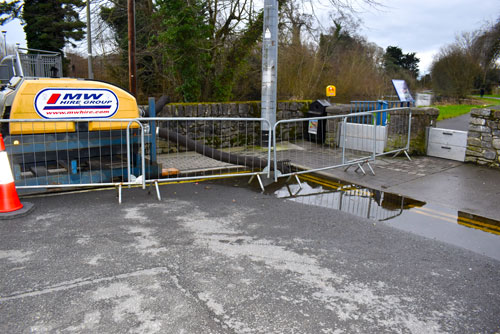
Although flood barriers are in place here and pumps are operating on Emmet Street, Thurles, flooding continues as water is rising through wastewater drains on the street surface, before being pumped again into the swollen river. In these circumstances, surface barriers offer little or no protection. Pic: G. Willoughby.
But for many towns, the more uncomfortable truth is this: a significant part of the problem is neglect, plain, predictable, year-after-year neglect, and it sits squarely with local authorities and the agencies they work alongside.
When river channels and outfalls are allowed to silt up, narrow, and clog, the river loses capacity. Water backs up sooner. “Manageable” rain becomes road flooding, business disruption, and damaged homes. That is not an act of God, it’s an act of governance.
Maintenance isn’t glamorous, so it gets skipped. Routine river maintenance is boring. It doesn’t lend itself to ribbon-cutting. It requires surveys, schedules, repeat work, and public reporting. And that’s exactly why it’s so often pushed down the list. Instead, we get the shiny alternative; manufactured flood barriers, the visible, photogenic, capital-heavy answer. They may have a place in specific settings, but far too often they’re treated as a substitute for basic poor river stewardship. Even professional bodies that caution against dredging as a universal fix still accept the basics: increasing channel conveyance can help reduce levels in smaller, more frequent floods. The key is that it must be targeted and properly managed, because indiscriminate dredging can speed flows and shift risk downstream. So nobody credible is demanding a reckless “dig everything” policy. What people are demanding is far more reasonable:
Why are we spending vast sums on barriers when the river’s basic capacity is being allowed to deteriorate in the first place?
Thurles: Tarmac by the river, while sewage flowed in plain view. Nowhere is the contradiction more glaring than in Thurles, Co. Tipperary.
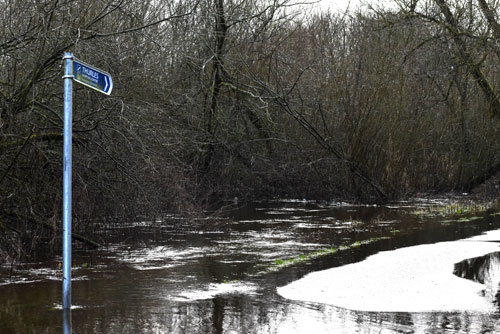
Flooded new Thurles tarmac pathway, while a tangle of willow trees and low, leaning branches stretch across the water, effectively blocking and constricting its flow. Pic: G. Willoughby.
In April 2022, a public district meeting heard claims that “raw sewage” was flowing into the River Suir along the extended Riverwalk area. The report quoted a councillor saying he had pictures and describing it as disgusting.
Read that again carefully: The issue wasn’t hidden away in a remote field. The allegation was that sewage was entering the river along the very walkway being promoted as an amenity. Then, in March 2024, a Thurles-based TD publicly questioned Uisce Éireann about discharges of raw sewage into the River Suir, in Thurles, and in September 2025, further local reporting again described sewage and pollution concerns in the town centre stretch. So let’s stop pretending this is a mere “perception issue”. If a town is paving and polishing riverside paths while the public is seeing (and smelling) pollution in the water, that’s not regeneration. That’s cosmetic spending beside a neglected system.
You also raise an accusation many locals will recognise: that some works were pushed through to use up available funding, especially after another walkway plan failed to materialise. I can’t independently prove the motive — but the pattern is familiar: when capital money appears, councils can scramble to spend it quickly on visible works, while harder, messier problems (pollution sources, maintenance regimes, enforcement) are left to drag on.
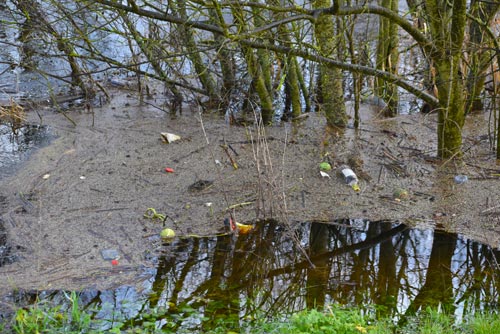
Stationary filth and litter in abundance as Thurles Municipal District provides river-side seating, without even one litter bin being placed in the vicinity. Pic: G. Willoughby.
Funding announcements don’t equal progress: In November 2025, a funding allocation of €447,300 for an extension of the Thurles River Suir walkway was publicly announced under the ‘Outdoor Recreation Infrastructure Scheme‘, including a planned looped walk.
Here’s the question that should be asked at every launch and photo-call: What is the point of extending a riverside amenity if the river itself is being allowed to degrade, and if flooding repeatedly makes sections unusable anyway? Local reporting at the time of that funding announcement explicitly linked renewed frustration to ongoing flooding and calls for proper maintenance of the river.
Who should be held responsible? Start with the council: This is where the gloves come off. Tipperary County Council cannot keep presenting flooding as a surprise while communities can see, year after year, the tell-tale signs of avoidable risk: silting, blocked channels, overgrowth, neglected outfalls, and the creeping sense that nobody is minding the basics.
And when the response defaults to barriers and big-ticket projects, rather than a published maintenance programme, people are right to feel played. Yes, extreme weather is real. But neglect is real too. And neglect is optional.
What Thurles (and every town) should demand now: If councils want to be taken seriously, the minimum standard should be:–
A published annual maintenance schedule for key watercourses: inspections, targeted desilting, vegetation management, debris clearance, and outfall/culvert checks, with dates and locations.
Before-and-after surveys at known pinch-points showing what capacity was restored and what risk was reduced.
A public pollution action list: identify suspect outfalls, state ownership/responsibility, publish remedial timelines (with named leads across council and Uisce Éireann).
A rule of priorities: no more “path-first, river-later” optics. If the water is compromised, fix the water first.
Independent oversight and reporting, including engagement with the Environmental Protection Agency and catchment structures like LAWPRO, which has recently hosted public discussions where concerns about the Suir around Thurles were raised.
And one final point: agencies such as the Office of Public Works can fund schemes and design defences, but if local maintenance and accountability are missing, we will keep paying twice: first in flood damage, then again in erecting flood barriers.
In the words of Forrest Gump, “Stupid is as stupid does”, meaning a person’s intelligence is defined by their actions and behaviour, rather than their appearance, reputation, or perceived abilities.
Again Three Questions: (1) Why have Rates in Tipperary increased by 5%? (2) Why are we forced, yes forced, to pay property tax on houses we worked hard to purchase, from already taxed incomes? (3) Why do we continue to elect and pay local councillors who make absolutely no contribution in dealing with the problems existing in our respective areas, while officials really make the decisions.
See link to PDF declaration HEREshowing salaries and expences over a 3 month period (12 weeks), of between €10,300.00 and €15,500 each.[Note: €15,500÷ 12 =€1 291.66 in costings per week, while double jobbing, per Tipperary Co. Council].
If we’re serious about flooding, stop buying flood barriers as being the first answer. Start with the river itself. Start with proper maintenance. Start with the truth.
Ireland’s Daily Drug Docket: Punish the Profiteers, Treat the Addicted.
Hard on Supply, Human on Use: Time for Common Sense in Irish Drug Policy.
Spend any time around a District Court and you quickly get the sense of a system carrying a weight it was never designed to hold. Day after day, more people find themselves before the courts on drug-related charges; possession, small-scale supply, probation breaches linked to use, and the petty crimes that trail behind addiction, like a shadow.
The scale is not anecdotal. In 2023, the courts made 21,907 orders in relation to drug offences in the District Court alone, involving 15,858 defendants. The wider crime picture is hardly reassuring either: the CSO recorded 16,119 incidents of controlled drug offences in 2024, and noted that the decline that year included falls in both possession for sale/supply and personal use incidents. Even if the trend line moves up or down in a given year, the reality in communities is constant: drugs are an everyday presence, and the courts are one of the last public services left standing at the point of crisis.
Against that backdrop, it infuriates decent people to see what looks like “soft” sentencing for dealers, especially when the damage is so visible. Families are burying loved ones. The Health Research Board recorded 343 drug poisoning deaths in 2022, a grim number behind which sit real kitchens, real bedrooms, real unanswered phones.
So why, people ask, does someone caught dealing sometimes receive a shorter sentence because they have no previous convictions and plead guilty early?
The first uncomfortable answer is that sentencing in Ireland is not a simple “one crime, one fixed penalty” system. Judges set a sentence based on the seriousness of the offence, then adjust it for aggravating and mitigating factors. Two of the most common mitigating factors are (a) no previous convictions, and (b) an early guilty plea.
The logic of the guilty plea is not mysterious, even if it sticks in the throat. A timely plea saves court time, shortens lists, avoids a contested trial, and often spares witnesses the ordeal of giving evidence. Citizens Information says plainly that you can generally expect a reduced sentence for pleading guilty, because it saves time and can be seen as remorse. The Director of Public Prosecutions’ own guidelines also recognise that a guilty plea is a factor to be taken into account in the mitigation of a sentence.
A clean record is treated as relevant because courts look not only backwards at wrongdoing, but forwards to the likelihood of rehabilitation and reoffending. It doesn’t mean “good character” cancels out harm. It means the system is trying, sometimes clumsily, to calibrate punishment to a person as well as to an act.
None of this means the law is blind to serious trafficking. Ireland’s Misuse of Drugs Act has a specific high-value supply offence, the well-known €13,000 threshold, aimed at commercial dealing and importing. Citizens Information summarises the core idea: for importing drugs at that level, there is a very severe sentencing framework, with limited scope to depart where the court finds exceptional circumstances. In other words, at the top end, the law’s intent is deterrence and long sentences. If the public perception is that dealers “walk free”, the more likely explanation is that many of the cases clogging lower courts are not kingpins, but street-level, low-level, or messy hybrid cases where addiction and dealing overlap, and where the headline seriousness is assessed differently.
But the deeper question is not really about discounts for pleas. It is about who we choose to blame. In the public conversation, users are often spoken about as if they are simply reckless, selfish adults who should carry full moral responsibility for every ripple of harm that follows. Yet, as anyone who has watched addiction up close knows, dependence is not a lifestyle accessory. It is frequently bound up with trauma, mental ill-health, homelessness, coercion, and despair. That reality is precisely why the Citizens’ Assembly on Drugs Use recommended that the State introduce a comprehensive health-led response to possession of drugs for personal use, responding primarily as a public health issue rather than a criminal justice issue, even while possession remains illegal.
This matters because criminalising users can make the problem worse. A conviction narrows employment, housing, and education options. Shame drives people away from services. Fear keeps people silent when they should be calling for help. Meanwhile, organised supply adapts, recruits, and replaces. If we’re honest, the criminal courts are often being asked to do the work of health, housing and social care, at the wrong end of the pipeline.
That doesn’t mean turning a blind eye to crime. It means recognising different roles in the drug economy and responding accordingly. A person in addiction who possesses a small amount is not the same as the person profiting from others’ dependence. The law already distinguishes, but our rhetoric often doesn’t.
There are also practical models that point in a better direction. The Drug Treatment Court in Dublin is explicitly designed as a supervised treatment and rehabilitation programme for offenders with problem drug use, as an alternative to custody in suitable non-violent cases. It is not soft. It is structured. It requires engagement, monitoring, and consequences for non-compliance. But it is at least an admission of reality: that for some offenders, reducing harm and reoffending means treating addiction rather than simply warehousing it.
So where does that leave the public anger, the very real anger, at dealers and the devastation around them? We should direct it with precision. The profiteers, the organisers, the coercers, the groomers of teenagers, the ones who intimidate communities and treat addiction as a business model, they deserve the full force of law and sustained policing pressure. The legislation exists to impose very serious sentences in the higher-end cases, and it should be applied firmly where the evidence supports it.
But if we keep pouring users through the courts as if punishment alone will cure dependency, we will continue to fill lists, fill cells, and fill graveyards, while congratulating ourselves on being “tough”. A country can be hard on the trade and humane to the addicted at the same time. In fact, if we want fewer victims, it is the only approach that makes any sense.
Thurles & Tipperary Says Stop The “Junket” Slur – Start the Accountability – Publish the Outcomes of St Patrick’s US Missions.
Ireland must travel, must engage, and must report back, in black and white.
Ireland should maintain the St Patrick’s Day diplomatic programme within the United States, including the Taoiseach’s White House engagement, because it is one of the few annual moments when a small island reliably gets direct access to the world’s most consequential decision-makers, investors and influencers.
But if we are truly serious about ‘people before posturing’, then every travelling politician and councillors must also be required to prove value for money and publish measurable outcomes on return.
That is the missing piece in this annual debate: loud accusations of “junkets” on one side, defensiveness on the other, and far too little mandatory, standardised reporting to the public.
It has been reported that nine or ten ministers are expected to travel to up to 15 US states around St Patrick’s Day. Meanwhile, FOI figures reports show €1,096,493 spent on 569 St Patrick’s Day events globally, with an average cost per event of €1,927.
That is not inherently scandalous. It can be excellent diplomacy. But it must be auditable diplomacy. Engagement is not endorsement, it’s statecraft.
Tourism matters too; and we should never insult the American people. The United States is one of Ireland’s most important tourism markets and supports jobs right across this island, from hotels and restaurants to visitor attractions, guides and local festivals. Tourism Ireland notes that in 2023 the island welcomed over 1.2 million US visitors, who spent about €1.7 billion here, making the US the most important overseas market for revenue. Tourism Ireland’s USA Market Profile 2024 reports 1.3 million American tourists, €2.0 billion in spend, and 11.4 million bed nights; figures that underline just how much Irish employment depends on maintaining goodwill with ordinary American people, not just the political class in Washington. You can disagree robustly with any US administration, while still showing respect to the American public, the diaspora, and the millions who choose Ireland in good faith.
Diplomacy that drifts into contempt is not “taking a stand” – it is self-harm.
Some opposition voices argue our Taoiseach should not go to Washington at all. People Before Profit TD Mr Richard Boyd Barrett has said it is “not appropriate” for Mr Martin to present President Donald Trump with shamrock this year. Labour MEP Mr Aodhán Ó Ríordáin has also publicly taken a “No to the Shamrock ceremony” position. Labour leader Ms Ivana Bacik has also ‘raised conditions’ around any visit if threats continue. Whatever the merits of ‘snub the White House’ rhetoric, it is just gesture politics unless those calling for such a boycott can set out a credible alternative strategy, which of course they haven’t.
Yes, they are entitled to their stance. But the public is entitled to ask a harder question: what is their alternative plan to protect Irish jobs, Irish exports and Irish leverage, in real time, when the stakes are highest?
Ireland cannot clap itself on the back for moral purity, while leaving Irish workers, exporters and inward investment exposed. The national interest is not served by boycotts that make headlines at home and achieve nothing in Washington.
The public interest test: show the receipts and the results. If critics insist on calling these trips “junkets”, and who can blame them, then the answer is simple: remove the ambiguity. From this year onwards, every minister and senior office-holder travelling on St Patrick’s missions should be required to publish a short, standard “Outcomes Report” within 30 days of returning, laid before the Oireachtas and posted publicly.
That report should include:
Full itinerary (meetings, organisations, purpose).
Total cost (travel, accommodation, hospitality), itemised.
Follow-up actions with named officials/agencies and deadlines.
What did not happen (meetings refused, issues parked, risks flagged).
This is not bureaucracy, it is basic democratic accountability. If nearly €1.1m is being spent globally on St Patrick’s Day events, the public should see, clearly, what Ireland gets in return.
A direct challenge to the “boycott brigade”. It is easy to demand that Ireland “takes a stand” from a safe distance. It is harder to sit across the table from power and argue Ireland’s case, on trade, immigration, investment, peace and international law, and then come home and account for what was achieved.
If the likes of People Before Profit and a Labour MEP want to oppose engagement, let them publish their own alternative: a costed, credible strategy that protects Irish livelihoods and advances Irish values, without access, without dialogue, and without influence. Otherwise, it is politics as performance. Who elected these people anyway?
Ireland should go – and Ireland should know.
Ireland should absolutely maintain the St Patrick’s diplomatic programme in the US, and Irish politicians should visit American cities beyond Washington because that is where investment decisions, diaspora networks and industry clusters live.
But also the era of “trust us” travel must end.
Go. Engage. Promote Ireland. Protect jobs. Defend values, and then report back to the over taxed individuals who fe..ing paid for it all.
From Ultra-Processed Foods To Hormone Residues: Food Safety, Public Health & Corporate Accountability Collide.
A landmark lawsuit filed by the City of San Francisco against major food and drink manufacturers has signalled a new phase in public health enforcement, one that treats diet-related harm not as an individual failing, but as a market and regulatory failure demanding immediate accountability.
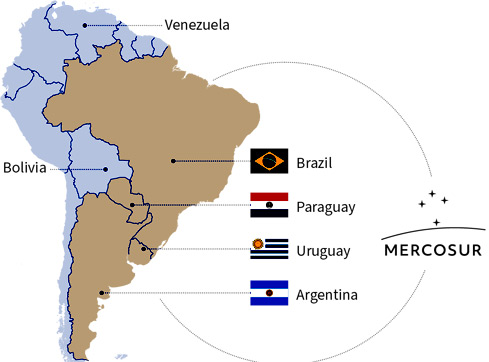
San Francisco alleges that ultra-processed foods were engineered and marketed in ways that encourage over-consumption, especially among children, and that the public ultimately pays the price through higher rates of chronic disease and spiralling healthcare costs. While that case will be tested in court, its wider message is already echoing across the Atlantic: Europe is facing its own “trust test” over what we allow into our food chain, particularly under the EU–Mercosur trade agreement.
Why this matters in Europe now: On 9 January 2026, EU member states greenlit the signature of the EU–Mercosur agreements, with the European Parliament’s consent still required before conclusion.
The European Commission states that EU rules apply equally to domestic and imported food, and that the agreement “upholds” EU food safety and animal/plant health standards.
However, confidence in “standards on paper” depends on something more basic: verifiable controls and traceability in practice.
Banned substances are not theoretical: recent Irish and EU recalls. The EU prohibits the use of hormones for growth promotion in farm animals. EFSA has also noted that ractopamine, a beta-agonist, is banned for use in food-producing animals in the EU and that the ban applies to meat produced in the EU and imported from third countries. Against that backdrop, Irish and EU reporting in recent weeks has documented the recall of Brazilian beef products after banned hormone residues were detected, including confirmation that a quantity entered the Irish market and was subject to official recall and follow-up.
The enforcement gap: what the EU’s own audit found. A 2024 European Commission DG SANTE audit of Brazil’s residue controls concluded that while many aspects of residue control plans were broadly consistent with EU principles, arrangements to guarantee that cattle destined for the EU market had never been treated with oestradiol 17β were “ineffective”. The audit stated the competent authority could not guarantee the reliability of operators’ sworn statements on non-use, and was not in a position to reliably attest to compliance with the relevant EU health certificate section.
This is the crux of the Mercosur anxiety: not whether Europe has rules, but whether Europe can consistently verify compliance, when supply chains are long, oversight differs, and commercial incentives are strong.
Ultra-processed foods and “addictive design”: the parallel problem. The San Francisco case centres on claims of deceptive marketing and products engineered to drive consumption. Meanwhile, the health evidence base around UPFs continues to expand. A major BMJ umbrella review reported that greater UPF exposure is associated with higher risk of adverse health outcomes, particularly cardiometabolic outcomes, across many studies. Controlled research has also shown that ultra-processed diets can increase calorie intake and weight gain compared with minimally processed diets under tightly controlled conditions.
The common thread is accountability: when products (or supply chains) are designed to maximise throughput and profit, public health cannot rely on consumer vigilance alone.
Calls to action Tipperary is now calling for a joined-up response that protects consumers, supports credible producers, and restores trust in our food chain: (1) A tougher “trust-but-verify” regime on imports). Full use of the EU’s Official Controls framework to ensure import compliance is proven through audits, sampling, and enforceable consequences, not assurances alone. (2)Mandatory transparency on audit findings and corrective action plans. Where EU audits identify weaknesses in residue controls or traceability, the public must see timelines, milestones and proof of remediation. (3)Stronger protections for children in the food environment. Restrictions on marketing tactics that normalise high-sugar, high-salt, heavily engineered foods to children—mirroring the direction of the San Francisco action. (4)Clearer front-of-pack information and health claims enforcement. Consumers should not need a chemistry degree to understand what they are buying, or whether “healthy” claims stand up. (5)A level playing field for farmers and processors meeting EU rules. Irish and EU producers operating under strict bans and controls must not be undercut by imports where verification is demonstrably weaker.
San Francisco has drawn a line under the era of ‘hands off’ regulation when public health harms are foreseeable and widespread. Europe is now at a similar crossroads. The EU–Mercosur debate cannot be reduced to tariffs and quotas: it is also about trust, enforcement and the credibility of our bans on hormones and other restricted substances. Public health must not be negotiated away, nor should consumers be asked to carry the risk.
This website uses cookies to improve your experience. We'll assume you're ok with this, but you can opt-out if you wish.AcceptRead More
Privacy & Cookies Policy
Privacy Overview
This website uses cookies to improve your experience while you navigate through the website. Out of these, the cookies that are categorized as necessary are stored on your browser as they are essential for the working of basic functionalities of the website. We also use third-party cookies that help us analyze and understand how you use this website. These cookies will be stored in your browser only with your consent. You also have the option to opt-out of these cookies. But opting out of some of these cookies may affect your browsing experience.
Necessary cookies are absolutely essential for the website to function properly. This category only includes cookies that ensures basic functionalities and security features of the website. These cookies do not store any personal information.
Any cookies that may not be particularly necessary for the website to function and is used specifically to collect user personal data via analytics, ads, other embedded contents are termed as non-necessary cookies. It is mandatory to procure user consent prior to running these cookies on your website.





Recent Comments