We learned last week that the Data Protection Commission (DPC) has fined the HSE €645,000, following serious failures in the care of confidential medical records.
The investigation began after two data breaches were reported in 2023. People had gained unauthorised access to paper medical records stored in the disused St Loman’s psychiatric hospital in Mullingar and St Conal’s Hospital in Letterkenny. Videos of the records were subsequently posted on social media.
When inspectors examined 12 HSE storage sites, they found records in appalling conditions. Documents were stored in disused bathrooms, cubicles, a shipping container inside a turf shed and derelict buildings. Some records were damaged by mould, water, rubble and animal droppings. The DPC also found that records had been retained longer than necessary and that some breaches had not been reported promptly to either the regulator or the people/patients affected.
The DPC imposed four fines totalling €645,000 and ordered the HSE to audit its storage facilities, remove records from unsuitable locations and introduce a proper system for tracking and managing paper records. The HSE’s previous similar data-protection failures were treated as an aggravating factor.
But who will really pay this fine? The HSE is funded mainly with public money. Therefore, the €645,000 will not come from the pockets of the officials responsible. It will come from resources that could otherwise have been used for patients, staff and health services. Once the fine has been confirmed by a court and collected, the DPC must transfer the money to the Government’s Central Fund, namely the Irish Exchequer. It does not go to the patients whose records were mishandled, and it does not remain with the DPC. The result is that one taxpayer-funded public body pays another part of the State. The money leaves the HSE’s budget and returns to the general Exchequer.
The HSE will then find itself €645,000 short in its future dealings with patients and support services, unless it can absorb the loss elsewhere. If it seeks additional funding, that money will again have to come from the taxpayer. The HSE cannot simply demand the fine back, but future governments may provide it with increased funding through the normal budget process.
Is this not ridiculous? The HSE must certainly be held accountable for the disgraceful treatment of sensitive medical records. Strong corrective action, public accountability and consequences for those responsible are entirely justified. However, taking money from the health service, placing it in the Exchequer and potentially providing more taxpayers’ money to the HSE later looks like public money being moved in a circle.
Meanwhile, patients may face the real cost through reduced resources or delayed services, although they did nothing wrong. The people directly responsible may suffer no personal financial consequence, while taxpayers effectively pay the penalty.
The fine sends a public message, but it raises a serious question; is moving €645,000 of taxpayers’ money from one State account to another really the best way to hold a public body accountable?
Meaningful accountability should correct the failures without making patients and ordinary taxpayers pay for the same institutional mistakes again.
Livestock farmers across Tipperary are being advised to watch their cattle and sheep closely, following confirmation of a new bluetongue virus serotype 3 (BTV-3) infection in County Wexford.
The Department of Agriculture has confirmed that an unvaccinated 16-month-old heifer tested positive during a postmortem examination. The animal had shown no obvious clinical signs before its death. This is the first Irish case identified as an infection acquired during 2026. It does not mean that a case has been detected in Tipperary.
Bluetongue is transmitted mainly by biting midges and is not normally spread through direct contact between animals. It affects ruminants, including cattle, sheep, goats and deer. Sheep can be particularly severely affected, although illness and deaths can also occur in cattle.
Tipperary farmers should watch for:
Fever, lethargy or loss of appetite
Sudden fall in milk production
Lameness
Swelling around the face, mouth or tongue
Drooling or discharge from the eyes or nose
Sores around the nose and mouth
Abortions, stillbirths or deformed newborns
Any sudden or unexplained death
The virus poses no risk to human health or food safety. Vaccination is regarded as the most effective protection, but it must target the relevant virus strain. Farmers with unvaccinated livestock should contact their veterinary practitioner promptly to discuss BTV-3 vaccination. Any suspicious illness or unexplained mortality should also be reported without delay.
Allergens in specific batches of Lidl’s Crownfield Musli Riegel bars not labelled in English.
Alert Summary Thursday, 3rd September 2026.
Allergy Alert Notification: 2026.A26. Allergens: Please see table below. Product Identification: Please see table below. Batch Code: Please see table below for batch number and expiry date. Country Of Origin: Poland.
Message: The ingredients on the below batches of Crownfield Müsli-Riegel bars are not labelled in English. The implicated batch of Crownfield Müsli-Riegel Schoko contains peanut, milk and cereals containing gluten (wheat, oats and barley). There may also be an unintentional presence of rye, nuts (hazelnuts, almonds, walnuts, cashew nuts, Brazil nuts, pecan nuts, pistachios, macadamia nuts, soya, sesame, mustard and lupins). This may make the batches unsafe for consumers who are allergic to or intolerant of peanut, milk, cereals containing gluten, nuts, soya, sesame, mustard and/or lupins, and therefore, these consumers should not eat the implicated batches.
Carbon Dioxide: What It Is and How We Can Reduce It.
Firstly, Carbon dioxide, known as CO₂, is a colourless and odourless gas. It consists of one carbon atom and two oxygen atoms.
CO₂ occurs naturally. People and animals breathe it out, plants use it to grow, and decaying vegetation also releases it. At normal outdoor levels, it is not poisonous. CO₂ also helps keep Earth warm by trapping some heat in the atmosphere. The problem is that human activity is now releasing far more CO₂ than nature can absorb. This strengthens the greenhouse effect and causes global warming. Most additional CO₂ comes from burning coal, oil and natural gas for electricity, heating, transport and industry. Cement production and cutting down forests are also major sources.
We cannot, and do not need to stop producing all CO₂. Natural emissions are part of life. Instead, we must reduce the extra CO₂ created by human activity.
CO₂. One carbon atom + two oxygen atoms.
We can do this by:
replacing fossil fuels with wind, solar, nuclear and other low-carbon energy;
using electric vehicles and public transport;
insulating buildings and using heat pumps;
making factories and machinery more efficient;
protecting and restoring forests, peatlands and wetlands;
repairing, reusing and recycling more materials;
reducing unnecessary energy and material consumption.
Some industries, including cement and chemicals, are difficult to make completely carbon-free. Projects such as Greensand may capture their remaining CO₂ and store it underground.
Carbon storage can help, but it should support, not replace cleaner energy and direct emission reductions. The main goal is to reduce human-made emissions as close to zero as possible and safely store only those that cannot yet be avoided.
Burying Carbon Beneath the North Sea. To this end, a specially built ship called Carbon Destroyer 1 is preparing to carry liquefied carbon dioxide from the Danish port of Esbjerg to the Nini West oil field in the North Sea. There, the CO₂ will be pumped into porous rock about 1,800 metres beneath the seabed. This operation is part of Project Greensand, led by INEOS Energy with Harbour Energy and the Danish state company Nordsøfonden. Commercial storage is expected to begin around mid-2026.
The idea appears simple:– Instead of allowing carbon dioxide from biogas plants and other industries to enter the atmosphere, it is captured, purified and cooled until it becomes liquid. It is then transported to Esbjerg, a city in Denmark and stored temporarily in tanks and loaded onto Carbon Destroyer 1.
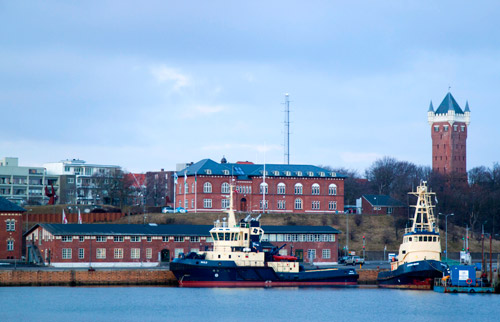
Esbjerg Harbour, Denmark.
The ship can carry approximately 5,000 tonnes of liquid CO₂ on each voyage, although some reports describe a full load of about 5,300 tonnes. It will sail to the offshore platform, connect to the injection system and pump the CO₂ through a well into the depleted oil reservoir.
The carbon dioxide is not stored in a large underground cave. It spreads through tiny spaces inside porous sandstone. A layer of solid, impermeable rock above the reservoir is intended to prevent it from escaping.
Project Greensand completed a smaller trial in 2023. Its first commercial phase aims to store about 400,000 tonnes of CO₂ each year. Eventually, the operators hope to expand capacity to between four million and eight million tonnes annually. Achieving that target would require more ships, wells and capture facilities. Supporters describe ships such as Carbon Destroyer 1 as “virtual pipelines.” They could collect carbon dioxide from industries in different countries and take it to suitable offshore storage sites without constructing pipelines across the whole of Europe.
However, the operation is not free from danger. Carbon dioxide does not burn, but a large leak can push oxygen out of the surrounding air. Because CO₂ is colourless, odourless and heavier than air, it can collect in low or enclosed spaces. A serious release at a port, aboard a ship or on an offshore platform could cause suffocation. Gas detectors, ventilation, emergency shutdown systems and restricted safety areas are therefore essential. There is also a risk of a pipe or transfer hose breaking while the ship is connected to the platform. Rough seas, equipment failure or loss of the ship’s position could increase this danger. Carbon Destroyer 1 has a redundant dynamic-positioning system to hold it in place, while emergency valves and breakaway connections are intended to stop the flow if something goes wrong.
Underground storage creates longer-term questions. CO₂ might escape through a damaged injection well, an old oil well, a fault or a weakness in the sealing rock. Excessive injection pressure could also damage the reservoir. Operators must therefore inspect old wells, limit pressure and monitor the movement of the stored CO₂ for many years. Project Greensand is subject to Danish and European licensing, environmental assessment and monitoring requirements. The Danish Energy Agency says geological storage must be shown to be safe and environmentally suitable.
Finally, carbon storage should not be treated as permission to continue all existing emissions. Capturing, cooling, transporting and injecting CO₂ uses energy and produces some emissions of its own. The technology is likely to be most valuable for industries such as cement and chemicals, where emissions are especially difficult to remove.
Project Greensand could become an important new way of dealing with industrial carbon emissions. But its success must be judged by transparent monitoring, verified permanent storage, honest reporting of accidents and leakage, and the amount of carbon it prevents from reaching the atmosphere; not simply by how many shiploads disappear beneath the North Sea.
When Does Somebody Else’s Pollution Become Our Responsibility?
Since yesterday September 1st 2026, Ireland’s fixed, on-the-spot fine for littering has increased from €150 to €250. This includes rubbish thrown from cars; whether it is a cigarette butt, bottle, food container or takeaway wrapper.
But fines raise a bigger question: At what point does somebody else’s pollution become our responsibility, especially when it enters a local river or waterway?Responsibility begins with the person who discarded the waste. Irish law prohibits causing or permitting polluting matter to enter waterways. Local authorities can investigate pollution, require remedial action and prosecute offenders.
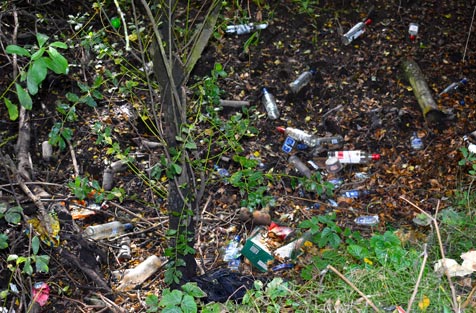
Suir Riverbed Thurles town centre, mainly caused by failure to provide a nearby litter bin.
However, responsibility cannot end with the individual. Many communities like Thurles town, point to too few conveniently located litter bins, or bins that are full or poorly maintained, in town centres, recreational areas and beside popular walking routes. Public-bin provision and maintenance are local-authority services, so councils also have a role in supplying suitable infrastructure where litter is regularly generated.
However, a lack of bins is never an excuse to throw rubbish from a car or throw it in or beside a river. If no bin is available, we must take our waste home. Nevertheless, enforcement works best when it is accompanied by adequate bins, regular collections, public education and convenient recycling facilities. Fining people without addressing obvious gaps in infrastructure tackles only part of the problem.
Once discarded, litter rarely remains where it falls. Rain washes roadside waste into drains, streams and rivers often promoted by Co. Councils. Currents carry it through neighbouring communities and towards lakes and the sea, where it can harm wildlife, obstruct waterways and leave the public paying for its removal. Ordinary residents are not legally responsible for another person’s offence. But once we see pollution threatening a shared waterway, we acquire a civic responsibility; report it, refuse to ignore it and support safe efforts to protect the area.
In the Republic of Ireland, litter, illegal dumping, overflowing public bins and local water pollution can be reported to the relevant city or county council. The EPA also recommends its “See It? Say It!” app, which sends photographs and location details to the appropriate authority.
The person who pollutes should pay. Councils must provide sensible disposal facilities and enforce the law. Communities should not be expected to continually clean up after repeat offenders, but silence allows the damage to travel downstream.
The litter may belong to somebody else, but the river belongs to all of us. Personal responsibility, proper infrastructure and effective enforcement must work together.
This website uses cookies to improve your experience. We'll assume you're ok with this, but you can opt-out if you wish.AcceptRead More
Privacy & Cookies Policy
Privacy Overview
This website uses cookies to improve your experience while you navigate through the website. Out of these, the cookies that are categorized as necessary are stored on your browser as they are essential for the working of basic functionalities of the website. We also use third-party cookies that help us analyze and understand how you use this website. These cookies will be stored in your browser only with your consent. You also have the option to opt-out of these cookies. But opting out of some of these cookies may affect your browsing experience.
Necessary cookies are absolutely essential for the website to function properly. This category only includes cookies that ensures basic functionalities and security features of the website. These cookies do not store any personal information.
Any cookies that may not be particularly necessary for the website to function and is used specifically to collect user personal data via analytics, ads, other embedded contents are termed as non-necessary cookies. It is mandatory to procure user consent prior to running these cookies on your website.







Recent Comments