Tipperary – Multi-Agency Operations in Clonmel and Emly (Wednesday, 25 February 2026).
Gardaí have completed planned multi-agency operations at a site in Clonmel, Co. Tipperary and a property in Emly, Co. Tipperary, yesterday, Wednesday, 25th February 2026, as part of an ongoing investigations into incidents within the region.
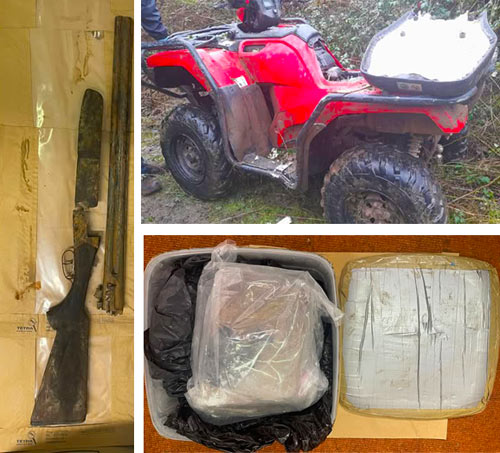
Firearm, stolen vehicle and cocaine, recovered by Gardai.
During a search at the Clonmel site, a stolen vehicle was recovered. The vehicle will now be subject to technical examination, before being returned to the owner.
Ten dogs were also seized during the searches at the site by the Irish Society for the Prevention of Cruelty to Animals (ISPCA), latter due to animal welfare concerns. The dogs are currently receiving veterinary care.
During a search at a property in Emly, a firearm was seized and will be subject to further technical and ballistic analysis. Gardaí also recovered approximately €70,000 worth of cocaine, which will be analysed by Forensic Science Ireland (FSI).
Justice Minister Mr Jim O’Callaghan announces more Efficient Criminal Legal Aid Scheme.
One fee for representation from beginning to end of a case.
Reform of criminal legal aid and restoration of fees fulfils Programme for Government commitment.
Implementation on 1st July, 2026.
The Minister for Justice, Home Affairs and Migration, Mr Jim O’Callaghan has today (24th February) informed the Government of his proposals to reform the criminal legal aid fee structure in the District Court. The reform will lead to greater efficiencies in the District Court and a more sustainable Criminal Legal Aid Scheme.
Minister O’Callaghan is proposing that one flat fee will be paid for representation from beginning to end of a case. This will remove the link between payments and the number of appearances, or legal aid certificates granted.
The proposal fulfils the Programme for Government commitment to reform criminal legal aid and the restoration of fees. Restoration of fees will commence from 1st July 2026.
Engagement with the Law Society of Ireland and relevant stakeholders will continue in advance of implementation on 1st July 2026.
Minister O’Callaghan said; “My department reviewed more than 350,000 District Court cases which took place during 2022 and 2023. The reform I am announcing today aims to address structural issues identified during this review, such as unnecessary adjournments resulting from the payment per appearance model. I have informed Government of my proposal to replace the existing fee structure with one flat fee. This will be payable regardless of the number of appearances, multiple certificates for cases heard together, or number of accused represented. This reform will lead to a more efficient system by reducing unnecessary adjournments. It will also simplify the administration of criminal legal aid, resolve cases sooner, and ensure practitioners are remunerated fairly.”
While the volume of criminal cases in the District Court has decreased, expenditure on criminal legal aid has nearly doubled; from €19 million in 2015 to €37 million in 2024.
The proposed payment of one fee for cases in the District Court will:
Encourage earlier case resolution.
Reduce administrative burden.
Support more efficient court sittings.
Ensure fair remuneration for practitioners.
As stated, there will be extensive engagement over the coming months with key stakeholders, including legal professionals, in advance of its implementation on 1 July 2026.
An Garda Síochána has published provisional crime statistics for 2025 showing a substantial increase in reported fraud and economic crime, alongside reductions across many traditional crime categories.
Fraud Rise Linked to Online Offending and Reporting Backlogs. Gardaí note that part of the increase reflects a backlog in reporting from previous years, while also pointing to online-enabled offending as a key driver behind the surge.
Digitally Driven Harmful Communications Also Increase. “Harmful communications” was among the few other categories to show a notable rise, with 750 incidents being reported in 2025, up from just under 600 in 2024. Reports involving the distribution of “grossly offensive communication” increased by 68%.
Traditional Crime Trends: Robberies and Burglaries Down. Provisional data indicates fewer reported instances of most major crimes, including a significant fall in robberies. In Dublin, this equated to 230 fewer robberies in 2025 compared with 2024. Burglaries also declined, with the north-west recording the most dramatic change, including a 34% drop in non-aggravated burglaries.
Operation Thor Cited in Burglary Reductions. Gardaí attributed improved burglary trends in part to Operation Thor, targeting organised burglary gangs and repeat offenders. Garda statements indicate residential burglary has reduced by approximately 75% over the past decade.
Enforcement Snapshot: Drugs, Cash and Gold Seized. During 2025, Garda teams reported seizures of €147 million worth of illegal drugs and approximately €6 million in cash and gold.
Public Order: Demonstrations Increase. Garda figures also indicate an increase in public demonstrations, with around 1,300 events in 2025 — approximately 12% higher than 2024.
Road Safety: Fatalities and Collisions Remain a Major Concern. The crime-statistics summary notes 188 deaths on Irish roads in 2025 and a 4% rise in total crashes. Separate road-safety updates reported around 190 fatalities in 2025 based on provisional collision figures.
Domestic Abuse: High Volume of Calls for Assistance. Gardaí reported receiving almost 67,000 calls relating to domestic abuse in 2025, close to 1,300 calls per week.
Homicide: Levels Unchanged Year-on-Year. The number of murder and manslaughter offences remained consistent with 2024, with 40 deaths recorded as a result of homicide-related offences in 2025.
Background Context. Garda commentary referenced CSO data showing Ireland recorded a 7% reduction in overall crime between 2019 and 2024, despite population growth over the same period.
Tipperary dentist sentenced for HSE deception – one-year jail term and a €100,000 payment order.
A county Tipperary dentist has been sentenced to a one-year custodial term and ordered to pay €100,000 to the Health Service Executive (HSE) after admitting deception-related offences connected to claims made under the Dental Treatment Services Scheme.
Mr Jerome Kiely, aged 47 years, of Acraboy House, Monard, Co Tipperary, pleaded guilty at Dublin Circuit Criminal Court to a number of sample charges of dishonestly inducing the HSE to make payments, including a claim of €326 for dentures, dated May 12th, 2015.
The court heard the HSE had placed trust in Mr Kiely as a practitioner, but that this trust was “misplaced”, Judge Martin Nolan said in delivering sentence. The judge accepted evidence that Mr Kiely has a history of depression and mental health difficulties, and also heard personal mitigation including a letter from his wife and references noting community involvement.
Judge Nolan imposed a three-year sentence, suspending the final two years subject to conditions. These include payment of €100,000 to the HSE within three months; a figure the court noted exceeds the amount proven and was described as an additional punitive element.
The court also heard that two bank accounts in Mr Kiely’s name, reported as containing approximately €830,000 and €667,000, have been frozen.
The Dental Treatment Services Scheme enables eligible adult medical card holders to access dental treatments and appliances through participating dentists.
Tarmac, Trolleys, Plastic Bags and Trampled Trees.
Double Ditch Obliterated, Then Abandoned.
Please first see the video immediately hereunder before preparing yourself to weep.
Now may I suggest you quickly grab a box of tissues.
Once upon a time, there was a place in rural Thurles, Co. Tipperary that had the cheek to be historic. They called it “The Double Ditch”; a raised path built through wet ground, faced with limestone, and rooted in the grim practicality of the once Great Famine, (1846-1849), to keep people working, to keep families alive, to keep feet dry enough to move. Yes, same was a civic scar, but an honest one, and a rare thing to be found in modern Ireland; a piece of lived history, a public walkway you could still walk on.
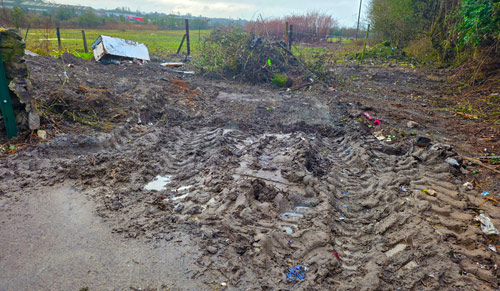
A recent abandoned attempt at cleaning the area.
Naturally, this could not be tolerated. So it became “connected”, “improved”, “enhanced”, “brought forward”, (whatever soothing verb local councillors, the local Municipal District Administrator and her officials would prefer), until all of it were “totally and wantonly obliterated”, its ancient hedgerows removed and the route flattened under heavy machinery, without so much as the courtesy of admitting what was being lost to the residents of our struggling town. Then, after much denial of its existence, with a straight face that would even shame a Victorian undertaker, it reappeared in planning language as being a “paved, pedestrian, walking route along a historical walking path”, despite being described by local councillors and politicians as not paved at all, before being levelled and left with only a temporary skin of tarmacadam.
And now we arrive at the masterpiece of their planning – “The Aftercare”.
Because nothing says “community amenity” like building a walkway and then abandoning it to rot, as if maintenance were an optional lifestyle choice, like decaf or seatbelts. The grand vision, a safe walking route on Mill Road, Thurles, tied into wider footpath plans, presented as “overdue” and “necessary”. The execution, however, appears to have followed the classic local-government model; do the ceremony; pour the tarmac; maximise the photocredit, then disappear vanishing into the mist.
So the area has now again begun its return to nature, that sacred Irish policy position otherwise known as “leaving it in a hape”. First came the willow saplings, same thrusting up through the tarmac like a botanical middle finger to uninterested municipal district officials, while rooting themselves into every crack that sheer neglect has kindly widened for them. Then arrived the briars and brambles, years of Autumn’s leaves, nettles and rank grass, all working in quiet co-operation like they’ve been awarded the contract. Soon enough, the walkway becomes less of a public route and more of a living demonstration of what happens when you build infrastructure with no real future plan to mind it, other than personal glorification.
And the litter, ah, the litter; not the dainty odd sweet-wrapper sort. No, this is the full rural-civic anthology, large plastic bags flapping like distressed flags; tyres slumped in the verge; broken wire fencing sagging like exhausted excuses. The occasional supermarket trolleys, thoughtfully dumped to ensure nobody confuses the place for cared-for land. If you’re lucky, a washing machine or two, because why wouldn’t you add white goods to a heritage corridor?
But the true flourish, the one that should make even the most hardened press-release writer blush, is how the site has been used as a stage for virtue, and then as a bin for its consequences.
In spring 2025, the area beside ‘Dun Muileann‘ on Mill Road, Thurles, became part of the One Hundred Million Trees planting push, funded locally by Allied Irish Banks’ Thurles branch, with students and the odd idle volunteer turning up to plant a dense mini-forest, using the Miyawaki Method; the whole point being fast-growing biodiversity and a carbon sink. The public reporting around it speaks of over two thousand native saplings planted at the site, a serious effort, and no small gesture of community buy-in.
And then, in the sort of anticlimax Ireland has successfully perfected; those young trees are left in a space now allowed to slide into total disorder, where over the past number of months horses are permitted to trample through the plantings that were meant to be protected long enough to establish themselves. A “green space”, promised and photographed, now reduced to a patch of scruff and horse manure, where the only thing thriving is the evidence of nobody being responsible.
That’s the moral of it, really, the fetish for the new, paired with the total inability to mind what’s then built.
Because it takes a special kind of civic arrogance to first flatten a famine-era landmark that once, literally, put bread into mouths, and then to shrug at the basic upkeep required to stop the replacement from becoming an overgrown dumping lane.
We are told, endlessly, about “heritage”, “biodiversity”, “active travel”, “community”. The words are always there; the maintenance however rarely is.
And so the Double Ditch, the real one, survives mostly as an idea: something that mattered, that was walkable, that carried memory in its stones. What’s left on the ground is the modern tribute: tarmac, blocked drains, weeds, rubbish, bent fencing, and the quiet certainty that nobody, supposedly in authority, will be held to account for any of it.
On behalf of myself, I offer my sincere apologies to Thurles Branch of AIB; (Sponsors), to MrRichard Mulcahy (Co-founder of the 100MT Project initiative) and to all those students who enthusiastically and eagerly took part in last April’s planting. Hopefully some of the trampled saplings will continue to survive, after all horse dung is a nutrient-rich organic fertilizer and soil conditioner.
This website uses cookies to improve your experience. We'll assume you're ok with this, but you can opt-out if you wish.AcceptRead More
Privacy & Cookies Policy
Privacy Overview
This website uses cookies to improve your experience while you navigate through the website. Out of these, the cookies that are categorized as necessary are stored on your browser as they are essential for the working of basic functionalities of the website. We also use third-party cookies that help us analyze and understand how you use this website. These cookies will be stored in your browser only with your consent. You also have the option to opt-out of these cookies. But opting out of some of these cookies may affect your browsing experience.
Necessary cookies are absolutely essential for the website to function properly. This category only includes cookies that ensures basic functionalities and security features of the website. These cookies do not store any personal information.
Any cookies that may not be particularly necessary for the website to function and is used specifically to collect user personal data via analytics, ads, other embedded contents are termed as non-necessary cookies. It is mandatory to procure user consent prior to running these cookies on your website.





Recent Comments