In July 1848, John Blake Dillon stood at a barricade at Killenaule, Thurles, County Tipperary, facing British cavalry.
Seventeen years later, the county elected him to Parliament. Those two moments connect Tipperary to a life shaped by rebellion, exile and a determination to serve Ireland.
This month, September, marks the 160th anniversary of Dillon’s death. His story recalls a turbulent chapter in the county’s history and a friendship that helped shape the ideals of the Young Ireland movement.
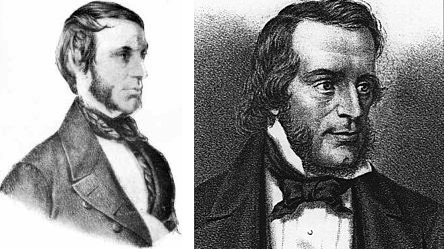
John Dillon was born in Ballaghaderreen in 1814, when the town belonged to County Mayo; (it is now within the borders of County Roscommon). After studying for the priesthood at Maynooth, he changed direction, entering Trinity College Dublin and pursuing a career in law. At Trinity, he became a close friend of Thomas Davis. In 1842, they joined Charles Gavan Duffy in founding “The Nation”, the newspaper around which ‘Young Ireland’ gathered.
Thomas Davis, born in Mallow, County Cork, in 1814, was the son of a Welsh army surgeon and an Irish mother. Although he qualified as a barrister, writing and public life became his principal calling. Songs such as “A Nation Once Again” and “The West’s Asleep” carried his political hopes far beyond the newspaper’s pages.
“A Nation Once Again”
Written by Thomas Davis, the song was first published in “The Nation” newspaper on July 13th 1844. It follows a narrator whose childhood reading about ancient heroes inspires a lifelong wish to see Ireland free. It however connects national liberation with personal responsibility, courage, selflessness, and moral character.
A Protestant, Davis believed that Irish nationhood should embrace people of different religious traditions. His friendship with Dillon, a Catholic, gave that conviction practical expression. His support for educating Catholics and Protestants together brought him into a bitter dispute with Daniel O’Connell over the proposed Queen’s Colleges in 1845. Political disagreement, however, did not extinguish personal regard: O’Connell was deeply distressed by his death.
“The West’s Asleep”
The song hereunder, again with words by Thomas Davis, mourns its apparent political slumber, recalls its landscape and history of resistance, and ends with a stirring declaration of awakening.
Davis died from scarlet fever in Dublin on September 16th 1845, aged thirty, and was buried in Mount Jerome Cemetery. For Dillon, the loss was both personal and political. A close friend and fellow founder of ‘The Nation‘ had died before their shared work was three years old.
His death came as potato blight began to threaten Ireland’s harvest. He did not live to witness the full catastrophe of the Great Famine or the desperate circumstances in which his surviving colleagues would make their decisions. His songs and ideas nevertheless remained part of the movement’s inheritance.
By July 1848, those colleagues faced mounting confrontation with the government in a country devastated by hunger. Tipperary became a central setting for the struggle. Carrick-on-Suir, Mullinahone, Killenaule and The Commons witnessed hurried meetings, uncertain plans and dangerous decisions. Local enthusiasm could not easily be turned into an organised force. Supporters lacked weapons and provisions, while the government commanded far greater resources.
At Killenaule, Dillon’s courage took a memorable form. In the book, “The Felon’s Track”, (Chapter VII), fellow ‘Young Irelander’ Michael Doheny describes how barricades were erected, as a troop of cavalry entered the village. Dillon stood at one of them and challenged the commanding officer; question asked, Was his purpose to arrest William Smith O’Brien?
According to Doheny, the officer denied that intention and pledged his honour as a soldier. The barricade was then partly removed, and Dillon took the officer’s horse by the bridle and led him out of town. The encounter passed without any bloodshed.
It is a scene worth remembering alongside the better-known confrontation at Ballingarry (South Riding), Thurles; Dillon within reach of armed soldiers, negotiating a passage through a moment that could have ended very differently.
Although involved in the Tipperary rising, Dillon was not present at the fighting at the Widow McCormack’s farmhouse on July 29th 1848 . He had left the immediate scene before O’Brien’s remaining supporters confronted police who had taken refuge in the house.
The fighting brought deaths and defeat. Captured leaders were subsequently tried for high treason in Clonmel, where death sentences were pronounced before being commuted to transportation. Tipperary thus witnessed both the rising’s collapse and the trials that followed.

Both signatures are written on the back of a prison library book called “Wreath of Friendship”.
Picture: G. Willoughby.
View : https://www.thurles.info/2023/08/03/how-soon-tipperary-forgets-ni-bhionn-cuimhne-ar-an-aran-a-hitear/
With the help of Maynooth friends Dillon escaped to France dressed as a priest, and subsequently reached the United States. In New York, he established a successful legal practice. Later, taking advantage of an amnesty, he returned to Ireland in 1856 and settled with his family at Killiney, County Dublin.
Then Co. Tipperary became central to his life again. In July 1865, the county elected him to Parliament. The former insurgent now pursued reform at Westminster, seeking cooperation between Irish nationalists and British Liberals. His work on land reform challenged the assumption that improvements made by tenants belonged to their landlords, while his opposition to suspending habeas corpus reflected his concern for civil liberty.
His parliamentary service was brief. On September 15th 1866, cholera took his life at Killiney. He was fifty-two. Tipperary had lost its representative little more than a year after electing him.
The family’s connection with the county continued. His son John Dillon would also represent Tipperary in Parliament, from 1880 to 1883, before his long association with East Mayo.
Dillon’s career resists a simple division between rebellion and constitutional politics. His participation in 1848 and his later commitment to parliamentary reform belong to the same life. Remembering him means recognising both the risks he accepted and the changes in his approach to securing Ireland’s future.
His friendship with Davis adds another dimension. Their collaboration expressed a belief that religious differences need not prevent people from working for a shared country. It did not resolve every disagreement about what Ireland should become, but it demonstrated the possibilities of friendship and common purpose across an entrenched divide.
That inheritance offers a question for later generations: how can political aspirations be pursued in ways that build confidence among people of different traditions? An inclusive national ideal must leave room for those whose identities, loyalties and hopes differ from our own.
For Tipperary, Dillon’s story remains rooted in particular places: the barricade at Killenaule, the towns and villages caught up in the events of 1848, and the constituency that later sent him to Westminster.
Remembered 160 years after his death, his life connects the immediate courage of confrontation with the patient work of reform, and the enduring effort to build a country in which people of different traditions can belong.
From that perspective, Sinn Féin’s historical support for the Provisional IRA’s armed campaign during “The Troubles” can be criticised as being in tension with the work of reconciliation essential to such an inclusive ideal. The strongest lesson from Davis and Dillon’s partnership is that national unity must be measured by the trust built between people of different traditions.
An echo of Davis and Dillon’s partnership can also be seen in Micheál Martin’s stated ambition to build understanding between Ireland’s different communities. Through his Shared Island initiative, Mr Martin has emphasised practical cooperation, dialogue and respect for all traditions. The parallel lies in the conviction that a shared future requires relationships strong enough to accommodate different religious and political identities. In that sense, his approach can be interpreted as reflecting the inclusive spirit embodied by the Protestant Davis and the Catholic Dillon.
US President Donald Trump’s unwelcome comments favouring Irish unity, after his meeting with Mr Martin earlier this September 2026, may have given this discussion renewed press and Sinn Féin PR relevance, but they do not in themselves establish Mr Martin’s future intentions. To my mind, the stronger basis for the comparison is Mr Martin’s longstanding emphasis on the need for reconciliation; future constitutional aspirations must always be accompanied by the patient work of building confidence, firstly, among those who view Ireland’s future differently.
Davis and Dillon’s friendship offers a historical illustration of why that work matters.




Recent Comments