Irish Government warns against fuel price gouging amid current Middle East tensions.
Taoiseach Mr Micheál Martin has said there is “no excuse for prices going up at the pumps yesterday, or indeed anywhere”, warning fuel and home-heating suppliers against taking unfair advantage of consumers in response to escalating conflict in the Middle East.
Speaking ahead of a Cabinet meeting, Mr Martin said Ireland currently has adequate supplies and noted that much of the State’s oil is sourced from the North Sea, including Norway. He acknowledged the situation could have implications over time if it does not stabilise, but said immediate price rises are not justified.
The Taoiseach said he has raised the issue with Minister for Energy Mr Darragh O’Brien and has engaged with the Competition and Consumer Protection Commission (CCPC). The Government has asked the CCPC to examine the sector for any unfair pricing practices. He also pointed to ongoing work on energy affordability and wider EU-level discussions on energy pricing structures.
Enterprise Minister Mr Peter Burke said energy price rises are a concern for the economy, noting prices increased on Monday, while emphasising the country has continued to see solid growth despite geopolitical instability.
A significant roads funding package for 2026, announced in February 2026, has been outlined for Tipperary, covering both regional/local roads and national roads.
Regional & Local Roads (Tipperary County Council): €49,379,670. The largest share of the allocation is directed toward the day-to-day upkeep and long-term resilience of the county’s regional and local network.
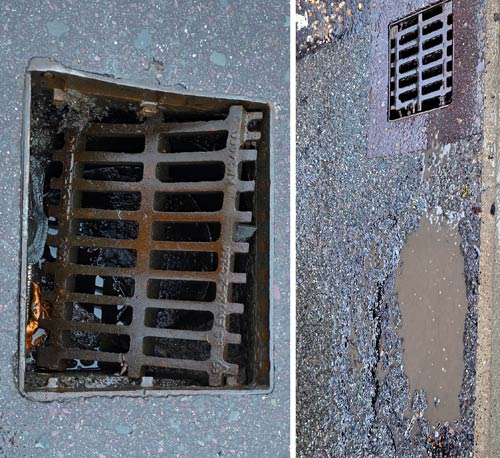
Over last weekend, you’d be forgiven for thinking Thurles, Co. Tipperary, had been abandoned, judging by the state of our streets. Once again we’re driving on loose gravel, while yesterday’s potholes are “repaired” with cold tarmac tipped straight into puddles, as if water were a suitable foundation.
Worse than that, a drain cover was left open since last Thursday, near to the junction at Bowe’s corner; the grate cover having been dislodged in direct line with vehicle wheels. (See picture featured hereunder.)
Pic 1 Left: Grate cover dislodged. Pic 2 Right: On Barry’s Bridge, once again, a sinking surface, as 18 wheelers bounce over a raised pedestrian platform. Pictures: G.Willoughby.
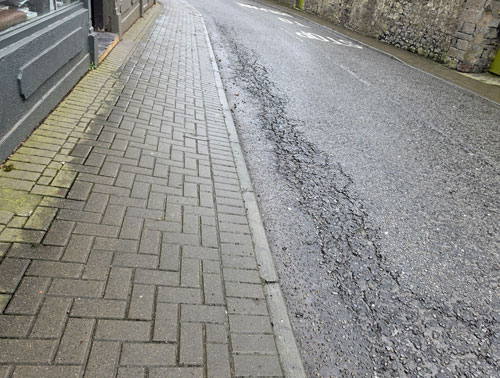
Parnell Street, Thurles beginning to sink and unravel with footpath now at a distinct sloaping angle. Picture: G. Willoughby.
“Protection & Renewal”: €36,234,670. Within the regional and local roads budget, €36,234,670 is assigned to Protection & Renewal. This funding supports a wide range of works and programmes, including:
restoration, improvement, and maintenance works
discretionary schemes
bridges and structures
drainage projects
road safety measures
climate adaptation works
community involvement initiatives (and other related supports)
National Roads (Tipperary): €8,360,343.
In addition, €8,360,343 has been allocated for national roads within Tipperary, supporting key routes that play a major role in commuting, freight, and regional connectivity.
A Combined Local Package of Approximately €57.7m. Taken together, the figures referenced locally bring the overall roads investment package for Tipperary to around €57.7 million for 2026.
National Context: Over €1.5bn for Roads in 2026. For broader context, the Department of Transport has stated that more than €1.5 billion was provided nationally in 2026 for national roads and regional/local roads, placing the Tipperary allocation within a substantial nationwide investment programme.
Data Centres Usually Pay Less per Unit of Electricity Than Households in Ireland, Official Figures Show.
New analysis of Ireland’s official electricity price statistics shows that very large electricity users; latter a category that includes many data centres, typically pay a lower price per unit (kWh) than households.
Key findings (official statistics). Figures published by the Sustainable Energy Authority of Ireland (SEAI) for January to June 2025 show:
Households (average, including all taxes): ~31.7 cent per kWh
Business customers (average, excluding VAT) ~24.3 cent per kWh
Very large business users (“Band IG”, over 150,000 MWh); ~ 19.5 cent per kWh (excluding VAT)
In simple terms, the biggest users pay less per unit than households, on average, in the published data.
Why this happens (in plain English). This difference does not necessarily mean data centres are “getting a special deal.” It mainly reflects how electricity bills are structured for different types of customers:
Household prices include more taxes. The household figure is reported with all taxes included, while business figures are commonly shown excluding VAT (and many businesses can reclaim VAT).
Big users buy electricity differently. Large industrial-style customers can often use different contract types and buying arrangements than households (who usually buy through retail tariffs).
Important note A lower “cent per kWh” figure doesn’t automatically mean the total bill is low. Very large users can still face substantial overall costs because they consume huge volumes and can have significant capacity-related charges.
Justice Minister Mr Jim O’Callaghan announces more Efficient Criminal Legal Aid Scheme.
One fee for representation from beginning to end of a case.
Reform of criminal legal aid and restoration of fees fulfils Programme for Government commitment.
Implementation on 1st July, 2026.
The Minister for Justice, Home Affairs and Migration, Mr Jim O’Callaghan has today (24th February) informed the Government of his proposals to reform the criminal legal aid fee structure in the District Court. The reform will lead to greater efficiencies in the District Court and a more sustainable Criminal Legal Aid Scheme.
Minister O’Callaghan is proposing that one flat fee will be paid for representation from beginning to end of a case. This will remove the link between payments and the number of appearances, or legal aid certificates granted.
The proposal fulfils the Programme for Government commitment to reform criminal legal aid and the restoration of fees. Restoration of fees will commence from 1st July 2026.
Engagement with the Law Society of Ireland and relevant stakeholders will continue in advance of implementation on 1st July 2026.
Minister O’Callaghan said; “My department reviewed more than 350,000 District Court cases which took place during 2022 and 2023. The reform I am announcing today aims to address structural issues identified during this review, such as unnecessary adjournments resulting from the payment per appearance model. I have informed Government of my proposal to replace the existing fee structure with one flat fee. This will be payable regardless of the number of appearances, multiple certificates for cases heard together, or number of accused represented. This reform will lead to a more efficient system by reducing unnecessary adjournments. It will also simplify the administration of criminal legal aid, resolve cases sooner, and ensure practitioners are remunerated fairly.”
While the volume of criminal cases in the District Court has decreased, expenditure on criminal legal aid has nearly doubled; from €19 million in 2015 to €37 million in 2024.
The proposed payment of one fee for cases in the District Court will:
Encourage earlier case resolution.
Reduce administrative burden.
Support more efficient court sittings.
Ensure fair remuneration for practitioners.
As stated, there will be extensive engagement over the coming months with key stakeholders, including legal professionals, in advance of its implementation on 1 July 2026.
The decision by Minister for Education and Youth, Ms Hildegarde Naughton to pause the SNA allocation review is being presented as calm, careful engagement. In reality, it reads like an emergency brake pulled after the system lost public confidence. The Department today has now halted all review changes, including cases where schools had already been notified of reductions, and has halted further letters being distributed, until further talks conclude.
That climbdown matters because the damage was not theoretical. By mid-February, national reporting indicated a substantial number of schools had been advised of proposed reductions for September 2026, with reviews still ongoing across the system. In places like County Tipperary, where schools already balance long travel distances, limited specialist services and stretched staffing, even the suggestion of a cut can trigger immediate anxiety for families and staff, because replacing supports is rarely straightforward, and delays have real consequences.
The most serious criticism is not that reviews exist, but that the review appears to be anchored to a narrow definition of “primary care need”, while schools are trying to deliver genuine inclusion in busy, complex classrooms. This approach may suit an administrative model, but it struggles to reflect the daily reality of autism, anxiety, communication needs, sensory overload, behavioural regulation and safety supports that keep children present, learning and well in school.
Even where Government insists overall SNA numbers are rising nationally, parents do not experience “national totals”. They experience whether support exists in their child’s classroom, in their school, on their timetable, from next September. For principals, the immediate issue has been the uncertainty; letters arriving without clear explanations that schools and communities can trust, and an appeals-based system becoming the default route to preserve basic supports.
The result is a familiar pattern; schools forced into scramble mode, families left fearful, and SNAs living with insecurity, while Ministers attempt to restore confidence after the fact.
If Ireland can fund the world, it can fund inclusion here at home. Government has pointed to significant overall spending on special education and additional SNA posts. But the public anger here is rooted in a simple perception; children with additional needs are being treated as a variable in a resourcing exercise, rather than as young citizens, whose right to education should be guaranteed in practice, not merely promised in policy statements.
This is where the old phrase about Ireland as the “land of saints and scholars” starts to ring hollow. A country that prides itself on education should not run a core disability support through a process that leaves parents hearing developments informally, or forces schools into repeated fights to keep what they already have.
Political contrast is unavoidable. The State can move quickly and confidently when funding priorities relate to foreign policy, international commitments, or expanding the national footprint abroad. In Budget 2026, the State found record allocations to project Ireland abroad; a record €840m in overseas development assistance and new funding for expanded diplomatic footprints, championed by Mr Simon Harris, through the Department of Foreign Affairs and Trade. It also committed a record €1.49bn for defence, through the Department of Defence. Separate reporting has put Ireland’s support to Ukraine since 2022 at €467m, with further commitments announced in late 2025. Those decisions may be defensible in their own right, but they sharpen the question parents keep asking; “Why does the system struggle so visibly when it comes to getting certainty right for children with special educational needs here at home?”
That question lands sharply at local level. In County Tipperary, as in many counties, schools are not arguing for luxury supports. They are arguing for stability, the ability to plan staffing, to avoid disruptions for vulnerable children to prevent September becoming a cliff-edge, where SNAs are central to keeping children safe, regulated and able to access learning, the idea of “review first, reform later” feels somewhat backwards.
The pause must not become a temporary quietening of the headlines, before the same review process returns with slightly amended language. If Government is serious about inclusion, it should redesign allocations around individual need, transparency, and proper multi-disciplinary supports and not around a narrow definition of care and an appeals mechanism that schools rely on to prevent harm.
If Ireland wants to be a land of scholars again, it needs to start by proving, in real staffing decisions, that children who need support will have it, without panic, without uncertainty, and without having to fight for it, every upcoming year.
This website uses cookies to improve your experience. We'll assume you're ok with this, but you can opt-out if you wish.AcceptRead More
Privacy & Cookies Policy
Privacy Overview
This website uses cookies to improve your experience while you navigate through the website. Out of these, the cookies that are categorized as necessary are stored on your browser as they are essential for the working of basic functionalities of the website. We also use third-party cookies that help us analyze and understand how you use this website. These cookies will be stored in your browser only with your consent. You also have the option to opt-out of these cookies. But opting out of some of these cookies may affect your browsing experience.
Necessary cookies are absolutely essential for the website to function properly. This category only includes cookies that ensures basic functionalities and security features of the website. These cookies do not store any personal information.
Any cookies that may not be particularly necessary for the website to function and is used specifically to collect user personal data via analytics, ads, other embedded contents are termed as non-necessary cookies. It is mandatory to procure user consent prior to running these cookies on your website.






Recent Comments